| Pictures (click to enlarge) |
Type | Description | Blade Length |
Overall Length |
Muzzle |
Markings | ||||||||||||||||||||||||||||||
| in. | mm. | in. | mm. | in. | mm. | |||||||||||||||||||||||||||||||
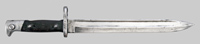 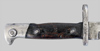      |
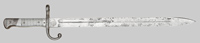
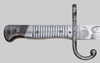
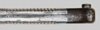
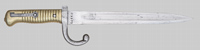
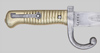
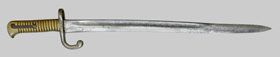
M1871/84 | Knife bayonet used with the 8 mm. German M1888 Commission Rifle.
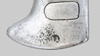
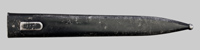
Colin Webster’s research, published in, Argentine Mauser Rifles 1871–1959, documents Argentina’s urgent 1892 contract to purchase 5,000 German M1888 Commission Rifles from Ludwig Loewe & Co. The contract specified inclusion of a “sabre-bayonnette German M88.” Rifles and bayonets were inspected in Germany by the Argentine Comisión de Técnica Armamento before being crated for shipment. The 5,000 bayonets were on-board ship for Argentina by March 1, 1892, 18 days after the contract was signed (1892 was a leap year). An Argentine collector indicates that his contacts confirmed that the bayonets furnished included both M1871 and M1871/84 types. Some may have been used by the Provincia de Buenos Aires (Province of Buenos Aires). According to Webster, these were never issued to the Army and those remaining in military stores were sold to Peru. This example has no maker mark remaining on the ricasso, however, another example observed was marked, Weyersberg, Kirschbaum & Co. Both examples have the same “RA” mark on the pommel and "AC" mark on the lower spine. The "RA" inside an oval is an Argentine property mark, representing República Argentina. This replaced the earlier "E.N" Ejército Nacional (National Army) property mark. It is possible that the AC mark may be related to Argentina's inspection process. This example also has "1.c" stamped into the wood grip. The bayonets would have been supplied with the standard German leather-body scabbard. This example’s scabbard is a replacement. Both bayonet and scabbard are numbered alike, indicating that they were paired during service (somewhere). The scabbard appears to be an Austrian M1888, which was also used on M1871/84 bayonets made by Steyr for export. The blade on this bayonet will not quite insert fully, leaving 1 or 2 mm. of the ricasso showing. I have tried this blade with an identical scabbard from a Steyr M1871/84 and the result is exactly the same. |
9.875 | 251 | 14.625 | 371 | .690 | 17.5 | Spine (lower): "A C"
Crosspiece: "1177" Pommel: circle-"RA" Scabbard (frog stud): "1177" |
|||||||||||||||||||||||||||
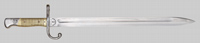 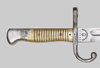    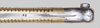     |
M1891 Brass Grip | Sword bayonet for use on the 7.65 mm. Argentine M1891 Mauser rifle.
This is an early example with the brass grips. There has been a lot of speculation regarding the brass grips being for the Navy, for NCO's, and the like. None of that is correct. Much of the conventional wisdom regarding Argentine Mauser bayonets was clarified by research published in 2003 by Colin Webster in his book, Argentine Mauser Rifles 1871-1959. Argentina opted for the 400 mm. (15.75 in.) blade, (correctly) anticipating that Chile was likely to adopt a shorter 250 mm. (10-in.) blade bayonet for their Mausers. The 1880s and 1890s were a period of heightened tensions between Argentina and Chile over their international border. (The Argentina-Chile border is the world’s 3rd longest international border. Some portions remain disputed to the present-day.) However, the prototype bayonet turned out heavier than the Argentines wanted, so they made a number of design changes to lighten it (thinner blade, slimmer hilt, and others). Aluminum grips were part of the proposed weight-reduction effort. However, the aluminum grips were not ready for production, so brass was substituted, temporarily, so as not to further delay production. M1891 bayonets were produced in Germany by Weyersberg, Kirschbaum, & Co. of Solingen. Brass-gripped bayonets were made 1892–93. Production switched to aluminum grips, mid-1893, after producing 40,000 brass grip bayonets. Bayonets and scabbards were serial numbered to the rifle with which they were issued. The scabbard with this example is the early type, with the throat secured in front by a single screw. Later scabbards (pictured below) had the throat secured on the sides by two rivets. The "RA" inside an oval is an Argentine property mark, representing Republica Argentina. This replaced the earlier "E.N" Ejercito Nacional (National Army) property mark. Most M1891 rifles and bayonets were exported to the USA in the 1950s and 1960s, when Argentine export laws required that the national crest be ground away before being sold. This example must have been imported later, as the crest is intact. |
15.75 | 400 | 20.50 | 521 | .615 | 15.6 | Ricasso (left): "Weyersberg" over "Kirschbaum & Co." over "Solingen"
Ricasso (right): "Modelo Argentino 1891" in arc over Argentine Crest (ground) over "D0411" Blade (spine): "A" star Crosspiece (left): "R" Crosspiece (left): "P" star Crosspiece (front): "G" Pommel: "RA" inside an oval Grips (both): "M" in circle Lower Tang: "23" Scabbard (body): "D0411" and "D" Scabbard (mouth): "E" |
|||||||||||||||||||||||||||
| M1891 Aluminum Grip | This example has the more typical aluminum grips and ground Argentine national crest.
According to Webster, the grip metal is an alloy of aluminum, with 6 percent copper. 190,000 aluminum grip bayonets were made, 1893–1901. The rifle with which this example was issued was made in 1900 by Deutsche Waffen-und Munitionsfabriken (DWM). |
15.75 | 400 | 20.50 | 521 | .615 | 15.6 | Ricasso (left): "Weyersberg" over "Kirschbaum & Co." over "Solingen"
Ricasso (right): "Modelo Argentino 1891" in arc over Argentine Crest (ground) over "U4374" Blade (spine): "A" star Crosspiece (left): "P" star Crosspiece (left): "P" star Crosspiece (front): "G" Pommel: "RA" inside an oval Grips (both): "M" in circle Lower Tang: "718" Scabbard (body): "U4374" and "D" Scabbard (mouth): "E" Scabbard (ball finial): "RA" inside an oval |
||||||||||||||||||||||||||||
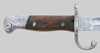
| M1891/31 Engineer's Carbine | Knife bayonet for use with the 7.65 mm. M1891/31 Engineer's Carbine.
The bayonet is a modified M1879 sword bayonet, formerly used with the 11.15 mm. M1879 Remington rolling-block rifle. This example was originally made by the firm of W. R. Kirschbaum of Solingen, Germany. It was modified into its present configuration in 1931, when Argentina added a bayonet lug to the M1891 Mauser Cavalry Carbine for use by military engineers. 5,000 cavalry carbines were converted by the Argentine automobile maker HAFDASA—Hispano Argentina Fabrica de Automoviles Sociedad Anonima (Spanish-Argentine Automobile Factory, Incorporated). The modified carbines and bayonets are designated the M1891/31 Engineer's Carbine. Modifications to the bayonet included shortening the blade, cutting off the muzzle-ring, and replacing the muzzle-ring with the strange trapezoidal wedge, which slides into part of the carbine's jury-rigged bayonet mount. The scabbards were shortened by cutting a section out of the middle and crudely brazing the two ends together. The unusual trapezoidal muzzle ring is unique to this bayonet. Strange and unique mounting systems are a common characteristic of bayonets made for rifles that weren't originally intended to mount a bayonet. Some new-made M1891/31 bayonets were produced by the firm J.C. Suarez. These have wood grips and a brass pommel. Several variations have been observed. |
9.75 | 248 | 14.625 | 371 | n/a | Ricasso (left): "W.R. Kirschbaum" over "Solingen"
Ricasso: (right): "C 9373" Crosspiece (face): "5" Scabbard (body): "C 9373" |
|||||||||||||||||||||||||||||
       |
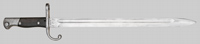
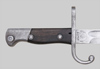
M1909 First Pattern | Sword bayonet for use on the 7.65 mm. M1909 Argentine Mauser rifle, which was derived from the famous 8 mm. Mauser Gewehr 98.
M1909 bayonets were made by the firm Weyersberg, Kirschbaum & Co. of Solingen, Germany. W.K.C. produced approximately 170,000 bayonets from 1909–1912. As designed, the M1909 bayonet differed from the M1891 in having the press stud relocated to the opposite side of the pommel, wood grips, a T-O hilt that encircled the rifle's cleaning rod, and a low Mauser 98-style muzzle ring. When the first 3,000 rifles and bayonets arrived, a logistical problem became evident. While the low muzzle ring provided a stronger mounting, it meant that the new bayonet would not mount to the earlier M1891 rifle nor would the M1891 bayonet mount to the M1909 rifle.
|
15.75 | 400 | 20.875 | 530 | .615 | 15.6 | Ricasso (left): "Weyersberg" over "Kirschbaum & Co." over "Solingen"
Ricasso (right): "Modelo Argentino 1909" in arc over Argentine Crest over "A1702" Spine: Star-A proofmark Crosspiece (front): "G" Scabbard (body): "A5019"and "D" and quartered circle |
|||||||||||||||||||||||||||
          |
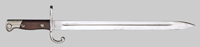
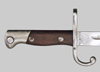
M1909 Second Pattern | Sword bayonet for use on the 7.65 mm. M1891 and M1909 Argentine Mauser rifles.
To allow interchange of bayonets between the M1891 and M1909 rifles, the bayonet design was revised to incorporate the higher M1891 muzzle ring on the remaining bayonet production (all but the first 3,000) and the Ricchieri Adapter was developed for installation on M1909 rifles and carbines. Reversion to the high M1891 muzzle ring also eliminated the need for a T-O slot and clean-out hole, which resulted in shortening of the hilt by 10 mm. The rifle with which this example was issued was made in 1910 by Deutsche Waffen-und Munitionsfabriken (DWM). |
15.75 | 400 | 20.50 | 520 | .615 | 15.6 | Ricasso (left): "Weyersberg" over "Kirschbaum & Co." over "Solingen"
Ricasso (right): "Modelo Argentino 1909" in arc over Argentine Crest over "B2943" Spine: Star-A proofmark Crosspiece (left): "P" star Crosspiece (front): "G" Scabbard (body): "B2943" and "D" and quartered circle Scabbard (ball finial): "RA" inside an oval |
|||||||||||||||||||||||||||
          |
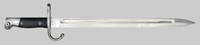
M1909 Second Pattern (Duplicate Issue) | This example is a duplicate, to replace the M1909 bayonet originally issued with rifle E9526, which was made in 1910 by Deutsche Waffen-und Munitionsfabriken (DWM).
Argentina appended the Latin word "bis" (twice) to the bayonet's serial number to signify that it was the second bayonet to carry this particular serial number. |
15.75 | 400 | 20.50 | 520 | .615 | 15.6 | Ricasso (left): "Weyersberg" over "Kirschbaum & Co." over "Solingen"
Ricasso (right): "Modelo Argentino 1909" in arc over Argentine Crest over "E9526BIS" Spine: Star-A proofmark Crosspiece (front): "G" Scabbard (body): "E9526BIS" and "D" Scabbard (mouth): "E" Scabbard (ball finial): "RA" inside an oval
|
|||||||||||||||||||||||||||
 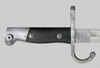     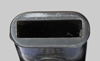 |
M1909/47 | Sword bayonet for use with the 7.65 mm. M1909/47 Mauser Carbines. This bayonet will also mount to the earlier M1891 and M1909 infantry rifles. The M1909/47 is an indigenous copy of the M1909 bayonet.
According to Webster, M1909/47 carbines and bayonets were produced under the auspices of the Direccion General de Fabricaciones Militares (Directorate General of Military Production), at the Fabrica Militar de Armas Portailes (Army Portable Weapons Factory) in Santa Fe. This factory was also known as the “Domingo Matheu” factory, named after a founding member of Argentina’s first independent national government, the Primera Junta (First Assembly). 19,072 M1909/47 bayonets were made at Domingo Matheu 1947–59, along with a similar number of M1909 carbines. Two production runs were for the Army and smaller quantities for civil police and security organizations. M1909/47 bayonets were also made for the Navy at the Arsenal de Artilleria de Marina, Zárate (Naval Artillery Arsenal, Zarate) 1950–55.
The Argentine-made scabbard has a somewhat more flattened and slightly rectangular, cross-section, compared with the oval cross-section of the German M1909 scabbards. This example was one of the 405 former CSF bayonets re-issued to the Gendarmería Nacional, bearing serial number 00768. The M1909 carbine with which this bayonet was issued was made in 1953. The Gendarmería Nacional was formed in 1938 as a paramilitary force to relieve the regular army of border security duties. The Gendarmería’s mission later expanded to include police and internal security duties as well. The Gendarmería Nacional were among the Argentine forces to engage the British during the Falklands War of 1982. |
15.75 | 400 | 20.50 | 521 | .615 | 15.6 | Ricasso (left): "D.G.F.M.-(F.M.A.P.)" over "Sable Bayoneta" over "Mauser" over "Mod.-1909"
Ricasso (right): "G.N." over "00768" Scabbard (body): "015268" over "00768" |
|||||||||||||||||||||||||||
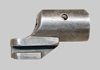 |
Ricchieri Adapter | Adapter designed by Gen. Pablo Ricchieri to allow use of M1891 bayonets with the M1909 rifle. Upon adoption of Ricchieri's adapter, M1909 bayonets were made with the high M1891 muzzle ring to allow use with either rifle.
These adapters were also used extensively by Spain and are found pinned to the bayonet lug of Spanish M1943 Short Rifles. Gen. Ricchieri was responsible for the introduction of Mauser rifles, mandatory military service, and the overall modernization of the Argentine Army in the latter years of the 19th Century. Gen. Ricchieri died in 1936. |
n/a | n/a | n/a | None. | ||||||||||||||||||||||||||||||
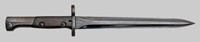 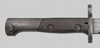 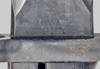   |
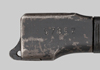
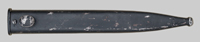
FN Model 1949 | Knife bayonet for use on the 7.65 x 53 mm. Fabrique Nationale (FN) Model 1949 self-loading rifle.
Argentina received 5,536 Model 1949 production rifles in 1954-55. Many were converted to 7.62 mm. NATO caliber 1972-74. The ricasso marking and serial number on the pommel end are diagnostic of Argentine Model1949 bayonets. "ARA" is an abbreviation for Armada de la República Argentina, as the Argentine Navy was the Country's user of the Model 1949 rifle. Model 1949 bayonets marked "AAMZ" were either produced in Argentina or were reworked there. AAMZ abbreviates Arsenal de Artilleria de Marina - Zárate. This bayonet type was also used by Belgium, Colombia, (Belgian) Congo, Egypt, and Luxembourg. Brazil used the M1924/49 Short bayonet; and, Indonesia and Venezuela used the M1924/49 Long bayonet with their Model 1949 rifles. |
8.875 | 225 | 14.00 | 356 | .720 | 18.3 | Ricasso: "A R A"
Pommel: "1308" |
|||||||||||||||||||||||||||
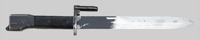 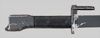   |
FAL Type A | Knife bayonet for use on the 7.62 mm. NATO caliber Fabrique Nationale - Fusil Automatique Leger (Light Automatic Rifle), or FN–FAL, selective-fire rifle.
According to Argentine collector-researcher Gustavo Pablo Fierro, Argentina began using the FAL in the late 1950s, first purchasing them from FN, then assembling rifles in Argentina. Similarly, bayonets were first purchased and later manufactured in Argentina at the Domingo Matheu Factory in Santa Fe. This example was manufactured in Argentina. Argentine-made scabbards are more pointed, while European-made scabbards are more radiused. |
7.625 | 194 | 12.375 | 314 | .600 | 15.2 | Pommel: "57857"
Mortise: "Z" |
|||||||||||||||||||||||||||
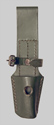 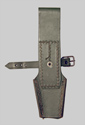 |
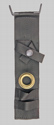
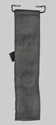
M1909 Leather Belt Frog | Green leather belt frog for carrying the M1909 Mauser bayonet.
Argentine collector-researcher, Gustavo Pablo Fierro, has greatly expanded the collecting community’s understanding of Argentine belt frogs. The Correaje Argentino de Cuero (Green Leather Belting) was introduced ca. 1970 and served until superseded by the nylon Correaje Tempex (Tempex Belting) by the mid-1980s. Although the change to Tempex equipment was well under way, the Green Leather equipment saw extensive use during the 1982 Falklands War. This example was intended for the Mauser bayonet. Later examples intended for the FAL bayonet had the left seam hidden (or tucked under) to allow the FAL Type A bayonet's flash-hider prongs to straddle the front piece. The frog measures 9.375 in. (240 mm.) long x 2.75 in. (70 mm.) wide. This frog was not classified by Carter. |
n/a | n/a | n/a | None. | ||||||||||||||||||||||||||||||
  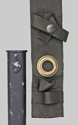  |
Nylon FAL Belt Frog Proposed by Tempex GmbH | Nylon belt frog proposed by Tempex GmbH to the Argentine Navy for use with the FAL Type A and C bayonets, but was not adopted.
The body is made of material very similar to that used in automotive seat belts. The unusual brass grommet design secures the scabbard with the frog stud facing inwards. The frog measures 8.75 in. (222 mm.) long by 1.875 in. (48 mm.) wide. This frog was not classified by Carter. |
n/a | n/a | n/a | None. | ||||||||||||||||||||||||||||||
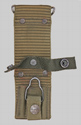 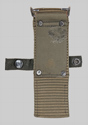 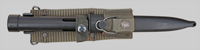 |
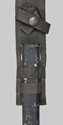
Tempex-Style FAL Belt Frog | Olive green nylon web belt frog used with the FAL Type C bayonet.
The Correaje Tempex ((Tempex Belting) web equipment saw use during the 1982 Falklands War, although it had not yet completely superseded the Correaje Argentino de Cuero (Green Leather Belting). This is a clone of the Tempex GmbH frog, manufactured in Argentina. While Tempex frogs were used in the 1982 Falklands War, clones like this example were made later for issue to Argentine Forces. The quality of materials and construction on this example is far below that of the true Tempex frog. Monocrom S.A. was one of the Argentine manufacturers, however, there were other unidentified makers as well. The frog measures 7 in. (178 mm.) in length by 2.187 in. (56 mm.) wide. This frog was not classified by Carter. |
n/a | n/a | n/a | None. | ||||||||||||||||||||||||||||||
| Back | ||||||||||||||||||||||||||||||||||||
| Return to Bayonet Identification Guide Index | ||||||||||||||||||||||||||||||||||||
| © Ralph E. Cobb 2010 All Rights Reserved | Top | |||||||||||||||||||||||||||||||||||