| Pictures (click to enlarge) |
Type | Description | Blade Length |
Overall Length |
Muzzle |
Markings | |||
| in. | mm. | in. | mm. | in. | mm. | ||||
         |
M1867/41 Albini- Braendlin |
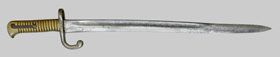
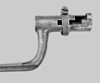
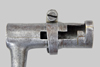
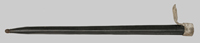
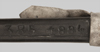
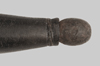
Socket bayonet for use with the 11 mm. M1867 Albini-Braendlin rifle. The Albini-Braendlin rifle was a breechloading conversion of earlier M1841 and M1853 muskets.
This example is a conversion of the earlier M1841 socket bayonet, as is evidenced by the off-center bridge and brazing lines on the socket. New-made M1867 bayonets were also produced. This scabbard was issued into Belgian Army service in 1884, as indicated by the markings. The first number on the scabbard body is a regimental roll number and the second the year of issue. These scabbards were also also used with export production by the Liege firms, such as the Uruguayan M1871 Mauser socket bayonet. |
18.25 |
464 | 20.875 |
530 | .675 |
17.1 | Socket: "N2334" various proofmarks
Locking Ring: "-LL" Scabbard (body): "385" and "1884" |
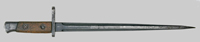 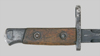 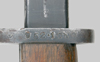    |
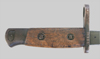
M1916 | Sword bayonet for use with the 7.65 mm. M1889 Mauser rifle.
Much of the conventional wisdom regarding Belgian Mauser bayonets was clarified by research published in 2016 by Anthony Vanderlinden in his book, FN Mauser Rifles. M1916 bayonets were produced from 1916–1918 at Manufacture D'Armes de le Etat (Arms Manufacturer of the State): abbreviated MAE. During this period, MAE had temporary factories in Calais, France; and Birmingham, England, having been forced to evacuate their Liege factory in 1914. The wartime M1916 bayonets included a number of variants among which Belgium made no distinction. Bayonets of conventional construction, with the crosspiece pinned to the tang (visually identified by the tang meeting the crosspiece at a right angle), were conversions of earlier M1889 bayonets. The hooked lower crosspiece was deleted and the blade replaced. This probably accounts for the relative scarcity of M1889 bayonets today. New made M1916 bayonets had the hilt made from a single forging, visually identified by a radiused transition where the crosspiece meets the tang. Blades were either of a flattened cruciform profile or T-back blades salvaged from French M1874 Gras bayonets. Blade length was 450 mm. Many, including this example, were subsequently shortened during rework. The scabbard has been shortened by cutting off the lower portion and neatly brazing a cap on the end. The muzzle ring diameter was 17.5 mm. Regardless of manufacturing process, blade profile, or blade length, if the muzzle ring diameter was 17.5 mm., the bayonet was designated M1916. The "1Ch" crosspiece marking indicates use by the 1st Division de Chasseurs Ardennais (in English, The Ardennes Hunters), one of the most capable Belgian Army units to fight in 1940. The Chasseurs Ardennais were a small, highly mobile infantry force, equipped with light armored vehicles, motorcycles, and bicycles. The Division took the brunt of the German onslaught on May 10, 1940, as German panzers struck the low countries through the Ardennes Forest. The Chasseurs Ardennais' mission was to delay the Germans and prevent them from encircling the Belgian Army, before French troops could come up to help stop the German advance at the Meuse River. At Bodange, vastly outnumbered and outgunned Chasseurs Ardennais held up Rommel's 7th Panzer Division for 9 hours, before giving ground. The Division fought its way completely across Belgium during the 18 days of combat, making its final four-day stand at Lille, France, buying the British precious time to evacuate Dunkirk. With no chance of evacuation, many of the Chasseurs Ardennais evaded capture and fought on with the Maquis (resistance). More than 500 Chasseurs Ardennais were killed in the 18 days of May 1940. Over 200 more were later killed fighting with the resistance. Reconstituted after the German surrender, the Chasseurs Ardennais remains one of the most prestigious regiments in the Belgian Army, having served in Korea, the Belgian Congo, Bosnia, Kosovo, and Afghanistan. |
13.625 | 346 | 18.00 | 457 | .690 | 17.5 | Ricasso: "H" inside a circle
Crosspiece (right): "952•1Ch" and "H" inside a circle |
       |
M1916–35 | Sword bayonet altered for use with the 7.65 mm. M1935 Mauser rifle and M1889/36 conversions.
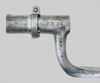
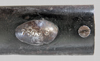
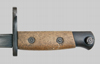
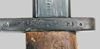
In 1935, the updated Belgian Mauser M1935 was adopted and earlier M1889 rifles altered to the M1889/36. M1916 bayonets were converted for use with the updated rifles by bushing the muzzle ring to 15.5 mm. These are found in several blade lengths, as bayonets were simply converted as found in military stores. Bayonets with the bushed muzzle ring were designated M1916–35. The bushing is clearly visible in one of the images at left. A small number of new made bayonets were produced with a 248 mm. blade length and 15.5 mm. muzzle ring. These were designated M1935. |
17.25 | 438 | 22.00 | 559 | .610 | 15.5 | Ricasso: "B"
Crosspiece: "75733" Pommel: "L" inside a square Scabbard (frog stud): "75733" |
   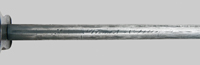  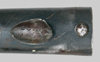  |
M1916–35 | The blade on this example was salvaged from a French M1874 Gras bayonet, as evidenced by the vestiges of script on the blade spine. Gras rifles and bayonets were still used by Belgian Colonial troops during the First World War period.
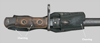
The scabbard is also a former French M1874 that has been shortened and had the Belgian frog stud affixed. Although the scabbard is undamaged, the bayonet will not insert all of the way, the blade point bottoming out while leaving about 0.25 in. (6 mm.) of the blade exposed. This example retains its original 450 mm. blade length, but has been bushed down to 15.5 mm. for use with the M1935 and M1889/36 Short Rifles. Collector's references refer to the T-back blade variant as "Gendarmerie" bayonets. However, recent research failed to find any substantiation linking these to the Gendarmerie. The "2ChA" crosspiece marking indicates use by the 2nd Division de Chasseurs Ardennais. As described above, the Chasseurs Ardennais fought extensively in the Battle of Belgium, from May 10–27, 1940. This example was found in a Second World War German leather belt frog, suggesting that this bayonet may have been issued to local "police" who helped maintain order during the German occupation. As shown in the last image at left, both the frog and the outward-facing wooden bayonet grip show evidence of charring. |
17.625 | 448 | 22.375 | 568 | .615 | 15.6 | Crosspiece (right): Circle-H and "2947•2ChA•"
Scabbard (frog stud): "2ChA" over "2947" |
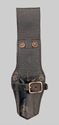 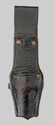 |
Belt Frog | Dark brown leather belt frog for carrying the M1916 bayonet.
The frog measures 8.00 in. (203 mm.) long x 2.375 in. (60 mm.) wide. Constructed with four copper rivets, with large washers. Incorporates a securing strap with a plated steel buckle. The frog originally had a hilt strap, inside the belt loop. This example is missing the hilt strap. Carter classified this frog as #43, indicating that this frog was issued with the M1916 bayonet. |
n/a | n/a | n/a | None. | |||
 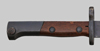  |
M1924 Mauser Export | Sword bayonet for use with M1924 and M1930 Short Rifles produced by FN for export.
This example appears to be an unissued bayonet produced by FN post-war. It came in the post-war web belt frog below. The two had been stored together for many years, as evidenced by the corrosion on the scabbard body where it contacted the frog. These were made for use with Mauser rifles manufactured for export. This example is the long variant, which was the most popular type. A short variant had a 300 mm. (11.75 in.) blade, but was not as popular with export customers (who mostly purchased short rifles). Pre-War bayonets had metal in the white, with a blued scabbard. Post-War customers were offered different finish options (e.g., phosphate, paint over phosphate, blued). FN produced Mauser military rifles for export into the late1950s. |
15.125 | 384 | 20.25 | 514 | .610 | 15.5 | None. |
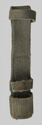 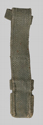  |
Belt Frog | Post-war web belt frog that came on the M1924 Mauser Export bayonet above. This frog could also be used with the FN Model 1949 and FAL bayonets.
Based on the British Pattern 1937 design, this frog is made of olive green cotton webbing. The hilt strap floating loose inside the belt loop is characteristic of Belgian frogs. The hilt strap on this example was inserted through the existing belt loop and sewn together, so may be a repair. The frog measures 7.125 in. (181 mm.) long by 1.125 in. (29 mm.) wide. The upper scabbard loop is very narrow, measuring 0.625 in. (15.9 mm.) wide. This frog was not classified by Carter. |
n/a | n/a | n/a | None. | |||
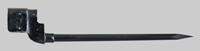 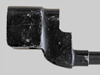  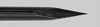 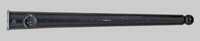   |
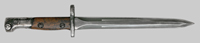
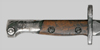
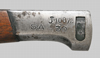
No. 4 Mk. II* | Socket bayonet for use with the caliber .303 Lee-Enfield No. 4 rifle.
This example was manufactured post-War for Belgium. Little is known of their manufacture and use. The maker is unknown, but is believed to be Belgian. The bayonet exhibits better finishing than most British No. 4 Mk. II* bayonets. The period of manufacture is believed to be late-1940s or early-1950s. The Belgians received Lee-Enfield No. 4 rifles and bayonets after Belgium was liberated in September 1944. The Belgian Army transitioned to the FN Model 1949 rifle beginning in 1951. However, the Rijkswacht (Gendarmerie) used the No. 4 rifle into at least the 1960s. Both bayonet and scabbard are serial numbered. This suggests production by a private contractor that was paid according to the number of pieces accepted. Serial number observations suggest about 7,000 were made. |
7.875 | 200 | 9.75 | 248 | .595 | 15.1 | Socket: "No. 4 Mk. 2" over "Bg" over Crown-JF proofmark over "5171"
Scabbard (mouthpiece): "5171" Scabbard (frog stud): "Bg" over Crown-JF proofmark |
      |
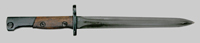
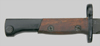
FN Model 1949 | Knife bayonet for use on the .30-06 caliber Fabrique Nationale (FN) Model 1949 self-loading rifle.
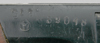
Research published in 2019 by Wayne Johnson in the revised and expanded second edition of his book, The FN-49, clarified much regarding bayonets used with the FN Model 1949 rifles. The Belgian Army received 87,545 production rifles beginning in 1951, accounting for roughly half of all Model 1949 rifle production. The Model 1949 bayonet was the result of a request by Egypt, the second Model 1949 rifle purchaser, who wanted a shorter, thinner blade than the M1924/49 Long bayonet which had been produced for Venezuela. It has the classic Belgian hollow-ground double-edged blade, patterned after the Belgian M1935 bayonet. The serial number and Crown-JF markings identify this example as one that was used by the Belgians, rather than for export. "S.A 30" stands for Semi-Automatic 30 caliber. The Model 1949 bayonet was also used by Argentina, Colombia, (Belgian) Congo, Egypt, and Luxembourg. Over 140,000 were produced, making it the most common bayonet associated with the Model 1949 rifle. Brazil used the M1924/49 Short knife bayonet; and, Indonesia and Venezuela used the M1924/49 Long sword bayonet with their Model 1949 rifles. |
8.875 | 225 | 14.00 | 356 | .710 | 18.0 | Pommel: "S.A 30" and (Crown-JF) proofmark and "10872"
Scabbard Throat: "10872" Frog Stud: (Crown-JF) proofmark |
     |
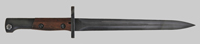
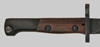
FN Model 1949 | This example has the second type of marking, "Circle-M", found on some Belgian Army bayonets. | 8.875 | 225 | 14.00 | 356 | .735 | 18.2 | Pommel: "SA 30" and "39018" and "M" inside a circle
Scabbard Throat: "39018" |
   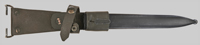  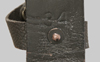  |
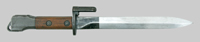
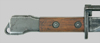
FN Model 1949 | This unserialized example is believed to have been produced in the mid-1950s, after completion of the Belgian contract rifles. The only markings are Belgian acceptance marks inconspicuously placed on the reverse crosspiece and scabbard mouth.
This example is in an unusual green leather belt frog, made for use with U.S. web equipment. The frog is constructed with 8 large copper rivets. The frog measures 7.50 in. (190 mm.) long by 1.375 in. (35 mm.) wide. The belt hanger and hilt strap are of pebble-grain leather. The belt hanger measures 2.125 in. (55 mm.) wide at the top. The origin of this frog remains a mystery. |
9.125 | 232 | 14.25 | 362 | .720 | 18.3 | Lower Crosspiece (reverse): Crown-acceptance mark.
Scabbard (mouth): Crown-acceptance mark. Frog (reverse): "34" |
  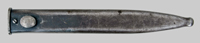  |
FAL Type A | Knife bayonet for use on the 7.62 mm. NATO caliber Fabrique Nationale - Fusil Automatique Leger (Light Automatic Rifle), or FN–FAL, selective-fire rifle produced by FN beginning in 1953. The FAL was used by more than 50 countries and became known by FN's clever Cold War advertising slogan: "the free world's right arm."
This bayonet was used by NATO countries until NATO adopted the 22 mm. rifle grenade in 1961. However, some non-NATO countries retained this bayonet much longer, not changing over to the Type C socket bayonet adopted to go with the 22 mm. flash-hider. The Type A bayonet is unique in having flash-hider prongs integrated with the crosspiece. No other bayonet, before or since, has adopted this design feature. Bayonets are encountered with wood, metal, and plastic grip scales. This example has wood grip scales. The finish can be parkerized, painted, or both. This example is parkerized, with traces of black paint on top of the parkerizing. The scabbard is blued, although many are painted black. Some scabbards have a teardrop frog stud (as pictured on the SAFN 1949 scabbard above). However, this example has an oval frog stud. I believe this scabbard to be one made in Europe for Argentina. This bayonet's mounting catch pioneered the "free-recoil" concept. A spring, internal to the hilt, absorbed recoil during rapid fire, allowing the bayonet to "float" independent of barrel vibrations. This mitigated some of the bayonet's adverse effect on accuracy during rapid fire. This concept was subsequently employed by the Dutch on the bayonet produced for the Portuguese variant of the AR–10 assault rifle. |
7.875 | 200 | 12.625 | 321 | .600 | 15.2 | Scabbard: "21058" |
 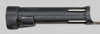 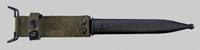  |
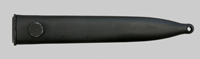
FAL Type C | Socket bayonet introduced in the 1960s for the FN–FAL selective-fire rifles that incorporated the 22 mm. NATO-spec flash hider.
This example is parkerized, with black paint over the parkerizing on the socket only. Two models of spring catch were used on the FAL Type C bayonet. The M1963 with serrations and the M1965 with 'wings." This scabbard is an uncommon Fabrique Nationale (FN) steel-bodied scabbard. Note that the throatpiece is oriented so that the socket faces outward when carried. This is typical of most FAL Type C scabbards. This type bayonet and scabbard was reportedly used by the Netherlands. |
6.50 | 165 | 11.25 | 286 | .890 | 22.6 | None. |
 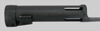  |
FAL Type C | This example is parkerized, with black paint applied over the parkerizing on the socket. | 6.25 | 159 | 11.25 | 286 | .890 | 22.6 | None. |
 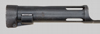  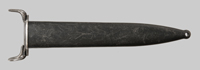 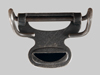 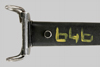 |
FAL Type C | This example is painted black overall and has an unusual scabbard. The scabbard is unusual in a couple of respects:
—It has a U.S. M1910-style wire belt hanger affixed to the scabbard throat piece. —The throatpiece is oriented so that the socket faces inwards when carried. This orientation is generally associated with South African scabbards, however, this scabbard is not South African. The bayonet's serial number is in a larger font than is typically observed. |
6.25 | 159 | 11.25 | 286 | .890 | 22.6 | Socket: "229508"
Scabbard (body): "646" in yellow paint |
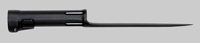 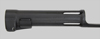 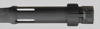  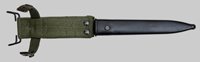 |
FAL Type C | This is believed to be the final Fabrique Nationale production type (ca. 1977–88), as FN sought to reduce cost of the FAL product.
FN constructed the socket by forging upper and lower halves using a drop hammer. Hot metal was poured in between the halves, to make the complete blank, which was machined to create the tubular socket. The sprue line is evident in the pictures at left. The earlier FAL Type C bayonets had a one-piece drawn socket. I have seen an unfinished casting that has a FN mold mark, so know that FN used this construction method. The scabbard body is plastic, with an integral web belt hanger. This construction method was subsequently used by the German firm, A. Eickhorn GmbH & Co. für Schneidwaren und Waffen KG (AES) of Solingen. These images of the FN (top) and AES (bottom) show differences that distinguish the two makers' production. |
6.50 | 165 | 11.375 | 289 | .890 | 22.6 | None. |
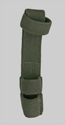 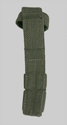 |
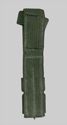
Belt Frog | Post-war belt frog for use with the FN Model 1949 and FAL bayonets.
The frog measures 6.75 in. (171 mm.) long by 1.125 in. (29 mm.) wide. Based on the British Pattern 1937 design, this example is made of olive green cotton webbing. It has a unique reinforcement providing a double thickness of webbing on the reverse where the frog would contact the equipment belt. The wide hilt strap floating loose inside the belt loop is characteristic of Belgian frogs. This frog was not classified by Carter. |
n/a | n/a | n/a | None. | |||
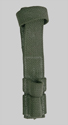  |
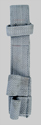
Belt Frog | This frog is nearly identical to the frog above, except it is made of synthetic webbing. The synthetic thread sparkles in bright light.
The frog measures 7.00 in. (178 mm.) long by 1.25 in. (32 mm.) wide. This frog was not classified by Carter. |
n/a | n/a | n/a | None. | |||
 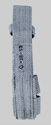  |
Belt Frog | Post-War Pattern 1937 web belt frog in a blue-grey color.
The frog measures 7.50 in. (191 mm.) long by 1.25 in. (32 mm.) wide. This example appears to be post-War (1952) owing to the marking. The maker identified by "XB" is not known. This frog was not classified by Carter. |
n/a | n/a | n/a | Reverse: "Broad Arrow and "XB-52" | |||
| Back | Next | ||||||||
| Return to Bayonet Identification Guide Index | |||||||||
| © Ralph E. Cobb 2010 All Rights Reserved | Top | ||||||||