| Pictures (click to enlarge) |
Type | Description | Blade Length |
Overall Length |
Muzzle |
Markings | |||
| in. | mm. | in. | mm. | in. | mm. | ||||
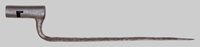        |
M1754 Style Cadet or Officer's Fusil |
Diminutive socket bayonet for a .60–.63 caliber cadet musket or officer's fusil, as it is only about 3/4 the size of a regular infantry bayonet. It is patterned after the French M1754 bayonet, which was used with the Charleville musket (which, incidentally, the Americans copied to produce the first U.S. military muskets made at Springfield Armory, following its establishment in 1795). Although, I am classifying this as French, this bayonet was made in France or Belgium; or possibly here in America. It is hand-forged and devoid of markings, so there's no way to be sure. Either way, it would have likely been made in the latter part of the 18th Century. The socket length is 2.812 in. (71 mm.). |
11.00 |
279 | 13.75 |
351 | .780 |
19.8 | None. |
     |
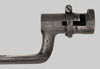
M1842 | Yataghan sword bayonet for use with the .71 caliber M1829/46 Mousqueton de Artillerie (Artillery Carbine), M1840 Carbine de Munition (M1840 Rifle Ammunition), M1846 and M1853 Carbine de Tige (M1846 & M1853 Pillar Breech Rifle), and M1859 Minié Carbine (Minié Rifle). These were all short, carbine-length arms.
A refinement of the world's first yataghan sword bayonet, the M1840, the M1842 had a longer, heavier blade and replaced the M1840's brass crosspiece with steel. The M1842 was a forerunner of the M1866. The M1842 blade is heavier than the M1866. This is most apparent when comparing the scabbards. This example was made in September 1856 at the French State Arsenal, Manufacture Imperiale de Châtellerault. "Yataghan" is derived from the Turkish word for "one who lays down" to describe the downard-sweeping double-curve blade profile. The double-curve added strength and rigidity, while keeping the hilt and point in alignment for thrusting efficiency. |
22.625 | 575 | 27.625 | 702 | .840 | 21.3 | Blade (Spine): "Mre Impale de Chat 7bre 1856 = S.B. Mle 1842"
Ricasso: circle-"M" and circle-"Star M" Crosspiece: "M"
|
  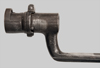    |
M1847 | Socket bayonet for a .69 caliber smoothbore musket.
The M1847 was a refinement of the M1822 bayonet.
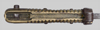
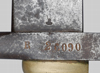
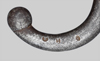
The 2.625 in. (67 mm.) long socket is cut for a bottom stud. The fuller is shallow, as wide as the blade, and squared off where it terminates at the ricasso. The locking ring has a distinctive profile when viewed end-on. The M1847 also introduced the tapered blade shoulder, which the U.S. adopted for its M1855 bayonet. The acceptance marking on the elbow is consistent with other known Liege, Belgium makers' acceptance marks. The identity of the maker represented by "NL" is not known. The ricasso marking is believed to identify the forger. The identity of the forger represented by "OM" is not known. Bayonets of this type were imported to the U.S. during the American Civil War to go with the 140,000 French muskets and Belgian copies purchased by the U.S. Ordnance Department. |
18.4375 | 368 | 20.75 | 527 | .855 | 21.7 | Ricasso: "OM"
Shank: crown over "NL" |
 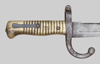      |
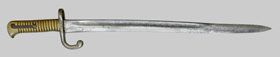
M1866 | Yataghan sword bayonet for use on the 11 mm. M1866 Chassepot needle-fire rifle.
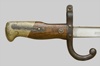
The M1866 rifle was referred to as the Chassepot, after its inventor, Antoine Alphonse Chassepot. The M1866 bayonet also mounts to the 11 mm. M1874 Gras rifle, although this example is difficult to mount to the Gras in my collection. M1866 bayonets were produced at the French state arms plants: Also by French government contractors: Government bayonets are marked on the blade spine with the factory, month, and year of production. A commercial producer was Felix Escoffier, St. Étienne. This example was made in December 1867 at the French State Arsenal, Manufacture Imperiale de Tulle. The blade bears the commercial trademark of Gustav Felix in Solingen, Germany, indicating that the blade was made under contract and assembled into a bayonet at Tulle. The scabbard has been modified by Germany, replacing the French frog loop with a German-style frog stud. |
22.75 | 578 | 27.50 | 699 | .690 | 17.5 | Blade (Spine): "Mre Impale de Tulle Xbre 1867" Ricasso (Left): "candle lamp" or "hot air balloon" makers mark. Ricasso (Right): "M" inside a circle Crosspiece (Left): "R26090" and French proofmarks Scabbard (Body): "50314" |
       |
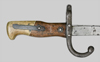
M1874 | T-back sword bayonet for use on the 11 mm. M1874 Gras rifle.
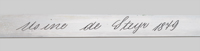
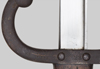
The M1874 was a conversion of the M1866 Chassepot design, that enabled use of the 11.15 x 59 mm. centerfire cartridge. The M1874 rifle is referred to as the Gras, after the French Army officer who developed the conversion, Colonel Basile Gras. M1874 bayonets were produced at the French state arms plants: Also by French government contractors: Government bayonets are marked on the blade spine with the factory, month, and year of production. Commercial producers include: This example was made in Austria, by Steyr, in 1879. Steyr produced approximately 200,000 M1874 bayonets for France, marking them in French "Usine de Steyr" (Machines of Steyr). Steyr also produced M1874 bayonets commercially. Steyr's commercial M1874 bayonets are marked in German, “Waffenfabrik Steyr” (Weapons Factory Steyr). |
20.625 | 524 | 25.50 | 648 | .710 | 18.0 | Blade: "Usine de Steyr, 1879."
Crosspiece: "RS 7702" Scabbard: "RS 7702" |
        |
M1874 Sutterlin Lippmann & Cie. | This example and the following example were produced for commercial sale.
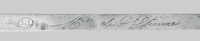
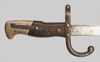
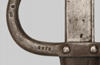
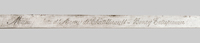
The French state arms factories were actually run by private contractors (entrepreneurs) appointed by the government. With their own funds, the entrepreneur purchased the materials for producing goods and paid the workers. The government purchased the contracted-for goods at cost plus 20 percent. If there were parts and materials left over after contracts were fulfilled, the entrepreneur could produce additional pieces for private sale. Commercial examples are marked on the blade spine with the maker and place of production, but no date. The maker of this example is believed to be Sutterlin Lippmann & Cie., who served as entrepreneur at St. Etienne from 1874–1884. Sutterlin Lippmann also produced Chamelot-Delvigne Model 1873 revolvers at St. Etienne from 1874–1884. "S * L" was Sutterlin & Lippmann's commercial trademark and is found on the revolvers produced at St. Etienne. This example is especially unusual in that it has a five-digit serial number (not four-digit). The serial number's placement, between the crosspiece pins, is also unusual. |
20.625 | 524 | 25.375 | 645 | .695 | 17.7 | Blade (spine): "c" and "S.L" in an oval and "Mre de St. Etienne"
Ricasso: "S' or "g" inspection mark Crosspiece (left): "60439" Crosspiece (front): "19" "3" and illegible inspection mark Scabbard: "S 79416" |
      |
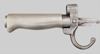
M1874 Francois Louis Henry | This example was produced by Francois Louis (F. L.) Henry at Châtellerault.
Francois Louis Henry was entrepreneur at Châtellerault, when he produced these M1874 bayonets. Henry also became entrepreneur at St. Etienne in 1884, succeeding Sutterlin Lippmann & Cie. M1822 swords are also encountered bearing the Henry Entrepreneur marking. The German firm of Alexander Coppel also produced M1874 bayonets. These are marked with the Coppel scales trademark on the ricasso. It is not known for which country Coppel made M1874 bayonets. |
20.50 | 521 | 25.375 | 645 | .695 | 17.7 | Blade (spine): "Manufacture d'Armes de Châtellerault - Henry Entrepreneur"
Ricasso: "S-diamond" and "H-oval" inspection marks. Crosspiece (left): "5988" and "H-oval" inspection marks. Crosspiece (front): "3" and illegible inspection mark Scabbard: "M 67977" Scabbard (ball finial): "3"and arrow. |
      |
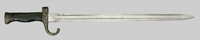
M1886 | Sword bayonet for use with the 8 mm. M1886 Lebel rifle.
The M1886 bayonet was the French mainstay during WWI and many were still in service at the Fall of France in 1940. The Lebel also saw extensive use worldwide by native troops in the French colonies. The M1886 introduced the distinctive cruciform blade, which remained a feature of most French bayonets until 1956. This example was made in 1890 at the Manufacture D'Armes St. Etienne (MAS). The scabbard was made by Manufacture Nationale d'Armes de Châtellerault (MAC). This is an early example that escaped later modifications, retaining its long blade, quillon, and raised round press stud. The silver-alloy grip is removable. A simplified version, Épée-Baïonnette Modèle 1886 Modifié 1915 (M1886 Sword Bayonet, as modified in 1915), was made during the First World War. |
20.50 | 521 | 25.125 | 638 | .600 | 15.2 | Quillon (left): "M 78397"
Scabbard: "D 83314" |
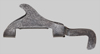 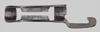  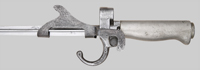 |
M1886 Bayonet Système Filloux Wire-Cutter | Wire-cutter attachment for use with the M1886 bayonet.
During the First World War, various devices for cutting barbed wire were developed by the major warring powers. This example was made to slide over the cruciform blade of a M1886 bayonet. As shown in official French instructions, once in place and the bayonet mounted, the user could catch a strand of wire in the device and fire the rifle to sever the wire. This cutter was designed in 1915 at the French government factory, Atelier de Construction de Bourges (Bourges Construction Workshop), by French artillery officer, Lieutenant Colonel Louis J.F. Filloux. Designated the Système Filloux pour Couper les Fils (Filloux System for Cutting Wire). The markings are reported to include the the month and year of production; and, the letter or number in a circle is reportedly a maker mark. This example was made in January 1916. The identity of the maker is not known. These have been reproduced, so provenance is helpful. This example was purchased in Belgium and brought to the U.S. by Dr. Jim Maddox. The seller had found unissued bundles of these, still tied with twine. Lt. Col. Filloux also designed the French 155 mm. Grande Puissance Filloux (GPF) modèle 1917 heavy field gun, which was adopted by the U.S. as the Gun, Model of 1918. The M1918 Gun served with U.S. Forces well into the Second World War. In 1919, Filloux was awarded the U.S. Army Distinguished Service Medal in recognition of his design and support for U.S. manufacture of his gun. |
n/a | n/a | n/a | "4" and "4" in an oval and "1 16" | |||
 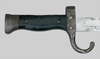 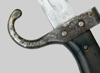   |
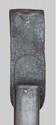
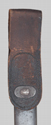
M1892 | Sword bayonet for the 8 mm. Mannlicher-Berthier M1890 Carabine de Cavalerie (cavalry carbine); and, M1892 and M1916 Mousqueton de Artillerie (artillery carbine).
This example was made prior to the turn of the Century by the French State factory, Manufacture Nationale d'Armes de Châtellerault. This example has the first type crosspiece, with the narrow 15 mm. muzzle-ring (same width as the crosspiece) and hooked lower quillon. This example also has black vulcanized rubber grips. The earliest examples had maker markings on the blade spine, similar to the M1866 and M1874. Marked blades are scarce, so this practice must have been ceased shortly after production commenced. Wooden grips were introduced ca. 1905. The second type crosspiece was introduced in 1912, with a wider muzzle ring (that extends over the grip). The third type crosspiece was introduced in during the First World War, with an abbreviated lower quillon. |
15.75 | 400 | 20.25 | 514 | .520 | 13.2 | Ricasso (left): proofmark
Crosspiece: "A 68028" and proofmarks Scabbard: "D 21364" |
 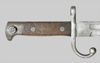     |
Remington No. 5 | Sword bayonet used with the 8 mm. Remington No. 5 rolling block military rifle.
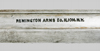
This is the long-blade variant of the knife/sword bayonet produced by Remington for use with the No. 5 military rifle. Remington produced 100,000 No. 5 rifles for France in 1915–16, chambered for the 8 mm. Lebel cartridge. The No. 5 military rifle was also made in large numbers for Mexico and many other countries in 7 mm. Remington also produced the No. 5 bayonet with an 8 in. (203 mm.) blade and and a 13 3/16 in. (335 mm.) blade. This example bears no French serial number, so its classification as French is speculative. However, this long-blade variant is most often associated with France. The blade marking indicates that the blade was likely made prior to Remington's merger with the Union Metallic Cartridge Co. in 1910. The pommel also lacks the oil hole inside the mortise (on the press stud side) characteristic of the French 1915–16 production. However, the bayonet could have been assembled from old stock already on hand in 1915, as military sales had nearly ceased due to the rifle's obsolescence. The scabbard body is steel, with an integral leather belt hanger. The scabbard length, including the belt hanger, is 20.75 in. (527 mm.). |
15.75 | 400 | 20.25 | 514 | .590 | 15.0 | Blade: Remington Arms Co. Ilion, N.Y. |
 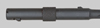  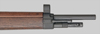  |
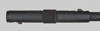
M1936 | Rod bayonet that stows in the forend of the 7.5 mm. M1936 bolt-action rifle. The rifle to which this bayonet belongs was manufactured in 1940, only a few months before France fell to the Germans.
This bayonet was also used on the 6,000 M1949 self-loading rifles produced under contract for Syria. M1949 rifles used by the French Army had no provision for a bayonet. |
13.00 | 330 | 17.00 | 432 | n/a | End Cap: "55" | |
  |
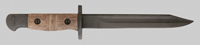
M1936–CR39 | Rod bayonet that stows in the forend of the M1936–CR39 folding-stock paratroop rifle.
This bayonet is shorter than the standard M1936 bayonet, due to the shorter barrel and forend of the M1936–CR39 rifle. CR is an abbreviation for Crosse Rebatible (Folding Stock). These rifles were not produced in large numbers. |
11.375 | 289 | 15.125 | 384 | n/a | None. | |
 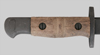   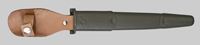  |
Combat Knife | British Pattern 1913 bayonet and U.S. M1917 scabbard that have been modified to serve as a combat knife.
It is believed that France purchased a quantity of Pattern 1913 and U.S. M1917 bayonets after the Second World War and modified them. The bayonet was modified by shortening the blade and grinding off the muzzle ring. The scabbard was also shortened and a leather belt hanger attached. The knife was originally made in 1916 by the Winchester Repeating Arms Co. of New Haven, CT. The M.S. marks on the scabbard mount may be the mark of the Maxim Silencer Co., which held the original M1917 scabbard patent. The belt hanger measures 5.00 in. (127 mm.) long by 2.25 in. (57 mm.) wide at its widest point These are often advertised as being for the French Foreign Legion. However, these were not exclusive to the Legion. In addition to the Legion, these knives were also used by: Marine Infantry Parachutists or RpIMA (Régiment de Parachutistes d'Infanterie de Marine). Marine Infantry Regiments or RCP (Régiment d'Infanterie de Marine) Parachute Infantry Regiments or RHP (Régiment de Chasseurs Parachutistes) Airborne Cavalry (Régiment de Hussards Parachutistes) Parachute Artillery or RAP (Régiment d'Artillerie Parachutistes) Parachute Engineers or RGP (Régiment du Génie Parachutistes) |
7.25 | 184 | 11.875 | 302 | n/a | Ricasso (Left): "1913" over "12 16" over "W"
Ricasso (Right): Broad Arrow, Bend Test Mark, and various inspection marks. Scabbard (topmount): "M.S" Scabbard (endmount): "M.S" |
|
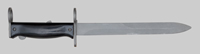 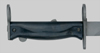    |
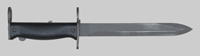
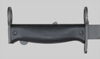
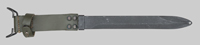
M1956 | Knife bayonet for use on the 7.5 mm. M1949/56 self-loading rifle. This bayonet incorporates a unique dual muzzle ring arrangement.
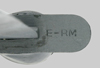
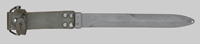
This is an early example, made before production switched to the M1958. The blade is patterned after the U.S. M4 bayonet. The blade was thought to be too weak due to the long false edge and was redesigned in 1958. According to Kiesling, approximately 40,000 of this early style bayonet were made. The scabbard body is steel, with an integral leather belt hanger. "E-RM" was once believed to represent Establishment Regional du Materiel. According to French author/researcher, Christian Méry, this is incorrect. The first letter represents the year of manufacture. This practice was adopted in 1955, so A= 1955 ... E = 1959, etc. The letters HF or RM identify the private contractors who produced these bayonets. The identity of the manufacturers was not known until French Collector Julien Ctr, provided documentation that clarifies the firms' identities: HF = Établissement Minière & Métallurgique du Périgord (Perigord Mining & Metallurgical Establishment) of Montluçon RM = Société R. Merat (R. Merat Company) of Suresnes (a suburb of Paris). |
8.50 | 216 | 13.25 | 337 | .875 | 22.2 | Crosspiece: "E-RM"
Scabbard: "E" and "HF" in an oval. |
     |
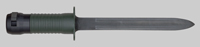
M1958 | This is the more common M1958 type, with the reshaped false edge. Because the blade is thicker near the point, the blade was shortened 20 mm. to keep the bayonet's weight the same. This ensured that the rifle would function the same with either bayonet.
Unlike the M1956 bayonet, the M1958 bayonet was produced at the French State Arms Factories: Manufacture d'armes St. Etienne (MAS) and Manufacture d'armes Tulle (MAT). This example was made in 1960 by the Manufacture d'armes Tulle (MAT). |
7.875 | 200 | 12.75 | 324 | .875 | 22.2 | Crosspiece: "MAT" over "F"
Scabbard: "MAT" over "F" |
 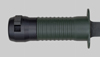 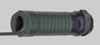 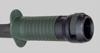 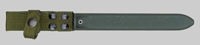 |
S.I.G. 540/542 | Socket bayonet designed in Switzerland for use on the Schweizerische Industrie-Gesellschaft (S.I.G.) 530, 540, and 542 assault rifles.
This bayonet bears a resemblance to the Type C socket bayonet used on some variants of the Belgian FN–FAL assault rifle. The 22 mm. socket diameter allows firing of the NATO-standard 22 mm. rifle grenades. The 530 was S.I.G.'s first 5.56 mm. rifle, developed during the late 1960s, but never produced in quantity. In the 1970s, the 530 gave rise to a family of S.I.G. assault rifles: the 540 (5.56 mm. rifle); 542 (7.62 mm. rifle); and, 543 (5.56 mm. carbine). The S.I.G. 540 family were produced under license in France by MANURHIN (Manufacture de Machines du Haut Rhin) from 1978–88. France adopted the S.I.G. 540 as an interim infantry weapon, until the FAMAS rifle was available in sufficient numbers. These rifles were exported to many countries, including: Bolivia, Central African Republic, Chad, Djibouti, Ecuador, Gabon, Indonesia, Ivory Coast, Jordan, Lebanon, Mauritius. Nicaragua, Nigeria, Oman, Paraguay, Seychelles, Swaziland, and Togo. Rifles of the S.I.G. 540 family were also manufactured under license in Chile and Portugal for their armed forces. |
7.00 | 178 | 11.00 | 279 | .870 | 22.0 | None. |
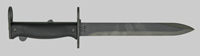 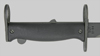   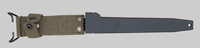   |
FAMAS | Knife bayonet for use with the 5.56 mm. NATO caliber FAMAS (Fusil d'Assaut de la Manufacture d'Armes de Saint-Étienne).
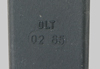
The bayonet is nearly identical to the M1949/56 bayonet. However, the scabbard is of a new design that has a plastic body, a web belt hanger; and, incorporates a retention device to secure the bayonet. The FAMAS is the service rifle currently used by the French armed forces. Unlike the M1949/56, on the FAMAS, the bayonet mounts above the barrel similar to the the German G3. The French troops refer to the bull pup-style FAMAS rifle as le Clairion (the bugle), due to its unusual profile when viewed from the side. DLT identifies the manufacturer as Durol SA (Durol Corporation), of Thiers. Durol has been in existence since the 1600s, as a manufacturer of cutlery. This example was made in January 1984 (the scabbard was made in February 1985). |
8.00 | 203 | 12.75 | 324 | .910 | 23.1 | Ricasso: "DLT" over "01 84"
Scabbard (body): "DLT" over "02 85" |
| Back | Next | ||||||||
| Return to Bayonet Identification Guide Index | |||||||||
| © Ralph E. Cobb 2010 All Rights Reserved | Top | ||||||||