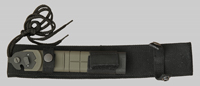
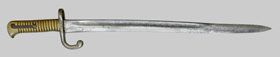
| Pictures (click to enlarge) |
Type | Description | Blade Length |
Overall Length |
Muzzle |
Markings | |||
in. |
mm. | in. | mm. | in. | mm. | ||||
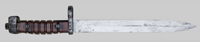 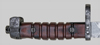     |
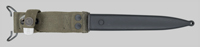
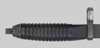
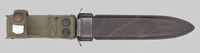
Rheinmetall G3 | Knife bayonet for use on the 7.62 mm. NATO caliber G3 selective-fire rifle.
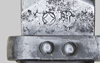
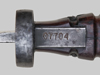
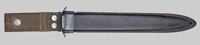
This is the bayonet designed by Rheinmetall AG of Dusseldorf when they began G3 production in 1959. The bayonets were manufactured by Carl Eickhorn Waffenfabrik AG of Solingen. This example carries both the Eickhorn squirrel and Rheinmetall diamond-circle trademarks on the ricasso. The Rheinmetall trademark is sometimes mistaken for that of Richard A. Herder, but that is erroneous. This example also has a serial number on the flashguard, indicating that it was actually issued. The Rheinmetall G3 bayonet differs from the more common H & K G3 bayonet in having a bright, double-edged blade that is 2.875 in. (73 mm.) longer. The red-brown plastic grip has 6 deep grooves. The press catch is at the 9 O'clock position (when viewed from the rear). It has a broad plain crosspiece secured by two domed rivets. The scabbard is patterned after the U.S. M8A1. The web frog terminates in a belt loop. The hit strap is missing on this example. The scabbard body is made of Durofol, a laminated wood developed in Germany during the Second World War. It is made by impregnating beech veneers of 0.2 to 0.3 mm. thickness with 25 to 35 percent of a water-soluble phenolic resin cured under both high pressure and temperature. Post-War, Durofol KG, J. Brangs & Co. of Solingen became the exclusive manufacturer, which later became Durofol Presswerk GmbH. The Australian from whom I obtained this example indicated that he had purchased it in Thailand many years ago. The West German government granted Burma a license to manufacture the G3 in 1960, in a move to forestall Burma aligning with communist East Germany. In advance of their beginning domestic production, Burma received 10,000 G3 rifles from Rheinmetall in 1961 and another 12,000 from Rheinmetall in 1962. I suspect that this bayonet was associated with one of the 1961-62 G3 shipments to Burma and later made its way across the border into Thailand. In 2009, British bayonet historian R.D.C. Evans published an excellent and comprehensive article on G3 bayonets that is available for download at no cost. |
9.375 | 238 | 14.375 | 365 | .870 | 22.1 | Ricasso: diamond-in-circle and squirrel
Flashguard: "07704" |
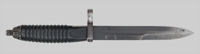    |
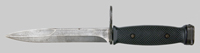
H & K G3 | This G3 bayonet was H & K's design, dating from 1959 when H & K began producing G3 rifles.
H & K's G3 bayonet was widely adopted and became the G3 bayonet adopted by the German Bundeswehr (Federal Armed Forces). However, in practice, the Bundeswehr did not issue bayonets to troops. The blade is patterned after the U.S. M4 bayonet-knife. The black plastic grip has 12 grooves. The press catch is at the 9 O'clock position. It has a broad plain crosspiece. The scabbard is patterned after the U.S. M8A1. The web frog terminates in a belt loop, rather than the M1910 wire hanger typical of U.S. made scabbards. The scabbard body is made of Durofol, a laminated product described under Rheinmetall G3, above. The G3 rifle had a very long service life in Germany, entering service with the West German Bundeswehr in 1959 and serving until adoption of the H & K G36 rifle in 1997. |
6.50 | 165 | 12.125 | 308 | .870 | 22.1 | None. |
 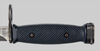  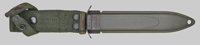  |
M7 | Carl Eickhorn Waffenfabrik of Solingen, Germany, briefly produced M7 bayonets under license from Colt, just prior to their 1975 bankruptcy. The vast majority of German-made M7 bayonets encountered today were produced by A. Eickhorn GmbH (AES), not Carl Eickhorn Waffenfabrik.
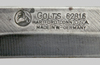
The Carl Eickhorn M7 bayonet is a variation of the Colt Part No. 62316 M7 bayonet. It incorporates Colt’s solid tang and universal grip, secured with screws and loose hex bolts (the example at left has USGI replacement grips). The blade runout is curved, like the early Colt-Imperial M7. However, the construction differs from the early Colt-Imperial bayonet in that the guard and latch plate are secured by welding. They produced two versions of the M7 bayonet, a standard M7 and a M7 with an abbreviated lower guard (pictured). A February 2, 1979, letter from Mr. Robert Roy of Colt Industries is quoted in M. H. Cole’s book, indicating that: “Carl Eickhorn was the only manufacturer of the M7 bayonet in Germany, to my knowledge. I believe that he produced approximately 80,000 bayonets.” With respect to the variant with the abbreviated lower guard, the above letter indicated that: “[It] … was the first production lot from Carl Eickhorn and had a cross guard which was cut off short so that it could be used interchangeably on bayonets that this company made for the M16 and also the German G3 and HK33 rifles. The bayonet is mounted on top of the barrel on the G3 and HK33. Therefore, the normal extension on the bottom of the cross guard would interfere with sighting. There are some versions of this bayonet with “Germany” stamped in a curve on the top of the cross guard. This was done to satisfy U.S. Customs since a “Made In Germany” stamp had not been put on the bayonets. These bayonets were made 1975/76.” These were marked on the blade with the Colt “Rampant Horse” trademark and “COLT'S 62316 HARTFORD, CONN. U.S.A. Most were also marked “Made in W.—Germany” under the Colt address. The guards were marked “US M7.” Some without the address on the blade were apparently marked for customs purposes as described above. |
6.50 | 165 | 11.50 | 292 | .880 | 22.4
|
Blade: Colt 'rampant horse' logo, followed by "Colt's 62316," Hartford, Conn USA", Made in W. Germany."
Crosspiece: "US M7" Scabbard: "U.S. M8A1" over "Made in W. Germany" |
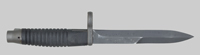 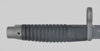  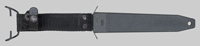 |
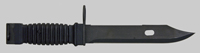
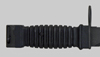
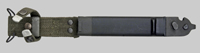
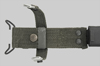
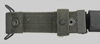
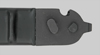
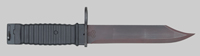
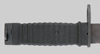
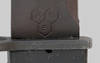
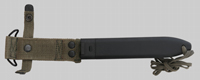
G3 | This G3 example was made by Gesellschaft für Metallverarbeitung mbH & Co. (GMS) [in English, Society for Metalworking L.L.C.]. GMS purchased the Carl Eickhorn factory and squirrel trademark following Eickhorn's bankruptcy in 1975.
GMS introduced a larger 20 mm. pommel for its G3 products. This innovation eliminated the need to install an adapter to the G3 rifle, in order to mount a bayonet. The GMS bayonet has a 12-groove black plastic grip that is more roughly-textured than the Eickhorn bayonets. The press catch is at the 4:30 position. It has a broad plain crosspiece. The scabbard has a black plastic body with an angular tip. This scabbard design is believed to have originated at Carl Eickhorn Waffenfabrik AG, prior to the firm's bankruptcy. This example lacks the locking device to retain the bayonet. The scabbard's integral web belt hanger is made of black nylon. The plain crosspiece and lack of a locking device; and the nylon belt hanger suggest that this example was likely made for commercial sale rather than military use. GMS went bankrupt in 1981, so this example would date from 1976–81. |
6.50 | 165 | 11.875 | 302 | .870 | 22.1 | None. |
          |
KCB–77 M1 | Knife bayonet for use with the 5.56 mm. NATO caliber M16 assault rifle. This example was manufactured by GMS.
The KCB–77 series are an improvement of the KCB–70 bayonet, which was designed in the late 1960s by Carl Eickhorn Waffenfabrik and the Netherlands firm NWM (Nederlandsche Wapen-en Munitiefabriek) for the Stoner 63A weapons system. GMS changed the plastic formula and made the grip more robust in order to remedy cracking problems encountered with the plastic used for the KCB–70 bayonet. GMS also developed their own wire-cutter scabbard design, since the Eickhorn family held the KCB–70 wire-cutter patent. The GMS wire cutter assembly is tubular and entirely surrounds the plastic scabbard body, where the Eickhorn design is a flat plate that attaches to the side of the plastic scabbard body. GMS produced a more elaborate belt hanger, which included the U.S. M1910 style wire loop, but also allowed attachment to a plain belt. In addition to the KCB–77 M1, GMS also produced a KCB–77 M3 variant for use with the 7.62 mm. G3 assault rifle. The GMS product had the G3 bayonet adapter built in to the pommel, similar to the GMS G3 bayonet pictured above.
|
6.875 | 175 | 11.75 | 298 | .870 | 22.1 | Ricasso: Squirrel trademark
Crosspiece (face): "1005–9110" and "AT 783884" |
    |
KCB–77 M1 | This KCB-77 example was manufactured by A. Eickhorn GmbH, Solingen (AES).
Shortly after Eickhorn's 1975 bankruptcy, members of the Eickhorn family formed a new firm, A. Eickhorn GmbH & Co. für Schneidwaren und Waffen KG (AES) [in English, A. Eickhorn Company for Cutlery and Weapons L.L.C.]. Because GMS owned the squirrel trademark, AES developed the generic trademark shown on this bayonet: three conjoined hexagons containing the letters “A,” “E,” and “S.” When GMS went bankrupt in 1981, the squirrel trademark and other GMS stock were acquired by E & F Hörster GmbH & Co. AES obtained a license to use the squirrel trademark on bayonets and combat knives from Hörster ca. 1982–83. The 1984 AES catalog shows both the hexagon and squirrel trademarks. This bayonet is shown on page 3 at bottom left. Following Hörster’s bankruptcy in 1996, AES re-acquired exclusive rights to the squirrel trademark. |
6.875 | 175 | 11.75 | 298 | .870 | 22.1 | Ricasso: Letters AES, each inside a hexagon. |
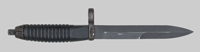 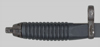 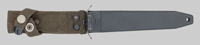   |
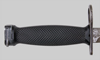
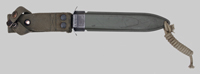
G3 | This G3 example has the 12-groove black plastic grip, similar to the 1959 design. The press catch is at the 9 O'clock position. It has a broad notched crosspiece.
Although unmarked, the blade has a plum hue, which is characteristic of products manufactured by AES. The scabbard has a black plastic body with an angular tip. The scabbard incorporates a locking device to secure the bayonet in the scabbard. The scabbard's integral web belt hanger is one inch longer than on the earlier 1959 design scabbard. |
6.50 | 165 | 12.00 | 305 | .870 | 22.1 | None. |
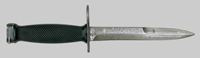     |
M7 | It is unclear who made this M7 bayonet. However, it was most likely made by AES, owing to the one-piece grip design (which appeared on AES production in the early 1980s); and, the scabbard's similarity to those previously made by Carl Eickhorn Waffenfabrik and those encountered on Hatian-contract bayonets known to have been produced by AES in 1985–86.
The 1984 AES catalog shows the M7 bayonet with a one-piece grip at center left on page 1. The scabbard on this example is unmarked. AES made M7 bayonets for many countries, including Indonesia. The absence of a US M1910-style wire belt hanger indicates this example was made for wear on a plain belt. Hopefully, further research will reveal which country used this example. |
6.50 | 165 | 11.75 | 298 | .880 | 22.4 | Crosspiece (front face): ""Solingen" and "US M7" and "W. Germany" |
| Top | |||||||||
East Germany |
|||||||||
| Pictures (click to enlarge) |
Type | Description | Blade Length |
Overall Length |
Muzzle |
Markings | |||
| in. | mm. | in. | mm. | in. | mm. | ||||
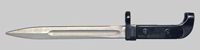 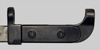    |
Modell 47 (AK47) | Knife bayonet for use with the 7.62 mm. Maschinenpistole Kalashnikow (MPiK) Kalashnikov AK47 assault rifle.
A copy of the Russian 6X2 bayonet, the East German Modell 47 bayonet is distinguished by the black plastic grip scales, electropencil serial number on the crosspiece, and gray web belt hanger with a glove fastener. East Germany produced the Modell 47 bayonet from 1959–1965. The reason for the unusual grip and second partial muzzle ring was that the bayonet was an afterthought, the AK47 not being initially designed to accept a bayonet. |
7.875 | 200 | 12.25 | 311 | .695 | 17.7 | Crosspiece: "Y7451" Snap on frog strap: "W U K" |
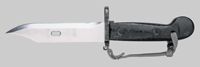 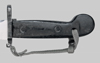 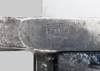  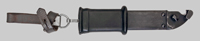  |
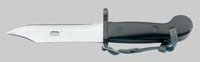
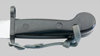
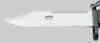
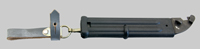
Modell 59 (AKM Type I) | Knife bayonet for use with the 7.62 mm. Maschinenpistole Kalashnikow Modernisierter (MPiKM) Kalashnikov AKM assault rifle.
A copy of the Russian 6X3 bayonet, the East German bayonet has black plastic grip. Black steel scabbard with a black rubber insulator. Gray leather belt hanger and gray web retention strap. The leather belt hanger is 3.75 in. (95 mm.) long. East Germany produced the Modell 59 bayonet from 1965–1978. This example has seen considerable service.
|
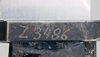
5.875 | 149 | 11.00 | 279 | .695 | 17.7 | Crosspiece (left): "Z3486" (electro-engraved)
Crosspiece (right): "K100" (inside a rectangle) Mortise: "0722" (electro-engraved) Scabbard (insulator): "5996" |
    |
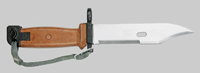
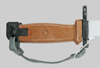
Modell 59/2 (AKM Type I Transitional) | Knife bayonet for use with the 7.62 mm. Maschinenpistole Kalashnikow Modernisierter (MPiKM) Kalashnikov AKM assault rifle.
The move to a scabbard body made from fiberglass-reinforced polyamide was a cost-saving measure introduced in 1979. The bayonet remained unchanged. This AKM variant represents a transition between the AKM Type I and Type II bayonets, mating the Type I bayonet with the scabbard that would also accompany the later Type II bayonet. Only East Germany and Russia did so. The Modell 59/2 was produced by East Germany from 1979–1985. The leather belt hanger on Modell 59/2 scabbards is 3.625 in. (92 mm.) long. |
5.875 | 149 | 11.00 | 279 | .695 | 17.7 | Crosspiece: "K" Mortise: "178046" electro-engraved Scabbard (body): "1 1946/2" Scabbard (metal end): "046" electro-engraved |
   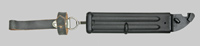   |
Modell 74 (AKM Type II) | Knife bayonet for use with the 5.45 mm. Maschinenpistole AK–74 (MPi–AK–74) Kalashnikov AK74 assault rifle. Could also be used with the 7.62 mm. MPiKM (AKM) rifles.
East Germany produced the Modell 74 bayonet from 1985–1987, when the AK74 bayonet was to be introduced. This never occurred, due to east-west reunification. The orange grip Modell 74 is believed to be the early East German production and is more finely finished than the later black grip bayonets. Gray web retention strap. The leather belt hanger on Modell 74 scabbards is 4.75 in. (122 mm.) long, noticeably longer than the belt hanger used on Modell 59 and 59/2 scabbards. |
5.75 | 146 | 10.50 | 267 | .695 | 17.7 | Grip (left): "225690" electro-engraved
Crosspiece (right): inspection mark Scabbard (body): "225690" electro-engraved and "1 1946/4" Scabbard (metal end): inspection mark |
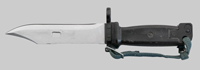 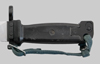 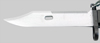 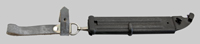 |
Modell 74 (AKM Type II) | This example is of the later black grip Modell 74. The blade exhibits arced tool marks common to East German bayonets in the last years before reunification. | 5.75 | 146 | 10.625 | 270 | .695 | 17.7 | Grip (left): "410809" electro-engraved Grip (barrel channel): "K" and "2" in a circle. Scabbard (body): "410809" electro-engraved and "1 1946/5" Scabbard (metal end): "A" |
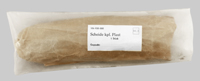  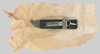 |
AKM Replacement Scabbard | AKM replacement scabbard in original packaging.
In English, the label would read something like: “Scabbard, Complete, Plastic, 1 Piece", Packed: March 1981." The belt hanger on this example is the early 3.625 in. (92 mm.) long variant used with the AKM Type I and Transitional bayonets. This is consistent with the packing date on the label. The longer 4.75 in. (122 mm.) belt hanger came in with the AKM Type II bayonet ca. 1985. The leather hanger is liberally dusted in talcum powder to protect against mildew. |
n/a | n/a | n/a | Label:
“106-930-000 |
|||
| Top | |||||||||
Unified Germany |
|||||||||
| Pictures (click to enlarge) |
Type | Description | Blade Length |
Overall Length |
Muzzle |
Markings | |||
| in. | mm. | in. | mm. | in. | mm. | ||||
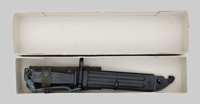
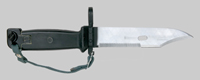
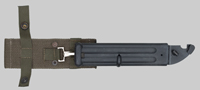
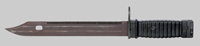
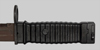
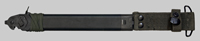
| G36 | Knife bayonet for use with the 5.56 mm. NATO caliber G36 assault rifle. This example is unissued in its cardboard packaging.
This G36 bayonet was created in 1996 on a trial basis in an attempt to make use of the large stocks of former East German Modell 74 (AKM Type II) bayonets. The original muzzle-ring was cut away and a new, large diameter muzzle ring welded in place. The original leather belt hanger was replaced by a complex web and plastic belt hanger designed to fit the West German load bearing equipment. The plastic belt attachment piece was made by YKK Stocko Fasteners GMBH, Kirchhofstraße 52, 42327 Wuppertal. The belt hanger measures 6.375 in.(162 mm.) long by 2.00 in. (51 mm.) wide. G36 rifles produced for export have NATO-specification bayonet lugs, so utilize more modern bayonets, such as the KCB–77 M1/KH-JS bayonet used by Spain. |
5.75 |
146 | 10.625 | 270 | .870 | 22.1 | Grip: "427239" in electropencil
Scabbard (body): "427239" and "2" and "1946/5" Belt Hanger (visible side): "STOCKO" over "Fasteners" and "VV 1774004" Belt Hanger (hidden side): ">PA 66<" |
|
|
KCB–77 M1/L | Long variant of the KCB–77 M1 knife bayonet produced by AES. This bayonet will mount to the 5.56 mm. NATO caliber U.S. M16 assault rifle.
The blade finish has a plum hue, common to later AES production. The scabbard measures 16.75 in. (425 mm.) long, including the integral belt hanger. The scabbard body is plastic, with a metal throat and Eickhorn-patent wire cutter assembly. The integral web belt hanger and tie thong are patterned after the US M8A1 scabbard. AES produced several variants of the KCB–77 bayonet, beginning in the early-mid 1980s. The KCB–77 "family" subtypes were as follows: M1 was for the M16 Unlike the standard-length KCB–77 M1, the long variant does not bear the Eickhorn squirrel trademark. The only markings on this example are temporary export marks "Germany" on the ricasso and scabbard throat, in white paint, indicating that this example was produced following reunification in 1989. These marks disappear almost immediately in handling. This example still has the export mark on the scabbard. This long-blade variant is attributed by some sources as intended for use on the Israeli 5.56 mm. NATO caliber Galil assault rifle, but this has never been substantiated. The USA provided Israel large quantities of the M16 assault rifle, which influenced Israel to limit production of the Galil and use the M16 rifle and M7 bayonet instead. Consequently, few of the long-blade KCB–77 M1/L bayonet were sold. AES went bankrupt in 2004. The British firm Lightweight Body Armour Ltd. (LBA) bought the AES factory in Solingen and the squirrel trademark, rebranding the edged weapons manufacturing as Eickhorn–Solingen Ltd. In 2008, LBA International ceased being a shareholder and the company was spun off to Scottish investors, who restructured the company as a limited partnership named OES Holdings. The current business, Eickhorn-Solingen GmbH, uses two trade names: Eickhorn-Solingen Limited and The Original Eickhorn Solingen, somewhat interchangeably. The company continues to produce the Bayonet System 2005, the KCB-77, and a U.S. M7 clone. |
9.875 | 251 | 14.875 | 378 | .880 | 22.4 | Scabbard: "Germany" |
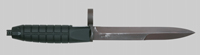  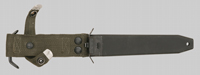   |
G3 | This example has the 7–groove black plastic grip with integral pommel. The press catch is at the 9 O'clock position. It has a half-notched crosspiece.
The blade has a plum hue, which is characteristic of products manufactured by A. Eickhorn GmbH, Solingen (AES). This example has export markings "Solingen Germany" on the scabbard body, suggesting that it was produced following reunification in 1989, but before AES' bankruptcy in 2004. The scabbard has a black plastic body with an angular tip. The scabbard incorporates a locking device to secure the bayonet in the scabbard. |
6.50 | 165 | 11.875 | 302 | .870 | 22.1 | Scabbard (body): "Solingen" over "Germany" |
| FAL Type C | Socket bayonet for the FN–FAL selective-fire rifles that incorporated the 22 mm. NATO-spec flash hider.
Like the two preceding bayonets, this example was made by AES following reunification in 1989, but before AES' bankruptcy in 2004. AES constructed the bayonet by forging upper and lower halves using a drop hammer. Hot metal was poured in between the halves, to make the complete blank, which was machined to create the tubular socket. The sprue line is evident in the pictures at left. The scabbard body is plastic, with an integral web belt hanger. The hilt strap's stippled glove fastener is characteristic of AES products. Most Belgian FAL Type C bayonets had a drawn socket, although FN also used casting near the end of FAL production. These images of the FN (top) and AES (bottom) show differences that distinguish the two makers' production. |
6.50 | 165 | 11.375 | 289 | .890 | 23.6 | Ricasso: "Solingen" over "Germany"
Scabbard (body): "Solingen" over "Germany" |
|
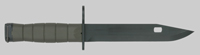 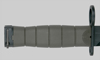      |
Bayonet 2000/2005 | Knife bayonet adaptable for use with many of the 5.56 mm. NATO caliber assault rifles used today.
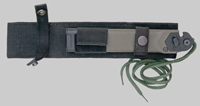
AES developed the Bayonet 2000 based on a NATO Standardization Agreement using the latest in metallurgy and polymer technology. The quality of materials and standard of manufacture is extremely high, as would be expected of Eickhorn design and manufacturing. This design borrows the crosspiece and pommel of the U.S. M7, mating them with a much more substantial and sophisticated blade. The Bayonet 2000/2005 has a green grip and scabbard, with black web frog for attachment to MOLLE load bearing equipment. The reverse of the scabbard body has a square, white honing pad, impregnated with diamond or sapphire. The detachable nylon bayonet carrier measures 11.25 in. ( 286 mm.) by 2.375 in. (60 mm.). The bayonet carrier is designed for use with the MOLLE load-bearing system, variations of which used by Canada (Tactical Vest), the USA, and many other NATO countries. MOLLE = MOdular Lightweight Load-carrying Equipment. The Bayonet 2000 was selected by the U.S. Marine Corps in 2001, however, the contract was never made due to political maneuvering that forced adoption of a U.S. manufacturer's bayonet. This was a severe blow to AES, which went bankrupt in 2004. Following AES’ bankruptcy, the company was renamed Eickhorn-Solingen Ltd. It became a subsidiary of the British firm, LBA International, who re-branded the bayonet as Bayonet 2005. In 2008, Eickhorn-Solingen Ltd. was purchased by Scottish investors, who restructured the company as a limited partnership named OES Holdings. The current company, Eickhorn-Solingen GmbH, continues to produce the Bayonet System 2005 under The Original Eickhorn Solingen brand. Countries using the Bayonet 2000/2005 include the UK, Canada Sweden, Netherlands, and Ireland. A blatant clone of the Bayonet 2000/2005, the B2K (below), was produced and marketed by a competing firm, Waffentechnik Borkott & Eickhorn GmbH. This apparently led to legal issues which resulted in management of Eickhorn-Solingen taking control of Waffentechnik Borkott & Eickhorn in 2018. |
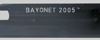
7.25 | 184 | 12.25 | 311 | .870 | 22.1 | Ricasso (left): "Original" over Eickhorn trademark (squirrel) over "Eickhorn" over "Solingen" and "Made in Germany"
Blade (left): "Bayonet 2005" Grip Flat (left): "Bayonet 2000" "Pat. Pend." Grip Flat (right): "Germany" and Eickhorn trademark (squirrel) |
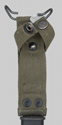
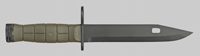
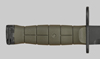
| B2K | Knife bayonet adaptable for use with many of the 5.56 mm. NATO caliber assault rifles used today.
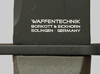
This example was produced by Waffentechnik Borkott & Eickhorn GmbH., a company formed in 2005 after the A. Eickhorn-Solingen (AES) bankruptcy and purchase by investors. Waffentechnik Borkott & Eickhorn was a venture by Jörg Eickhorn and the German metals and plastics firm, Borkott GmbH., in direct competition with Eickhorn-Solingen Ltd. The B2K is a blatant clone of Eickhorn-Solingen’s Bayonet 2000/2005. This apparently led to legal issues which resulted in management of Eickhorn-Solingen taking control of Waffentechnik Borkott & Eickhorn in 2018. The quality of materials and standard of manufacture is extremely high, as would be expected of Eickhorn design and manufacturing. This design borrows the crosspiece and pommel of the U.S. M7, mating them with a much more substantial and sophisticated blade. It has a green grip and scabbard, with black web frog for attachment to MOLLE load bearing equipment. The reverse of the scabbard body has a square, white honing pad, impregnated with diamond or sapphire. The detachable nylon bayonet carrier measures 11.25 in. ( 286 mm.) by 2.375 in. (60 mm.). In 2004, Jörg Eickhorn received a U.S. Patent on his bayonet carrier, which he described as a Belt for a Multifunctional Tool. The bayonet carrier is designed for use with the MOLLE load-bearing system, variations of which are used by many countries. MOLLE = MOdular Lightweight Load-carrying Equipment. Before legal issues put an end to sales, the B2K was purchased by the Bundeswehr, Ireland, Malaysia, Slovenia, and Vietnam. |
7.25 | 184 | 12.25 | 311 | .870 | 22.1 | Ricasso (left): "Waffentechnik" over "Borkott & Eickhorn" over "Solingen • Germany" | |
| Back | Next | ||||||||
| Return to Bayonet Identification Guide Index | |||||||||
| © Ralph E. Cobb 2009 All Rights Reserved | Top | ||||||||