| Pictures (click to enlarge) |
Type | Description | Blade Length |
Overall Length |
Muzzle |
Markings | |||
| in. | mm. | in. | mm. | in. | mm. | ||||
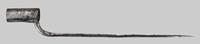 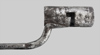 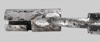 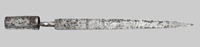 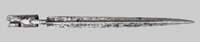 |
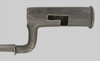
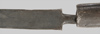
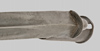
Early Colonial Socket Bayonet | Socket bayonet for a .75–.80 caliber flintlock musket.
2.562 in. (65 mm.) socket with seam under the classic shank attachment shield. L-mortise cut for a bottom bayonet mounting stud. Very heavy for its size, suggesting that it is likely made of iron. It is very difficult to date early Colonial Period bayonets. They were made in small numbers by local blacksmiths, without benefit of gauges and other production tooling common to European manufacture. As a result, no two are alike. Colonial Militias began forming in the 1730s. Because early militias focused primarily on defending settlements against Indian attack, the production and procurement of bayonets was spotty, at best. The more established militias, such as in the Massachusetts Bay Colony, are documented as having bayonets by the 1750s. However, by 1775, when the Revolutionary War began in earnest, only about half of Massachusetts Bay Colony muskets were equipped with bayonets. The Germanic features: forward-sweeping shank, flattened triangular blade profile, and applied socket construction are reminiscent of ca. 1730 European production, which points to Colonial American manufacture during the French & Indian War or early Revolution Period (1755–1770). The example below is more typical of bayonets produced during the Revolutionary War, when locally-made bayonets tended to more closely copy official British or French designs. The blade measures 0.875 in. (22 mm.) wide. The muzzle length is 1.0625 in. (27 mm.). |
14.437 | 341 | 16.00 | 406 | 1.00 | 25.4 | None. |
     |
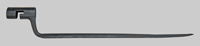
Colonial Socket Bayonet | Socket bayonet for use with a .75 caliber flintlock musket.
Blacksmith-made copy of a British Early Land Pattern Brown Bess socket bayonet. The mortise is cut for a bottom bayonet mounting stud. Although crude by European standards, this bayonet is a fairly refined example of the non-regulation bayonets made during the Revolutionary War. This example probably dates from 1770–1780. The socket measures 3.625 in. (92 mm.) long. The blade measures 1.165 in. (30 mm.) wide. The muzzle length is 1.11 in. (28 mm.). |
16.50 | 419 | 20.125 | 511 | .915 | 23.2 | None. |
     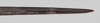 |
American Charleville-Style Musket | Socket bayonet for use with an American Charleville-style musket.
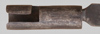
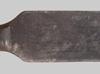
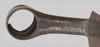
Reilly classified this bayonet as #B38A in his book, American Socket Bayonets and Scabbards. Recent research by Joseph Serbaroli Jr., published in the Society of American Bayonet Collectors (SABC) Journal, Volume 119, Spring 2022, concludes that these bayonets were most likely made 1781–95 for American-made Charleville-style muskets. American Charleville copies tended to have larger diameter barrels and smaller bayonet mounting studs than the French M1774, dimensions of which are more consistent with these American bayonets (and making these bayonets unable to mount properly to the French M1774). These were once thought to be replacement bayonets produced for French M1774 Charleville muskets held in U.S. military stores at Philadelphia. During the Revolutionary War, French arms were received at Philadelphia after the British evacuated in 1788. Approximately 6,500 French muskets were still reported there in 1797. (Ref. Joseph R. Marsden, Society of American Bayonet Collectors Journal, Volume 33, Fall 2000.) This example bears the "* over US" marking on the socket, indicating that it was held in a U.S. federal government storage facility after the Revolutionary War. A variety of blade markings are found on these. The appearance of a face flute is unusual on U.S. bayonets of this period. The face of the shank is flush with the front of the socket, another distinctive feature of this type. This example's socket was originally cut for a top stud, but was subsequently recut for a bottom stud. Perhaps, it was repurposed for issue to State Militia or during the War of 1812 when the U.S. was critically short of serviceable arms. The socket length is 2.50 in. (64 mm.). Muzzle length is 0.985 in. for top stud; 0.965 for bottom stud. Length of face flute is 5.5 in. (140 mm.). |
14.00 | 356 | 16.50 | 419 | .870 | 22.1 | Ricasso: illegible marks
Socket (left): * over US |
      |
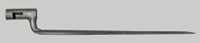
Harper's Ferry Pattern 1801 | Socket bayonet for use with the .69 caliber Harpers Ferry 1795 Type I "Charleville" musket.
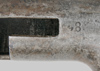
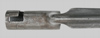
A clone of the French M1763 Charleville musket, the 1795 was the first musket type produced at the U.S. national armories. Prior to creation of the Ordnance Department, in 1812, military small arms manufacturing lacked the organization and standardization that is generally associated with U.S. arms. Nomenclature around bayonets produced 1795–1815 is somewhat uncertain, due to lack of standardization and almost continual introduction of design changes. Schmidt identifies this type as the Harper's Ferry Pattern 1801, which was produced from 1801–08. Scant documentation exists regarding early manufacture of bayonets at Harper's Ferry Armory. This example conforms to the few documented dimensions, having a 3–inch (76 mm.) socket and 15–inch (387 mm.) blade. Some Harper's Ferry muskets have a top bayonet mounting stud, while others have been observed with a bottom bayonet mounting stud, which is how this example's socket is cut. The elbow has a flattened face marked "US". There is a single punch mark on the ricasso and no face flute. The unbridged socket has the vestiges of what appears to be a 3–digit serial number (Harper's Ferry serial-numbered socket bayonets until ca. 1812, while Springfield never did.). A 3–digit serial number would place this example in the first couple of years of Armory production (ca. 1801–02). |
15.25 | 387 | 18.25 | 470 | .845 | 21.5 | Ricasso: single punch mark
Elbow (face): "US" Socket: illegible 3–digit serial number |
     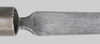 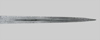  |
Springfield Pattern 1807 | Socket bayonet for use with the .69 caliber Springfield 1795 "Charleville" musket.
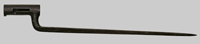
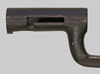
Schmidt identifies this bayonet as the Springfield Pattern 1807, which was produced from 1807–09. Earlier references may refer to this bayonet as the M1808. The Pattern 1807 was the first U.S. socket bayonet to have a bridge. The bridge strengthened the rear of the socket against the tendency to spread apart and cause the bayonet to dismount. As can be seen in the third picture at left, the bridge was almost paper thin. Subsequent bayonets, such as the M1816 below, had a more substantial bridge. In addition, the Pattern 1807 bayonet was the first U.S. bayonet to feature a face flute. As seen in the picture at left, the face flute was only about 5.00 in. (127 mm.) long and was very narrow. This example was made in 1809, owing to the diameter of the neck. In 1809, the neck diameter was increased from 0.360 in. (9.1 mm.) to 0.435–0.450 in. (11.0-11.4 mm.). This example's neck measures .460 in. (11.7 mm.). In 1810, Springfield introduced a longer socket (3.40 in. (86 mm.) vs. 2.70 in. (69 mm.) on this example). The only marking is a reference number that would also have been stamped on the musket's bayonet stud. 1809 was prior to the introduction of interchangeable parts, so each musket was produced as a "stand-of-arms," with its own bayonet. |
14.687 | 373 | 17.437 | 443 | .850 | 21.6 | Socket: "48" |
     |
Springfield Pattern 1810 | Socket bayonet for use with the .69 caliber Springfield 1795 "Charleville" muskets manufactured at Springfield Armory 1810–14.
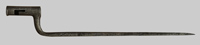
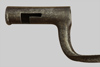
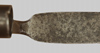
This bayonet was an improvement of the Pattern 1807 that featured a longer socket. The socket length on this example is typical of the type, measuring 3.375 in. (85 mm.). The socket bridge was also made more substantial. The Pattern 1810 bayonet featured the forger's initials on the ricasso, adjacent to the "US" marking. This enables identification of the forger or forgers and the periods when they were shown on the Armory's payroll. The face flute length was also increased to 7.00 in. (178 mm.). Two unusual features of this example are the shank diameter and the muzzle length. The shank diameter is large, measuring 0.590 in. (15.0 mm.), when 0.460–0.500 in. (11.7-12.7 mm.) was more typical. A larger shank diameter would typically suggest later manufacture, however, there isn't any evidence that this type was manufactured post-1815. The muzzle length is 0.980 in. (25 mm.), which is shorter than the 1.440 in. (37 mm.) typically encountered on this type. Whether this example was cut this way or the muzzle length subsequently altered to fit a different musket is not known. There is no obvious evidence of alteration. During this period, there were six different forgers at Springfield with the initials "JB", so we can't determine which one made this bayonet. However, they all were on payroll between 1813–15, so that would represent this example's likely period of manufacture. During the 1810–15 period, replacement bayonets were also made at Springfield for older muskets, so it is possible that this example is one that was made as a replacement for older arms being issued from existing stores. This was during the War of 1812, when there was a severe shortage of arms available for issue. The government was issuing any arms in military stores that could be made complete and serviceable. |
15.375 | 391 | 18.75 | 476 | .850 | 21.6 | Ricasso: "JB" "US" "3" |
       |
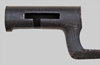
Mystery ca. 1810 U.S. Socket | Socket bayonet made ca.1810 that is configured for an unknown type of small caliber musket. This bayonet is one of the many mysteries among American socket bayonets of the early 1800s.
This example exhibits many characteristics of the Pattern 1810 socket bayonet; as well as exhibiting some characteristics not typically associated with the Pattern 1810. The 3.25 in. (83 mm.) socket length and blade length are typical of the Pattern 1810. The muzzle length is 1.4 in. and the shallow face flute extends 7 in. back from point, both typical of the Pattern 1810. Unusual characteristics include a lack of markings. The face of the elbow is flat. The socket bridge is rounded. The socket diameter of 0.750 in. indicates that it is configured for a musket bore smaller than the .69 caliber muskets then in use. There appears to be a line where the socket may have been cut and brazed together to reduce its diameter. A tiny bit of bronze is visible on the muzzle end of the socket. The quality of construction and finish seems consistent with arsenal work of the period. |
14.75 | 375 | 18.00 | 457 | .750 | 19.1 | None |
     |
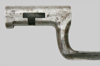
Mystery ca. 1815 U.S. Socket | Socket bayonet made ca. 1815 for use with an unknown .69 caliber musket. The exact identification of this example remains a mystery.
This example exhibits many characteristics of the socket bayonets made ca. 1816-21 at the Virginia Manufactory. However, the dimensions are not consistent with documented Virginia examples nor is the socket numbered like a Virginia bayonet. Reilly classified this bayonet as #B52 in his book, American Socket Bayonets and Scabbards. Reilly felt that it was a precursor to the M1816 and represented one of the earliest examples of the T-mortise (Wilson's Improvement). The socket is pretty close to the M1816, but the blade is vastly different. Longer and heavier; tapering to a sharp point; and lacking any face flute. The muzzle length is 0.950 in. (24.2 mm). and blade width 1.040 in. (26.4 mm.). |
17.50 | 445 | 20.75 | 527 | .850 | 21.6 | Socket (rear): hash marks. |
    |
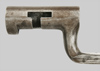
M1816 | Socket bayonet for use with the .69 caliber U.S. M1816 flintlock musket.
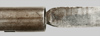
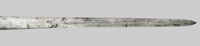
The M1816 musket and bayonet are the first U.S. arms not copied from foreign designs. These represent the first products of the newly-created Ordnance Department, which continues to regulate and standardize U.S. weaponry to the present day. The M1816 had a very long production period, from 1818 to 1840. Early examples were left in the white, while later examples were browned. Both Springfield and Harper's Ferry Armories produced the M1816. The point was also unique, resembling the prow of a boat. No other US bayonet type was pointed this way. There is an abbreviated face flute, extending about 9 in. (230 mm.) back of the point. The socket length is 3 in. (76 mm.). The T-mortise used on the M1816 socket was developed by Springfield Armory Master Armorer, Andrew Wilson, of New York. After leaving Armory employment, Wilson applied for a patent on his bayonet socket, which was granted in June 1814. In 1818, after a year of negotiations, the U.S. Government paid Wilson $3,000 for the right to use his patent, which was estimated to reduce the cost of each bayonet by 25 cents vs. adding a medial locking ring. Considering that the U.S. manufactured more than 600,000 bayonets from 1818–1844 using "Wilson's Improvement," the Government's $3,000 investment saved over $150,000. This example was made at the Springfield Armory, likely between 1827–1831, by bayonet forger Timothy Allen (based on period records, the initials accompanying the arsenal mark correspond those of the bayonet forger). Beginning in 1827, the neck diameter was increased from 0.435–0.460 in. (11.0–11.7 mm.) to 0.460–0.500 in. (11.7-12.7 mm.). This example's neck measures .472 in. (12.0 mm.). Beginning in 1832, inspectors placed their initials on the neck, rather than using a punch mark on the blade (each inspector put the punch mark in a different location). This example has the punch mark after the "US" arsenal mark. I obtained this example from an older gentleman, who purchased it in the early 1960s from the famous Francis Bannerman Sons military surplus dealer of New York. |
16.25 | 413 | 19.25 | 489 | .845 | 21.5 | Ricasso: "US." over "TA" |
     |
M1819 Hall Rifle | Socket bayonet for use with the .52 caliber M1819 breech loading rifle designed and patented by Captain John H. Hall.
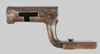
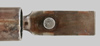
The unique offset bridge is diagnostic of the M1819 bayonet, required due to the rifle’s sights being offset to the left in order to facilitate operation of the breech block. This example has rounded blade shoulders, rather than the more commonly-encountered scalloped shoulders. Face flute measures 7.50 in. (191 mm.). Socket length is 2.937 (75 mm.); Muzzle length is 1.10 in. (28 mm.). A total of 29,593 M1819 (flintlock) and M1841 (percussion) Hall’s Patent breech loading rifles were produced between 1823–1842. 19,680 at Harper’s Ferry Arsenal and 5,700 by Connecticut contractor, Simeon North. The M1819 was the first breech loading military rifle produced in quantity and was the first rifled U.S. military arm to mount a bayonet. The M1819 rifle was beautifully engineered and worked reasonably well. It was reliable and produced a vastly higher rate of fire than any musket of the period, all with the superior accuracy of a rifle. That said, troops found firing the M1819 unpleasant due to gas leakage around the breechblock. Although detrimental in many respects, gas leakage served to rid the action of powder fouling, enabling 20 or 30 shots before cleaning vs. 3 or 4 shots for a muzzle loading rifle. However, the firer received the escaping gas in the face and downward toward their trigger hand, something most could simply not get used to. As a consequence, M1819 rifles mostly sat in storage. The lock, breechblock, and trigger were a single, easily-removable assembly that could be loaded and fired (kind of a makeshift pocket pistol). The M1819 rifle was the first truly assembly-line military rifle with fully-interchangeable parts. The production line that Hall created at Harpers Ferry was mechanized to an unprecedented level, which enabled use of "unskilled labor" (boys) and resulted in parts exhibiting previously unachievable levels of precision and uniformity. Hall’s innovative machines and processes fathered the American System of Manufacturing. The Hall breech loading mechanism paved the way for development of the Spencer, Sharps, and other successful breech loading rifles and carbines of the U.S. Civil War. |
15.812 | 402 | 18.75 | 476 | .785 | 19.9 | Ricasso: single punch mark |
  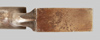     |
Type I Fencing Bayonet | Fencing bayonet used with .69 caliber non-firing fencing muskets.
There was no official nomenclature for 19th Century regulation U.S. fencing bayonets. In 1964, Hardin introduced the designation “Type I” in his book, The American Bayonet. The original M1816 bayonet blade was mostly cut away, then modified into a box receptacle that accepted a flexible whalebone (baleen) blade with a leather-covered India rubber or cork ball at the end. Baleen is taken from the whale’s mouth, so is not actually bone. Its flexibility, pliability, and strength made it behave much like modern plastics. In his book, U.S. Military Flintlock Muskets: The Later Years, Peter Schmidt documented that Watervliet Arsenal in New York produced 1,500 Type I fencing bayonets in 1852 and 1853. 1852–53 Ordnance Dept. reports also show that Washington Arsenal (site of present-day Ft. Lesley J. McNair) reported fabrication of 50 fencing bayonets. This example still has much of its original browned finish and the original thumbscrew for securing the blade. Period whalebone blades are rarely encountered today. This example bears the socket marking “w” over “a” and “52.” Production of a regulation fencing bayonet coincided with the 1852 publication of Captain (later, Maj. Gen.) George B. McClellan's Manual of Bayonet Exercise: Prepared for the Use of the Army of the United States. McClellan was not the author, but translated a French book on bayonet training for use by the U.S. Army. This example of McClellan's manual was printed in 1862 and used to train African-American soldiers of the 41st USCT. After marching 30 miles in 26 1/2 hours, these soldiers stopped the retreat of Lee's Army at Appomattox Courthouse shortly after 7 a.m. on the morning of April 9, 1865. Less than one hour afterwards, Lee began his historic ride to find General Grant. Read more about U.S. Fencing Bayonets in my article: Regulation U.S. Fencing Bayonets 1852–1915. |
n/a | n/a | .825 | 21.0 | Socket: "w" over "a" and "52"
Socket (bridge): "L 13" |
||
 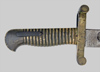 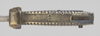    |
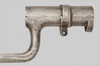
M1855 Sword Bayonet | Sword bayonet designed for use with the .58 caliber M1855 Percussion Rifle. It was also used with later M1841 "Mississippi" Rifles that were rebored to .58 caliber and altered with a bayonet lug that did not incorporate a guide.
According to the late Robt. Reilly, only 9,721 bayonets of this type, incorporating an unstopped fuller and without a guide slot, were produced at the Harpers Ferry Armory during 1857–61. An earlier variant, the Type II sword bayonet for use with early alterations of the M1841 Rifle, had a stopped fuller and incorporated a guide slot. 10,286 bayonets of this type were produced at the Harpers Ferry Armory during 1855–57. I have not yet been able to identify the inspector "SP". Hopefully, further research will reveal the information. The blade profile is unique. It is not a yataghan, but simply a curved blade with the hilt offset to keep the blade point out of the bullet's path. Notice in the second image, how the hilt's upper edge and the blade's upper edge are way out of parallel. This odd blade design was not used on any other bayonet. The scabbard is leather with brass mounts. |
21.625 | 549 | 26.375 | 670 | .885 | 22.5 | Hilt (upper flat): "SP" and "19" |
 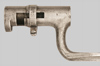   |
M1855 Socket Bayonet | Socket bayonet used with the .58 caliber M1855, M1861, and M1863 rifle-muskets.
The standard socket bayonet used by union forces during the U.S. Civil War, 1.5 million were produced by Springfield Armory and private contractors 1857–1865. The socket length is 3.00 in. (76 mm.). This example was made prior to 1864, when the locking ring mortise was lengthened by 2/10 in. (5 mm.) to allow the locking ring to travel past center for increased securing force. Collins & Company had previously began setting the stop pin above center to serve the same purpose (see Sharps New Model bayonet below). Springfield Armory opted for the locking ring modification instead in November 1863, as the improved locking ring could also be retrofitted to earlier bayonets. |
18.00 | 460 | 21.00 | 533 | .780 | 19.8 | Ricasso: "US" |
    |
M1835 Replacement | Socket bayonet for use with .69 caliber U.S. M1840 and M1842 muskets that were updated by rifling the barrels and, in the case of the flintlock M1840, converted to percussion ignition.
The M1840 was the last U.S. military flintlock musket. The M1842 was the first U.S. military percussion musket and the last U.S. infantry musket to be made as a smoothbore. A clone of the M1835 socket bayonet, made after M1835 production had ceased at the national armories in Springfield, Illinois, and Harpers Ferry, Virginia. This example is identical to the M1835 bayonets made from 1839–1855, except for its tapered blade shoulders. Period M1835 bayonets had scalloped blade shoulders, like the M1816 bayonet pictured above. Tapered blade shoulders were not introduced until after 1855. The socket length is 2.625 in. (67 mm.). Perhaps this bayonet was made 1856–59 when existing M1840 and M1842 muskets were rifled at the national armories; or early in the Civil War, when the converted M1840 and M1842 Rifled-Muskets were pressed into service. |
18.00 | 457 | 20.625 | 524 | .845 | 21.5 | Ricasso: "U.S." |
    |
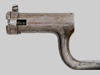
M1847 Artillery Musketoon | Socket bayonet for use with the .69 caliber M1847 Artillery Musketoon.
The M1847 Artillery, Cavalry, and Sapper's & Miner's Musketoons were among the last smoothbore long arms produced for the U.S. military. 3,359 M1847 Artillery Musketoons were produced 1848-59 without the ability to mount a bayonet. In 1858-59, an unknown quantity of M1847 Cavalry Musketoons were altered by Springfield Armory for use as Artillery Musketoons. The conversion also included installation of a bayonet stud to mount a socket bayonet. M1835/42 bayonets were shortened to 15-15 1/2 in. blade length for use with the Artillery Musketoon conversions. Examples are found with both the earlier scalloped blade shoulders and the mid-1850s tapered blade shoulders (like this example). A characteristic of these socket bayonets is the front edge of the socket being rolled (i.e., rounded over), the purpose of which is not known. The socket length is 2.625 in. (67 mm.). |
15.50 | 394 | 18.125 | 460 | .845 | 21.5 | Ricasso: "U.S." |
    |
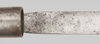
J. D. Greene | Socket bayonet for use with the .546 caliber J. D. Greene bolt-action breech loading rifle.
Patterned after the M1855 socket bayonet, the J. D. Greene socket differs in having a basal locking ring and straight mortise. The socket length is 3.00 in. (76 mm.). J. D. Greene bayonets had a blued finish, where the M1855 and most other Civil War socket bayonets were finished in the white. This example retains much of the original blue finish on the blade. Approximately 4,000 J. D. Greene rifles were manufactured 1859-63 by the Asa H. Waters Armory in Millbury, Massachusetts, 3,000 of which were shipped to Russia. The Massachusetts State Militia is believed to have received a small number of Greene rifles, which they likely employed in September 1862 at Antietam. Antietam was the only documented Civil War use of Greene rifles (Greene cartridges have been excavated there). The U. S. Ordnance Dept. contracted for 900 Greene rifles in January 1863; taking delivery later that year. These rifles are believed to have remained in stores, never seeing service. Patented in 1857 by Lt. Col. James Durell Greene, and improved in 1862, this was the first bolt-action rifle adopted by the U. S. Ordnance Dept. In addition to being the first regulation bolt-action, it was the only regulation underhammer action, only regulation oval-bore rifle, and only regulation rifle whose cartridge held the bullet behind the powder charge. The action was complex to operate and the unconventional loading procedure was simply beyond the ability of the common soldier to manage under fire. |
18.187 | 462 | 21.00 | 533 | .871 | 19.9 | Ricasso: "J. D. G." |
    |
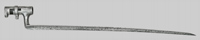
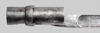
M1841 Drake Alteration | Socket bayonet used with .54 caliber U.S. M1841 rifles adapted for a socket bayonet. As originally made, the M1841 rifle did not accept a bayonet.
This bayonet is identified as B82 in Reilly’s book, American Socket Bayonets and Scabbards. Research by SABC member Ed Hull published in 2019 (Society of American Bayonet Collectors Journal, Volume 107, Spring 2019), summarizes what is known about this unusual socket bayonet. Bay State Works in Northampton, Massachusetts is documented as having received a State of Massachusetts contract for sword blades, bayonets and gun barrels on July 2, 1861. Bay State Works is believed to have produced the bayonets supplied to Boston contractor, Augustine J. Drake who altered Model 1841 rifles to accept a socket bayonet for the State of Massachusetts. Socket bayonets produced by Bay State Works share an unusual blade design, with the back flutes cut all the way through the elbow, that has come to be known as the “Drake Pattern.” Drake delivered 1,742 altered M1841 rifles and 1,984 “long bayonets” to the State in early 1862. 1,660 rifles and bayonets were immediately issued to the 46th and 51st Massachusetts Volunteer Infantry Regiments. These regiments were enlisted for nine months, serving in North Carolina 1862–63. The rifles and bayonets were marked with a rack number. This example’s rack number is in the letter-dot-number format used by the 46th, who received 920 rifles. A rack number using a letter-number format was used by the 51st, who received 740 rifles. An additional 303 M1841 rifles were altered to the Lindner Breechloading System by Boston contractor, Morse & Allen, also accept the Drake Alteration socket bayonet. 200 of these went to the Federal Govt.; 103 to Massachusetts. These 2,045 rifles are the only M1841 rifle alterations that accept a socket bayonet sized to the rifle’s original muzzle diameter. Others were altered to accept a sword bayonet or had the muzzle turned to accept the smaller diameter M1855 socket bayonet. This bayonet’s 20-inch. (505 mm.) blade required a special scabbard, of which Massachusetts procured 1,870. Approximately 2,287 of the M1841 Drake Alteration socket bayonets appear to have been produced. This example is one of the 920 issued to the 46th Mass. Volunteer Infantry, as evidenced by the rack number. A similar bayonet may have been produced for the Confederacy at the Fayetteville Arsenal in 1864–65. Identification of Confederate bayonets is challenging, requiring expert assessment. The socket length is 2.965 in. (75 mm.); muzzle length 1.220 in. (31 mm.). |
20.00 | 508 | 23.25 | 591 | .898 | 22.8 | Socket: "A . 27" |
    |
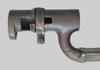
Drake Pattern Sharps/ Spencer | Socket bayonet used with .52 caliber Sharps breech loading rifles and .52 caliber Spencer repeating rifles adapted for a socket bayonet.
This bayonet is identified as B108 in Reilly’s book, American Socket Bayonets and Scabbards. Research by SABC members Paul Johnson and Joseph Marsden published in 1998 (Society of American Bayonet Collectors Journal, Volume 26, Winter 1998); and additional research by Paul Johnson published in 2019, in the book, Sharps Firearms: The Percussion Years 1848–1865, is responsible for what we know about this unusual socket bayonet. Early Sharps and Spencer socket bayonets were manufactured by the Bay State Works, Northampton, Massachusetts, along with the M1841 Drake Alteration bayonets described above. These bayonets share the unusual blade design that has come to be known as the “Drake Pattern,” although Augustine Drake was not involved with the Sharps/Spencer bayonet. Another distinguishing feature is an odd placement of the locking ring stop pin, 30-degrees further around the socket from that of the M1855 bayonet. The first Sharps rifles accepting a socket bayonet were the 2,000 Sharps rifles procured in 1862 for Col. Hiram Berdan’s 1st and 2nd Regiments of U.S. Sharp Shooters. An image taken in July 1862 unmistakably shows this unique socket bayonet in use by an identified soldier of the 1st U.S.S.S. The first 1,200 Spencer repeating rifles delivered to the Army are also documented as having been supplied with socket bayonets with 18.5 in. (470 mm.) blades produced in Northampton. This bayonet’s 18.5 in. blade was not compatible with the Army’s 18-inch scabbards. In November 1862, the Ordnance Department accepted the bayonets that had already been produced, but required that any additional Sharps and Spencer bayonets be of the standard 18-inch M1855 blade pattern. Approximately 3,200 of the Drake Pattern Sharps/Spencer bayonets appear to have been produced. Bay State Works ceased bayonet production in late 1862. Collins & Co. began producing bayonets in 1863, producing the M1855-style socket bayonets subsequently used with Sharps and Spencer rifles. The socket length is 3.00 in. (76 mm.); muzzle length 1.190 (30 mm.). |
18.50 | 470 | 21.50 | 546 | .815 | 20.7 | None. |
    |
Enfield Rifle-Musket | Socket bayonet for use with the .577 Caliber Enfield Rifle-Musket (also referred to in the USA as the "3-Band Enfield").
This example has no British government markings, indicating that it was likely imported to the USA during the American Civil War. The Enfield was the second most common rifle used in the American Civil War, with nearly 1 million imported and used by both sides. The socket length is 2.9375 in. (75 mm.). According to British socket bayonet authority Graham Priest, the “J•R” marking indicates that the bayonet was likely made in Liege, Belgium. The other ricasso marking may be an incomplete CHAVASSE. There was a retailer, Horace Chavasse & Co., at Alma street, Aston Newton (near Birmingham, England) 1860–1868. Chavasse has been documented as also having marked and exported P1856 sword bayonets. |
17.25 |
438 | 20.25 |
514 | .787 |
20.0 | Ricasso: "P (dot) B" and “CHAVAS”
Socket (rear edge): 2 punch marks and 7 notches |
| Back | Next | ||||||||
| USA—19th Century Bayonets (Post-1865) | |||||||||
| Return to Bayonet Identification Guide Index | |||||||||
| © Ralph E. Cobb 2010 All Rights Reserved | Top | ||||||||