| Pictures (click to enlarge) |
Type | Description | Blade Length |
Overall Length |
Muzzle |
Markings | |||
| in. | mm. | in. | mm. | in. | mm. | ||||
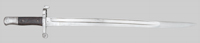 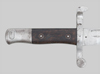 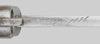      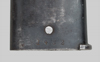 |
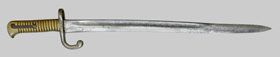
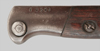
M1885 | Sword bayonet for use with the 8 mm. M1886 Kropatshek rifle (Espingarda de Infantaria 8 mm. m/1886).
This bayonet was designed for use with the M1885 Guedes single-shot rifle, of which 18,000 were in various stages of production at Steyr when Portugal decided to adopt the M1886 Kropatshek repeating rifle instead. Portugal paid for the Guedes', 8,000 of which were later completed by Steyr and sold to the Transvaal and the Orange Free State in So. Africa. The M1886 rifle takes its name from Austrian Alfred Ritter von Kropatshek, who designed the rifle's tubular magazine system. Both the rifle and its yataghan sword bayonet were produced by Steyr in Austria. According to Steyr records, 56,000 M1886 Kropatshek rifles were made for Portugal 1886–89, with an additional 1,000 produced in 1893–94. The small cross stamped on the ricasso is the Cross of Christ (Cruz de Cristo) or Portuguese Cross (Cruz Portuguesa). The small cross stamped on the crosspiece is the Avis Cross (Cruz de Avis). |
18.50 | 470 | 23.50 | 597 | .630 | 16.0 | Ricasso (right): "X"
Crosspiece (right): unknown mark Crosspiece (left): "JJ297" Spine: "Steyr 1886" Scabbard (frog stud): "OE" over "W G" Scabbard (body): "Q482" |
     |
M1904 |
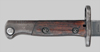
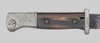
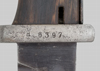
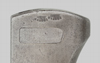
Sword bayonet for the 6.5 mm. M1904 Mauser-Vergueiro rifle. This bayonet was also used with the 8 mm. M1904/39 Mauser-Vergueiro Short Rifle conversion.
M1904 bayonets have a shorter hilt than M1908 and later Mauser bayonets, so only fit on M1904 Mauser rifles. The Portuguese M1904 rifles are believed to have been made ca. 1904–07 by DWM. The bayonets were made by Simson & Co. Approximately 75,000 were believed to have been completed, before Portugal ran out of money to continue production. No actual production records have been found. Portugal was the poorest of all Western European countries and was plagued by financial difficulties. The original bayonet finish was in the white. M1904 bayonets were later blued during rework. Brazil purchased 5,000 M1904 Mauser-Vergueiro rifles in 7 mm. for their federal district police. These used a M1904 yataghan bayonet. In 1915 South Africa obtained 20,000 M1904 Mauser-Vergueiro rifles and bayonets from the Portuguese in Mozambique. |
11.125 |
283 | 15.875 |
403 | .620 |
15.7 | Ricasso (right): "Simson & Co." over "Suhl"
Pommel: "F9591" |
     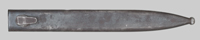 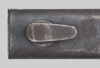 |
m/937 | Knife bayonet for use on the 8 mm. Mauser m/937 Short Rifle, produced for the Portuguese, in Germany, beginning in 1937. The m/937 is closely related to the Kar 98k. This bayonet was also used with Kar 98k rifles that Portugal obtained from Germany in 1941.
This bayonet was made in Germany, under contract for the Portuguese government. The bayonet is a German M1884/98 III, made on the same production line as those used by the Wehrmacht. This example bears German government acceptance marks (waffenamts), signifying that it met German government acceptance standards. There were two Portuguese contracts, one in 1937 and another in 1941. This example is from the second contract, as is evidenced by the serial number on the crosspiece and the WaA 883 inspection stamps. First contract examples have the serial number on the pommel and bear WaA 253 inspection stamps. Unlike bayonets produced for the German Army, these bayonets have no maker markings. The inspection teams represented by WaA 253 and WaA 883, covered many of the large Solingen blade makers, so it is not known which firm produced these bayonets. |
9.875 | 250 | 15.125 | 384 | n/a | Crosspiece: "H6397" Pommel: "WaA 883" (twice) Press Stud: "WaA 883" Scabbard (Frog Stud): "H59" Scabbard (ball finial): "WaA 883" |
|
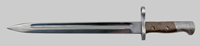 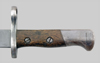    |
m/938 | Sword bayonet for use on MP 34 submachine guns made for Portugal by Steyr-Solothurn in German-occupied Austria. Portugal designated the MP 34 as the Pistola Metralhadora (machine pistol) m/938 (in 7.65 mm.) and m/942 (in 9 mm.).
Steyr designed the MP 34 to accept the Austrian M1895 bayonet. The m/938 bayonet is a conversion of the Portuguese M1904 bayonet. Portugal found it more economical to rework existing M1904 bayonets than to purchase the Austrian M1895 bayonets. According to bayonet author and researcher Dennis Ottobre, the conversion consisted of having the hilt cut in half across the tang, a new crossguard with high mounted 15 mm. muzzle ring installed (replacing the original completely) and then the tang was shortened and rewelded with new shorter grips installed. With all the cutting and welding it was necessary to reblue them entirely. The m/942 remained in Portuguese service into the 1970s, seeing combat in Africa during the Portuguese Colonial Wars. It must have been quite a sight, seeing this old-world submachine gun serving alongside the futuristic Armalite AR–10 assault rifle. |
11.125 | 283 | 15.375 | 391 | .595 | 15.1 | Ricasso (right): "Simson & Co." over "Suhl" Pommel: "3666" |
 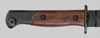 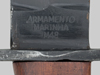 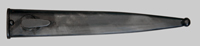 |
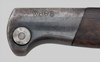
m/948 | Knife bayonet for the 9 mm. FBP (Fabrico Braco de Prata) m/948 submachine gun. This diminutive bayonet has a distinctive double-edged stiletto blade profile.
The m/948 was produced from 1948–1955. Fabrico Braco de Prata (Silver Arms Factory) was a State-owned arms factory in Lisbon. Today, FBP is known as INDEP—Indústrias Nacionais de Defesa, EP (Defense National Industries, Public Corporation). The m/948 was the only indigenous submachine gun used by Portugal. It enjoyed a long service life, seeing combat service in Angola, Guinea-Bissau, Mozambique, Portuguese India and Timor. These "Armamento Marhina" marked examples were sold by a well-known surplus dealer as original items. However, differences in fit and finish between these and other obviously-legitimate examples have led to the consensus that they are likely reproductions. |
7.00 | 178 | 11.875 | 302 | n/a | Ricasso" "Armamento" over "Marinha" over "M48" | |
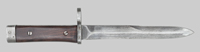 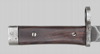    |
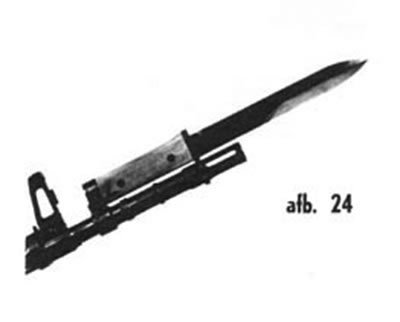
AR-10 | Knife bayonet for use on the 7.62 mm. NATO caliber Armalite AR–10 selective-fire rifle, produced in 1960 for Portugal by Artillerie Inrichtingen (Artillery Institutions) in the Netherlands. Portugal designated the AR–10 as the Espingarda de Assalto 7.62 mm. m/961.
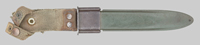
Unlike most modern bayonets, which mount below the rifle’s barrel, this bayonet mounts inverted above the barrel. The one-piece wooden grip is unique and wraps almost completely around the hilt. The only marking is the triangular Artillerie Inrichtingen trademark. The scabbard is closely patterned after the familiar U.S. M8A1 scabbard. The Portuguese AR–10 was the final production model. Earlier AR–10 rifles produced by Artillerie Inrichtingen used a German-made knife bayonet that mounted underneath the barrel. Much of the conventional wisdom regarding the AR–10 was clarified by research published in 2016 by Joseph Putnam Evans in his book, The AR-10 Rifle, World's Best Battle Rifle. He indicates that, in addition to the Portugal contract and Dutch Army trials, an additional quantity of Portuguese-type AR–10 rifles were supplied to Italy. Only a minority of the 240 Dutch Army trials rifles used the Portuguese bayonet (most used the Sudanese bayonet or no bayonet at all). Italy’s specific quantity is not known, but is believed to be less than 500 rifles. The last 60 AR–10s were shipped to Italy in January 1962, ending production at Artillerie Inrichtingen. The likely total production of this type bayonet was approximately 1,600–2,100 units. The AR–10 saw nearly two decades of combat service with Portuguese special forces fighting insurgents in Angola, Mozambique, Guinea-Bissau, and Timor. See my presentation, The Portuguese AR–10 Bayonet, for more information and pictures of the AR–10 bayonet in use by Portuguese troops in Angola and Mozambique. This example has seen considerable service. Low production numbers and extensive combat service in the African bush country have made surviving specimens of this bayonet scarce. |
7.125 | 181 | 11.75 | 298 | .855 | 21.7 | Ricasso: Superimposed "AI" inside a triangle.
Scabbard: "7446" |
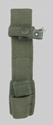 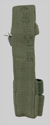 |
Infantry Belt Frog | Web belt frog for carrying the FAL Type A and m/948 bayonets. Will also accommodate the M1904, m/937, and m/938 bayonets.
Based on the British Pattern 1937 frog, the Portuguese design incorporates a glove fastener on the hilt strap. Measures 6.50 in. (165 mm.) long by 1.187 in. (30 mm.) wide. This frog was not classified by Carter. |
n/a | n/a | n/a | Illegible marking on reverse. | |||
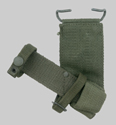 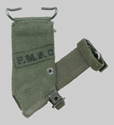 |
Mounted Belt Frog | Web belt frog for carrying the FAL Type A and m/948 bayonets. Will also accommodate the M1904, m/937, and m/938 bayonets.
Offset design incorporates a belt hanger that positions the frog at a 45-degree angle. Portugal adopted this concept in the 19th Century, for use by horse cavalry. This modern frog was most likely intended for use by mechanized troops. According to author/researcher Martin Brayley, FMSC stands for Fábrica Militar de Santa Clara. FMSC was a government factory located in the Campo de Santa Clara district of Lisbon. This factory manufactured quartering material, equipment, leather goods, etc. In 1969, FMSC was absorbed into the Oficinas Gerais·de Fardamento e Equipamento (OGFE) [General Uniform and Equipment Workshops]. OGFE was abolished in 2014, having become outdated, inefficient, and unable to compete with private industry; resulting in unsustainable financial losses. The frog measures 4.75 in. (121 mm.) long by 1.187 in. (30 mm.) wide. The belt hanger measures 5.50 in. (140 mm.) long by 2.25 in. (57 mm.) wide. This frog was not classified by Carter.
|
n/a | n/a | n/a | Reverse: "F. M. S. C." | |||
| Back | Next | ||||||||
| Return to Bayonet Identification Guide Index | |||||||||
| © Ralph E. Cobb 2010 All Rights Reserved | Top | ||||||||