Bayonet Collectors’ Network

Researching Your Finds

This is where I get the most enjoyment out of collecting.  The Internet has really empowered collectors, by placing so much information at our fingertips. It is really amazing, the stories your pieces tell as you gather more and more information.  See my Library and Links pages for leads on beginning to research your collection.

An essential tool is some sort of organized repository for the information you gather. Sometimes it takes years for all of the puzzle pieces to fall into place, so you must have a system to avoid losing information.  It doesn't have to be fancy.  A three-ring notebook will do (as it did for Jerry Janzen), as will a box with 4 x 6 cards. I have chosen to create a Microsoft Access database to store all of the information about each piece in my collection.  I also have photographed each piece in my collection and have linked the photos to the database, so that I can refer to them while I am researching.

I am a firm believer that the story does not add to the value of a piece, unless it can be documented to a reasonable degree. However, an unproven story can significantly add to your enjoyment.  And that's what collecting is all about: enjoyment.

Here are a couple of examples of how pieces in my collection have come to life through research.


German?, No. French?, No. German M1866 Chassepot Bayonet?

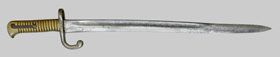
I obtained a French M1866 Chassepot bayonet on eBay. I wanted one because I didn’t have a M1866 and the M1866 had a huge influence on bayonet design.  I could also see that this one was an unusual and desirable variation, having a modified scabbard to fit the belt frog for the German M1871 sword bayonet. When I received it, I was pleased to see that it was an early piece, made in December 1867.

So far, the emerging story is that the bayonet was made in France in December 1867 and, given the modification, was likely captured by the Germans during the Franco-Prussian War of 1870-71.

I shared my new find with my BCN colleagues via e-mail.  The noted author of many bayonet books, Anthony Carter, wrote back from England, asking for any markings on the bayonet. Anthony, once the biggest bayonet dealer in Britain, no longer collected bayonets, just the data from bayonets.  In addition to the usual script on the blade spine, there was a funny little marking on the ricasso (the base of the blade).  He was working on a book about the M1866 Chassepot bayonet (which remained unfinished when he passed away in 2002) and asked if I could send him a picture of the marking on the ricasso. I had just bought my first digital camera and, for the first time ever, was able to send pictures.

He wrote back that the marking was that of a blade maker in Germany (what!). Here is what he wrote:

"That odd mark on the blade of your French M 1866 is the trademark of Gustav Felix in Solingen.  The firm is still in business, but even they aren't sure what this mark represented, most likely a hot air balloon they think. Several Solingen firms supplied blades to the French Arsenals. The Tulle Arsenal seems to have acquired a lot of blades from Gustav Felix in 1867."

So the story is that the French purchased the blade from Gustav Felix in Solingen, Germany.  It was assembled into a M1866 Chassepot bayonet in December 1867 at the French Imperial Arsenal at Tulle. The bayonet was captured by the Germans during the Franco-Prussian War of 1870-71. The Germans modified the scabbard, by replacing the frog loop with a German frog stud, and probably issued it as a sidearm to a policeman or security guard. Bayonets like this were used as sidearms until the end of WW I, and some were modified to fit other rifles (but this one is not).

The German tradition of having government officials carry sidearms dates back a few hundred years and was maintained until the end of WW II. Bayonets were officially classified as sidearms (seitengewehr). 

So, there you have it: From Germany, to France, then back to Germany.

M1866 Chassepot (German Capture)

M1866 Chassepot (German Capture)

M1866 Chassepot (German Capture)

M1866 Chassepot (German Capture)

M1866 Chassepot (German Capture)

Top


Argentine M1871 Mauser Rifle?

I was able to purchase a German M1871 Mauser rifle from an estate collection.  The M1871 was the granddaddy of them all, the first Mauser military rifle. 

The rifle was made in 1881 at the Bavarian Royal Arsenal at Amberg.  It carried the royal cypher of King Ludwig II and an issue-date of 1882.  I primarily bought the rifle as a shooter, however, there was one unusual thing about the rifle that was readily apparent. There were five notches cut into the comb of the stock.  This was unusual, because one doesn't often see deliberate defacement of military rifles. Armies are the same all over the world. You deface your piece and the sargeant takes you out behind the barracks and permanently disabuses you of that notion.

Granted, the notches could have been placed there by anybody.  However, the M1871 is long, heavy, and only is a single-shot rifle.  Not what a hunter would choose for hunting, so probably not from a hunter.  The collection from which it came was very well cared for and had some very nice pieces. That guy wasn't likely to have done it either. Although I had no idea at the time, there were a couple of other unusual things about the rifle. First, the German unit markings had been scrubbed from the tang of the buttplate, where they are customarily found on M1871s. I knew that it had been unit-marked at one time, because of the issue date.  Second, there was a strange cartouche on the buttstock that read:  “E.N”. 

I searched for years for the identity of that cartouche. I consulted The Imperial German Regimental Unit Marking, by Jeff Noll, in my reference library, and couldn't come up with anything that even remotely made sense. I corresponded with the author (a BCN member).  He wrote back that he thought that had seen the marking somewhere but didn't recall what it was. I spent hours and hours searching the web, sporadically, over the years. It seemed like a dead end. 

The breakthrough came in 2005. A thread started on gunboards.com about another E.N marked M1871 Mauser. The mark was identified as an Argentine military property mark, commonly seen on Remington rolling block rifles. E.N stood for Ejercito Nacional (National Army). What!  The Argentines used Remington rolling blocks, beginning in 1879, until their adoption of the M1891 Mauser. Then it came.  Noted firearms writer Paul Scarlatta posted the following:

“Yes, the Argies used Werndls, Gras and Rolling Blocks. According to Argentine arms expert, Senor Eduardo Fontenla, the dimensional similarities of cartridges for this trio of rifles permitted the use of the Remington round in Werndl and Gras. The usual practice was to issue 11x58R Spanish cartridges to troops regardless of which rifle they were equipped with. One can only wonder at the levels of marksmanship?

Snr. Fontenla told me that during one of the periodic civil upheavals that rocked Argentine history, the rebellious province of Buenos Aires purchased 500 Mauser Infanterie-Gewehr M.71 rifles from Steyr. After the federal army put down the rebellion, these Mausers were reissued to loyal national guard units. Because of the unique design of the Patrone M.71's case head and rim, 11x58R Spanish ammunition could not be used with it.”

It all fell into place.  While I couldn't find it plausible that a regular army soldier would deface his piece, an irregular doing it made perfect sense. The Germans didn't usually go out of their way to remove unit markings before selling off rifles. However, if a German arms dealer was selling them to a group fighting against one of their potential allies, where one of the rifles would inevitably fall into Argentine hands, he would want to make sure that the rifles couldn't be traced back to him.

I had been barking up the wrong tree all along, presuming that the marking was German. While this rifle is probably not one of the 500 referred to by Snr. Fontenla (wasn't made at Steyr), it obviously was there. I can't prove it, but the story that history tells really adds to the enjoyment of having this piece in my collection.

Mauser M1871 (Argentine Marked)

Mauser M1871 (Argentine Marked)

Mauser M1871 (Argentine Marked)

Mauser M1871 (Argentine Marked)

Mauser M1871 (Argentine Marked)

Mauser M1871 (Argentine Marked)

Mauser M1871 (Argentine Marked)

Mauser M1871 (Argentine Marked)

Mauser M1871 (Argentine Marked)

Mauser M1871 (Argentine Marked)

Mauser M1871 (Argentine Marked)

Mauser M1871 (Argentine Marked)

From Katmandu to California

Sometimes, much of the history can be found right on the piece itself, and is brought to life through the preservation process.

Overall

The .577 caliber Pattern 1853 three-band Enfield rifle-musket has the distinction of being the second most common infantry weapon of the American Civil War.  Close to a million Enfields were imported to the U.S. and used to good effect by both sides. This example is from a 43-ton cache of weaponry removed from the Royal Nepalese Armory at the Palace of Lagan Silekhana in 2003.  Near Katmandu, the Armory housed more than 50,000 firearms; over 150 ancient bronze cannon; tens of thousands of bayonets; and all manner of tools and accessories. The contents stored there included:  Brown Bess muskets; Brunswick rifles; Enfield rifle-muskets; Snider rifles and carbines; Nepalese copies of the Sharps slant breech rifle and carbine; and, Martini-Henry rifles.  Rifles stacked like cordwood. A few modern weapons were also found, including German MG﷓34 light machine guns and U.S. M-3 sub-machine guns.  The Nepalese were thrifty in the extreme. From the 1830’s onward, it was as if the Armory threw nothing away.

I received this rifle exactly as it was found in Nepal, having been in storage there for more than 125 years.  At first glance, it looked horrible beyond redemption.  Rescuing this was going to be a challenge.  The metal was rough and everything was encrusted in filth. The wood was black.  Handling the rifle left the hands black and sooty, giving the impression of it possibly having been in a fire. Not very encouraging.

Enfield2Enfield4

Enfield3Enfield1

Upon examination, the rifle was mostly there.  The buttplate was gone. Except for some worm damage, the stock seemed sound.  There were no major cracks or breaks. Even all three band-springs were present (now, that’s a miracle).
My objective was to clean off the grime and stabilize any further deterioration, without removing the original surface patina.  I wanted a clean musket that didn’t look cleaned. I’m a conserver; not a refinisher. I want to keep things the way they originally were.  I had hoped for a rifle in shootable condition, although, that didn’t seem likely at this point. I carefully disassembled the rifle. 

There was good news and bad news.  The good news was that everything came apart; and, nothing fell apart.  No stripped screws or other damage done. The bad news was that the barrel, ramrod, and barrel bands were rusty and pitted where metal had been in contact with wood.  Not entirely unexpected, due to the lengthy storage. None of the rusted surfaces would show on the re-assembled rifle.

An overnight soaking in mineral spirits did little to soften or loosen the scaly encrustations.  Working carefully with a dental pick, I was able to remove some of the deposits. However, this left the surface still looking rough and rusty-colored. As I studied the surface, it became apparent that what looked like rust, was not rust at all.  It seems that the exposed metal surfaces had been coated with grease; the grease had picked up a solid layer of dust from red clay soil, then hardened like concrete. I stepped up the chemical warfare and went at the deposits with denatured alcohol. Much better. The encrustations came off more easily, although still requiring tedious work with the dental pick. The alcohol left the remaining deposits discolored, making it obvious where more work was needed.  While I worked on the barrel, I tossed the bands and screws in a jar with some alcohol. After days of filthy tedium, I finally came away with a fairly nice barrel.  The metal was surprisingly well preserved, with no pitting at all on the exposed surfaces. A surprising amount of the original bluing was still present.

The lock was amazingly well preserved. The interior of the lockwork was greased.  The grease had not hardened and came off easily.  Once cleaned, the exterior lockplate and hammer retained much of the original bluing.  It looked more like it had been made last year, than last century.
 
As one might expect, the nipple was plugged solid. I used this to my advantage. I poured mineral spirits down the barrel and let it soak overnight.  After pouring out the contents, I started in on the bore. First, a few patches with bore solvent. Then a good brushing with a 20-gauge shotgun brush.  Then some more patches. Not too bad. Some rust, to be sure, but not much. It felt smooth, not like the sewer-pipe I expected to find.

The moment of truth had arrived. Time for a look at the rifling.  One can’t see far down a blind hole with a flashlight, so I employed a simple trick.  I found the largest lead bullet that I had on hand. It was a .45 caliber, flat﷓nosed bullet used for the 11.15 x 60 mm. M1871 Mauser rifle.  I polished the bullet’s nose up nice and shiny, and then dropped it down the barrel. Now, when I aimed light down the barrel, the bullet acted as a reflector and provided nice illumination.  Rifling.  Lots of rifling.  Bright and shiny. Amazing! It was beginning to look like a shooter after all. I poked at the debris in the nipple, and then blew down the barrel.  Out of the nipple came a blast of debris and solvent. Voila!

I cleaned the bands and other small parts using a brass brush. This removed the loose rust scale, without harming the underlying surface.  The brass triggerguard and nose-cap were heavily calcified. Using denatured alcohol and a rag, I cleaned the brass.  To ensure that the patina would remain intact, I decided to use only my fingernail as a scraper. What wasn’t removable with a fingernail, stayed. The result was just what I was looking for. No grime; patina intact.

By now, it was obvious that this rifle was very well made. The standard of fit and finish are excellent.  Certainly factory or arsenal produced. Not a knock-off, Afghan “Khyber Pass” rifle. Waaay too nice for that.

G1062-6

I believe this musket to be of Nepalese manufacture, dating from the period surrounding the Sepoy Rebellion of 1857-58. The Gurhka’s had fought the British to a standstill in the Anglo-Nepalese War of 1814-1816, earning the respect of British Officers. When the Bengal Army mutinied in 1857, 10,000 Nepalese Gurkhas, led by the Prime Minister, threw in with the British to put down the rebellion. From that point on, the Nepalese enjoyed favored status with the British government, receiving much in the way of military assistance and weaponry. Gurkha units fought along side the British in almost every subsequent 19th and 20th Century war, earning a stellar reputation.  During World War II, over 250,000 Nepalese Ghurka’s made up 55 battalions of the British Army, serving in North Africa, Europe, and the Pacific.  Gurhka regiments remain part the British Army today.

I didn’t want to use harsh cleaning methods on the stock, because I wanted the wood to retain its original character. Mineral spirits and a rag did nothing to remove the black deposits.  Mineral spirits and 0000 steel wool didn’t do much better.  The stock was coated in a black substance that looked like paint. However, I was sure that they wouldn’t have painted the stock.  After studying it some more, it dawned on me what it was.
 
It was layer, upon layer, of almost pure carbon that had built up over the 125+ years the rifle sat in storage.  I suspect that most of the people who lived near the Palace used wood or charcoal for cooking and heating. With an annual per capita income under $500, Nepalese city-life surely didn’t come complete with the piped-gas and running water comforts to which we are accustomed. The air was probably full of soot, almost year-round.  I mentioned my theory to a colorful collector-friend, who knew some of the inside story behind this fabulous cache of weaponry. His response rather bluntly confirmed my theory. He said, “Remember the 150 bronze cannon that were recovered?  The dumb**ses had been burning the carriages.”  Oh, the humanity! Those cannon dated from the Napoleonic Wars, and they were using the carriages for firewood.

Like it or not, removing these stubborn deposits would require the heavy artillery.  Out came latex gloves and Easy-Off oven cleaner. Crude, but effective.  If I wanted the black stuff gone, I would have to take my chances. Just like in the kitchen:  spray it on, wipe it off, try not to gag on the fumes.  After three or four applications, and half-a-roll of paper toweling, I had removed a fair amount of the soot.  This revealed enough to determine that the stock was made of walnut.  That made sense.  English Walnut (juglans regia) is native to Western Asia, where this rifle was most likely manufactured. I continued working the stubborn areas with oven cleaner. After a dozen or more additional treatments, over several days, the soot was gone.

The next step was to apply steam.  Steam would accomplish a couple of things.  It would raise some of the dents and would humidify the bone-dry wood.  Using a hot clothes iron and a clean, wet towel, I forced steam down into the wood.  I decided to repair the worm﷓eaten heel, but leave the remainder of the worm damage alone. Worms were a part of this rifle’s history and it wouldn’t be right to eliminate all traces. 

I knew that traditional wood-filler would not be sufficiently durable. I found a High-Performance Wood Filler by Minwax that claimed to be strong enough for durable repairs. I knew it was a resin of some kind, because it came with a tube of catalyst.  When I opened the can at home, the odor was unmistakable: Bondo. Well, heck.  If Bondo is durable enough to ride around on a car, it should be durable enough for this. Using the buttplate as a guide, I built up the heel about 1/8 of an inch at a time.  I taped off the surrounding area, to protect the wood, and carefully sanded the repair to a perfect profile. 

The greater challenge was going to be making the repair match the surrounding wood.  I wiped down the stock with mineral spirits.  This temporarily revealed what the wood would look like, once it has been oiled.  It looked great. Nice and dark, like a 150-year-old stock should. I made up a practice sample of Bondo.  I tried the darkest wood stain that I could find.  Much too light.
 
The resin wasn’t sufficiently absorbent to go with stain alone.  Next, I took some brown spray paint I had, mixed it with some of the stain, and applied it with a Q-Tip.  Closer, but still too light.  After letting the test sample dry a little, I applied another coat of stain, over the tacky paint/stain mixture. Very close.  I applied this two-step treatment to the repair until I was satisfied. Then, I treated the wood with a 50-50 mixture of boiled linseed oil and turpentine.  It looked good. Really good. The patina was there.  It didn’t look refinished. 

The next day, I remembered a flat-black touch-up paint pen that had been used for another project. I put a few dots of paint on my test sample and wiped it carefully with my finger. Perfect! Just what was needed to simulate the black grain of the walnut.  After going over the repair in similar fashion, it was so well blended that the repair was almost invisible. Can you spot the repair?

G1062-4

After three more coats of the linseed oil/turpentine mixture, the musket was ready to re-assemble. Re-assembly was quick and easy.  The many hours of tedious, filthy work paid off.  The musket looked great.  It was hard to imagine that this was the same ugly duckling that emerged from the shipping box. A very respectible example of the classic Enfield rifle-musket

G1062-2

G1062-3

G1062-5

After gathering all that was needed, it was time for a trip to the range.  After 125 plus years of silence, the old Enfield proved that it could still breathe fire. Although I still have some work to do to find an accurate loading, the rifle functioned flawlessly.

Ralph Enfield Musket copy

Even my 12 year old daughter got in on the act, putting rounds down range. Next year, when she studies U.S. History in school, she will have an extra measure of appreciation for the early Americans who forged our country into the world’s longest-lasting democracy.

Mary Enfield Musket2 copy

I never thought that I would own a shootable Civil War vintage musket. As the preceding pictures illustrate, there was a very well-preserved 150 year-old rifle underneath all that grime.  However, much of the story behind this rifle would have remained hidden, if it weren’t for the preservation process.  This lengthy, dirty and rewarding job shows that, sometimes, history is hiding in plain sight, just waiting to be discovered.

Top