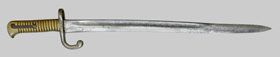
| Pictures (click to enlarge) |
Description | Blade Length |
Overall Length |
Muzzle |
Markings | |||
| in. | mm. | in. | mm. | in. | mm. | |||
 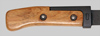   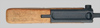 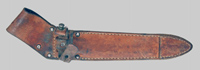  |
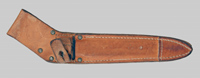
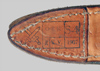
This is an example of the earliest type, with wooden grips, short tang, and no lower crosspiece extension.
Wooden (Beech) grips were only used during the first two years of production. This scabbard is made of smooth leather. |
6.75 | 171 | 11.25 | 286 | n/a | Ricasso: "D9460" and "30"
Scabbard: "13" in yellow paint on belt loop. Illegible marking on tip. |
|
 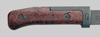  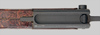 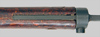   |
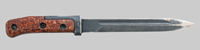
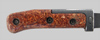
This example has the more common composition grip. The grip material is beech particleboard bonded with phenol formaldehyde resin. The grip was made in two halves, which were then bonded together with epoxy resin.
This example still has the short tang and is without the lower crossguard extension found on later examples. The grip scales are secured by two rivets. This scabbard is dated 1967 and is made of smooth leather.
|
6.75 | 171 | 11.125 | 283 | n/a | Ricasso: "M6382" and "11"
Scabbard: Crossed swords, followed by "OTK", "S-4", over "K", "K.V.", "1967" |
|
    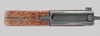 |
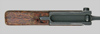
An example of the early, short-tang/no lower crosspiece type, with composition grip scales secured by three rivets. | 6.50 | 165 | 10.875 | 276 | n/a | Ricasso: "N 0253" and "11" | |
 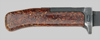 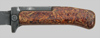    |
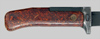
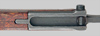
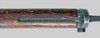
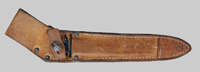
This example still has the short tang, but incorporates the lower crossguard extension.
Unusual variant using only epoxy to secure the composition grip scales. This was abandoned due to insufficient strength, which accounts for the relative scarcity of rivetless examples. The lower crossguard extension was adopted ca. 1970 to improve grip when dismounting the bayonet or using it as a hand weapon. |
6.625 | 168 | 10.875 | 276 | n/a | Ricasso: "N 3908" and "102" | |
       |
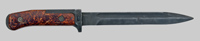
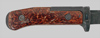
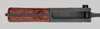
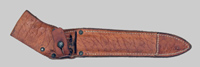
This example also has the short tang, but incorporates the lower crossguard extension. This variant has a single rivet securing the composition grip scales.
The scabbard on this example is unmarked and made of pebble-grain leather. |
6.75 | 171 | 11.125 | 283 | n/a | Ricasso: "Y 3864" and "442" | |
     |
Late-production variant with the full-length tang that protrudes beyond the grip scales. The grip scales are secured by two rivets.
The full-length tang was the final major design change, coming after addition of the lower crosspiece extension. It is unclear just when, but most probably in the mid-1970s. With the tang running full-length, the grip halves could no longer be epoxied together as had been done with the short tang bayonets. The scabbard on this example is made of coarse-grained leather. |
6.75 | 171 | 11.25 | 286 | n/a | Ricasso: "M8065" and "399"
Scabbard: Illegible marking on tip. |
|
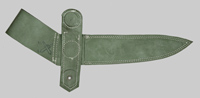 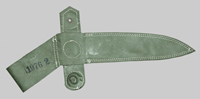   |
Green vinyl scabbard for use with the VZ–58 bayonet in nuclear, biological, and chemical (NBC) warfare environments.
This scabbard is part of the soldier's chemical warfare kit. The kit contains a vinyl suit, a vinyl magazine pouch, and a this vinyl scabbard. A special scabbard was necessary due to the difficulties encountered with decontaminating the absorbent all-leather scabbard, once exposed to toxic agents. |
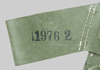
n/a | n/a | n/a | Front: "1976 2"
Reverse: crossed swords and "76" |
|||
| Top | ||||||||
| © Ralph E. Cobb 2009 All Rights Reserved | ||||||||