| Pictures (click to enlarge) |
Type | Description | Blade Length |
Overall Length |
Muzzle |
Markings | |||
| in. | mm. | in. | mm. | in. | mm. | ||||
 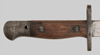      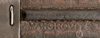 |
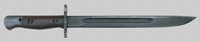
Pattern 1907 | Sword bayonet for use with the .303 caliber Short, Magazine Lee-Enfield No. I Mk. III (SMLE) rifle. The No. I Mk. III rifle was the Australian mainstay during both World Wars and afterward, until superseded by the L1A2 (FN-FAL) selective-fire rifle.
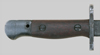
This example was produced in September 1941 at the Australian Small Arms Factory, Lithgow. Bayonet production at Lithgow began in 1913. The hooked lower quillon was deleted in 1915. Production ceased in 1927 and was resumed in late 1940. Bayonet production was moved from Lithgow to Small Arms Factory No. 3 at Orange in July 1942, where most of Australia’s Second World War bayonets were produced. The wood grips on this example are unmarked, consistent with early World War II Lithgow production. Lithgow's wood production equipment was moved to Slazenger Sporting Goods Co. of Sydney in 1941, where it remained until its return to Lithgow in the mid-1960s. Grips produced at Slazenger are marked “SLAZ”. The scabbard is of Second World War Australian manufacture, with the three exposed rivets securing the throatpiece. The endmount carries the Lithgow “MA” manufacturer’s mark. The leather scabbard body was produced by the Sydney-area tannery, Mangrovite Belting Pty. Ltd. Mangrovite began operation in 1913 and continued into the early-1990s. |
17.00 | 432 | 21.75 | 552 | .660 | 16.6 | Ricasso (left): "MA" over "1907" over "I"
over "9 41"
Ricasso (right): Broad Arrow acceptance marks, Viewer's (inspector's) marks, bend-test-mark (X) Scabbard (body): "Mangrovite" Scabbard (endmount): "MA" |
       |
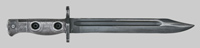
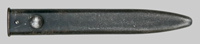
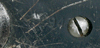
Owen Mk. I | Knife bayonet for use with the 9 mm. Owen submachine gun.
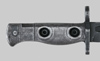
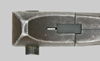
The Owen Mk. I bayonet is a Pattern 1907 newly-manufactured with a 10 in. (254 mm.) blade having a 5 in. (127 mm.) fuller. Owen Mk. I bayonets were manufactured at Small Arms Factory No.3, Orange in 1944–45 and at Lithgow Small Arms Factory in 1953. The wood grips were made by Slazenger and are marked with SLAZ and a two-digit year. The Owen Mk. I/I variant is an existing Pattern 1907 bayonet with the blade shortened to 8 in. These were converted at SAF-3, Orange in 1944, but are uncommon. Care must be taken to authenticate any example purporting to be an Owen Mk. I/I. The Owen scabbard is identical to the Australian-made Pattern 1907, but shorter to accommodate a 10 in. (254 mm.) blade. The scabbard bodies were made by Mangrovite and the steel mounts at SAF-3, Orange. This Owen Mk. I bayonet was made in January 1945 at SAF-3, Orange. The scabbard was made in 1953. |
10.00 | 254 | 14.875 | 378 | .665 | 16.6 | Ricasso (left): "MA" over "1907" over "1" over "1 45"
Ricasso (right): Broad Arrow, "X" (bend test), and "OA" Grip (right)" partial "SLAZ 44" Scabbard (top mount): "OA" Scabbard (body): "W" and "MA 53"
|
      |
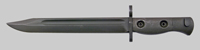
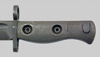
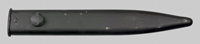
L1A2 | Knife bayonet for use on the L1A2 variant of the 7.62 mm. NATO caliber FN–FAL selective-fire rifle. This bayonet was also used on the 9 mm. F1 submachine gun.
L1A2 bayonets were manufactured 1957–1984 at Small Arms Factory, Lithgow. The earliest examples, such as this one, had the squared fuller like their British and Canadian counterparts. Australia changed to the unique rounded fuller in 1960. I had long thought this bayonet to be a Canadian C1, due to the square fuller. However, L1A1 Collector and Researcher, Kevin Adams, pointed out how the L1A2's assembly slot in the pommel is straight and the Canadian version is T-shaped, as shown in this comparison image. The scabbard is a wartime British No. 5 Mk. 1 body made by Wilkinson, paired with a post-War brass No. 5 Mk. 2 throatpiece. |
7.75 | 197 | 11.625 | 295 | .585 | 14.9 | Scabbard (body): S294 |
    |
L1A2 | This example is one of the more common later Australian L1A2 bayonets with the rounded fuller.
The Australian L1A2 scabbard has a more pointed appearance than the British No. 5 scabbard pictured above.
|
8.00 | 203 | 12.00 | 305 | .585 | 14.9 | None. |
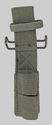 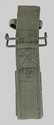  |
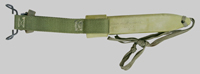
L1A2 Belt Frog | Olive green web belt frog for carrying the L1A2 bayonet.
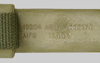
This frog was used by Australian troops to carry the L1A2 bayonet in Vietnam. Based on the Pattern 1937 frog, a U.S. M1910-style wire belt hanger was added below the existing belt loop, enabling the frog to be used with either Australian or U.S. web equipment. Australian forces served during the Vietnam War from 1966–72. Although long and heavy, compared to the U.S. M16, Australian forces favored the L1A2 for its reliability and the power of it's 7.62 mm. NATO cartridge. Measures 7.375 in. (187 mm.) long by 1.50 in. (38 mm.) wide. Carter classified this frog as #17 |
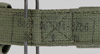
Reverse: Illegible markings and Broad Arrow. | ||||||
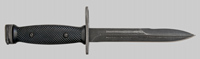 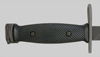      |
M7 | Knife bayonet for use with the 5.56 mm. NATO caliber F88 (Steyr AUG) assault rifle.
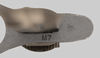
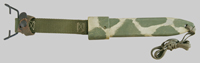
These were produced in 1991 by the General Cutlery, Inc. of Fremont, Ohio. They are Identical to the U.S. M7 Bayonet-Knife, save for the markings. Australian-contract M7 bayonets are simply marked “M7” and carry the Broad Arrow acceptance mark. The scabbard is manufactured by Hauser Products, Inc. of Chicago, Illinois. A variation of the U.S. M10 scabbard, being molded out of light green plastic with a green belt hanger (instead of black) with dark green paint in a camouflage pattern. The Australian-contract scabbard has the Broad Arrow molded into the front (instead of M10). Australia procured the M7 bayonet at the same time they contracted with Buck Knives to produce an Australian-contract version of the Multipurpose Bayonet System M9. Beyond that, little is known about their procurement. In January 1991, just before production was scheduled to commence, General Cutlery owner, Carleton Reitz, indicated that they planned to produce about 30,000 M7s for Australia. |
6.75 | 171 | 11.50 | 292 | .885 | 22.5 | Crosspiece (front): "M7" and Broad Arrow
Scabbard (front): Broad Arrow acceptance mark. Scabbard (reverse): "19204 ASSY 8448476" over "MFG 1Z803" |
| Back | Next | ||||||||
| Return to Bayonet Identification Guide Index | |||||||||
| © Ralph E. Cobb 2010 All Rights Reserved | Top | ||||||||