| Pictures (click to enlarge) |
Type | Description | Blade Length |
Overall Length |
Muzzle |
Markings | |||
in. |
mm. |
in. |
mm. |
in. |
mm. |
||||
   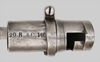 |
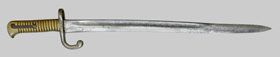
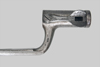
M1848 | Socket bayonet for use with the 16.9 mm. M1848 Tapriffel (Pillar Breech Rifle) and M1848–66 breech loading rifle (Snider Conversion).
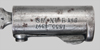
Originally manufactured in Liege for Schelswig-Holstein rebels, these rifles were taken by the Danish Government and altered at Kronborg 1853–55 for use by Danish forces. They were subsequently converted to the Snider breech loading system at Copenhagen in 1866. Bayonets were made in both Denmark and Belgium. The unit marking on the socket identifies the 20th Infantry Battalion, 4th Company, Weapon No. 136. |
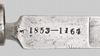
20.50 | 521 | 23.125 | 587 | .875 | 22.2 | Ricasso: "1853-1167" and "F"
Socket: "20 B. 4C. 146" |
   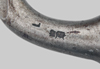   |
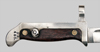
M1854 | Socket bayonet originally for use on the Dornbuchse M1849 rifles employed by Prussian-supplied Schelswig-Holstein forces rebelling against the Danish Govt. in 1849–1851. The rifles and bayonets were taken into Danish service and reissued as the Suhler Tapriffel Model 1854.
Unique locking spring designed by Johan Christian Wilken Kyhl (pronounced, 'cool') and first introduced in 1794. The Kyhl spring catch was used on Danish bayonets from 1794–1860 and also on bayonets made by Norwegian and Prussian makers. According to Per Holmback, noted authority on Scandinavian bayonets, approximately 12,000 of these weapons were taken over by the Danish Army after 1851 (from the Schleswig-Holstein rebels) and converted in 1854. The marking "SH XV B 186" stands for Schleswig Holstein 15th Battalion, Weapon 186. |
19.25 |
489 | 22.375 |
568 | .855 |
21.7 | Ricasso: Proofmark
Shank: German proofmarks Socket: "1855_4397" and "SH XV B 186" |
       |
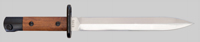
M1915 | T-back sword bayonet for use with the 8 mm. M1889 Krag-Jorgensen Rifle and Carbine.
Designated Kårdebajonet m/1915 (Sword Bayonet Model 1915), this T-back bayonet was used with the m/1889 Gevær (Rifle) from 1915–22; and beginning in 1923 and 1924 with the m/1889 Rytterkarabin (Cavalry Carbine), Ingeniørkarabin (Engineer Carbine), Fodfolkskarabin (Infantry Carbine), and Artillerikarabin (Artillery Carbine). The entire bayonet is a one-piece forging, save for the press stud. The wood grip scales are inset into the hilt and secured by flush brass rivets. The metal is in the white, although blued examples are also encountered. The scabbard is black leather with steel mounts. The topmount incorporates a spring locking device. Scabbards made of brown leather are also encountered. This example was made in 1917 at the Hærens Tøjhus (Army Arsenal) in Copenhagen. The serial number, 110013, corresponds to a M1889 Rifle or Carbine made in 1917. The unit marking, "2B.495" signifies the 2nd Infantry Battalion, Weapon No. 495. |
17.75 | 451 | 22.00 | 559 | .555 | 14.1 | Crosspiece (left): "110013"
Pommel (left): Crown over "17" Pommel (right): "2 B." over "495." |
 |
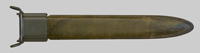
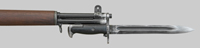
Madsen | Knife bayonet made during the 1950s by Compagnie Madsen, A/S, primarily for export sales of the Madsen Lightweight Military Rifle Model 1947.
Click on the photo to see a Madsen knife bayonet used by Colombia. |
8.187 | 208 | 12.562 | 319 | .610 | 15.5 | |
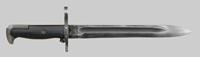      |
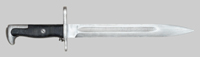
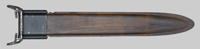
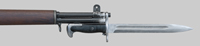
M1 | Knife bayonet for use on the caliber .30–06 M1 Garand rifle, designated Gevær m/1950).
Military Assistance Program (MAP) records document that the U.S. provided 69,808 M1 rifles to Denmark between 1951 and 1963. Denmark subsequently purchased an additional 20,000 M1 rifles produced in Italy. This example is a Second World War U.S. M1 bayonet, manufactured by the Union Fork and Hoe Co., Columbus, Ohio. The Danish-made scabbard copies the U.S. M7 scabbard, with the composition lower portion having a wood grain pattern instead of the U.S. M7's olive green. The scabbard body is made of Durofol, a laminated wood developed in Germany during the Second World War. It is made by impregnating beech veneers of 0.2 to 0.3 mm. thickness with 25 to 35 percent of a water-soluble phenolic resin cured under both high pressure and temperature. Post-War, Durofol KG, J. Brangs & Co. of Solingen became the exclusive manufacturer, which later became Durofol Presswerk GmbH. HMAK is an abbreviation of Hærens Materiel Kommando (Army Materiel Command). The HMAK marking was used beginning in 1969. |
9.75 | 248 | 14.375 | 365 | .640 | 16.3 | Ricasso: "U.F.H." over "U. ordinance bomb S."
Scabbard: "HMAK" |
      |
M1950 | Designated M1950, this example is a Danish copy of the U.S. M1 bayonet, made in 1955. Where these bayonet were produced has not been established. The likelihood is that they were made in Germany (perhaps by E & F Hörster).
FKF is an abbreviation of Førsvarets Krigsmateriel Førvaltning (Defense War Materiel Administration). This marking was used prior to 1960. HTK is an abbreviation of Hærens Tekniske Korps (Army Technical Corps). This marking was used 1960–69. The scabbard body is made of Durofol, a laminated product described under M1, above. |
9.75 | 251 | 14.625 | 371 | .620 | 15.7 | Ricasso: Crown over "FKF" over "1955"
Scabbard: Crown over "HTK" |
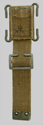  |
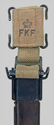
HTK Web Strap Belt Frog | Strap-type belt frog for securing the U.S. M7 scabbard (and it's Danish clone) to the Danish Army's British Pattern 1937 style web equipment belt.
The frog measures 8.00 in.(210 mm.) long by 1.625 in. (42 mm.) wide. This example is made of khaki green webbing and dates from the 1960s. |
n/a | n/a | n/a | Reverse" crown over "HTK" | |||
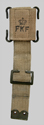 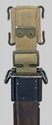  |
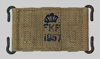
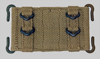
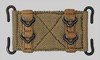
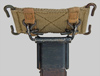
FKF Web Strap Belt Frog | An earlier, 1950s example, made of tan webbing.
It measures 8 in.(210 mm.) long by 1.625 in. (42 mm.) wide.
FKF is the abbreviation for the Forsvarets Krigsmaterial Forvalning (Defense War Material Administration). This marking was used prior to 1960. The images at left show the frog in use. |
n/a | n/a | n/a | Reverse" crown over "FKF" | |||
  |
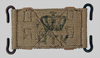
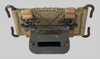
FKF Rectangular Belt Frog | Rectangular adaptor for securing the U.S. M7 scabbard (and it's Danish clone) to the Danish Army's British Pattern 1937 style web equipment belt.
This example is made of tan webbing. It measures 4.00 in.(102 mm.) wide by 2.25 in. (57 mm.) high. |
n/a | n/a | n/a | Reverse" crown over "FKF" over "1957" | |||
    |
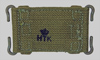
HTK Rectangular Belt Frog | This example is from the 1960s and is made of two different shades of tan webbing.
It measures 3.875 in.(98 mm.) wide by 2.125 in. (54 mm.) high. |
n/a | n/a | n/a | Reverse" crown over "HTK" | |||
 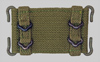 |
Olive Green HTK Rectangular Belt Frog | This example is from the 1960s and is made of olive green webbing.
It measures 4.00 in.(102 mm.) wide by 2.25 in. (57 mm.) high. |
n/a | n/a | n/a | Reverse" crown over "HTK" | |||
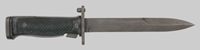 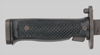  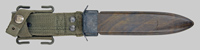 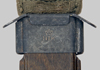 |
M1962 | Bayonet-knife used as a field knife by Denmark. Although it would mount to the M1 Garand rifle, it was typically issued as a field knife, to soldiers not armed with the M1 rifle.
The M1962 is a copy of the U.S. M5A1 bayonet, adopted by Denmark in 1962. Two production variants exist. both made in Germany. Early production is believed to have been produced by E & F Hörster. These had a peened pommel, as shown in the image at left. Later production had a smooth pommel and were marked "HMAK." These are believed to have been produced by Carl Eickhorn Waffenfabrik. According to Danish sources, 32,300 m/62 bayonets were procured. The scabbard is a copy of the US M8A1, employing a British-style belt fastener. The scabbard body is made of Durofol, a laminated product described under M1, above. HTK is an abbreviation of Hærens Tekniske Korps (Army Technical Corps). This marking was used 1960–69. |
6.625 | 168 | 11.25 | 286 | n/a | Pommel: Crown over "HTK" over "M/62"
Scabbard: Crown over "HTK" |
|
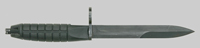   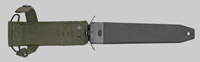 |
M1975 | Knife bayonet for use on the 7.62 mm. NATO caliber Gevær M/75 assault rifle. The Gevær M/75 is a variant of the German G3A3.
The blade is patterned after the U.S. M4 bayonet-knife. This example has the 10:30 press catch, however, examples may also be found with the 9 O'clock press catch. Three M1975 variations exist: Earlier scabbards had the British-style belt fastener, like the M1962 bayonet scabbard above. Later scabbards, like this example, had the U.S. M1910-style wire belt hanger. All Danish M1975 bayonets were made in Germany. This example was made by AES. However, early examples may have been produced by Carl Eickhorn Waffenfabrik, E & F Hörster, or another contractor. The flashguard marking, HMAK, is an abbreviation of Hærens Materiel Kommando (Army Materiel Command). The HMAK marking was used beginning in 1969. In 2009, British bayonet historian R.D.C. Evans published an excellent and comprehensive article on G3 bayonets that is available for download at no cost. Denmark purchased G3 rifles from Rheinmettal AG in Germany in the mid-1960s, designating them the Gevær m/66. The m/66 had a selector lock that required insertion of a special key to enable full automatic fire. In the mid-1970s, the Danes leased additional G3 rifles from Germany, designating them the Gevær m/75. The m/75 rifles were true selective-fire weapons. These were issued to the regular army and the m/66 rifles relegated to the home guard. The G3 was replaced in regular army service by the Diemaco C7 (M16) in the mid-1990s. |
6.75 | 171 | 12.25 | 311 | .875 | 22.2 | Flashguard: crown over "HMAK" |
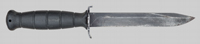        |
Feltkniv M/96 | Bayonet-knife used by Denmark exclusively as a field knife.
This is the Austrian Feldmesser 78, purchased by Denmark for use solely as a field knife. The blade and scabbard bear both the Glock trademark and Danish markings. This example has seen considerable use. The grip and scabbard are black. The scabbard is one-piece of molded plastic, with a belt hanger and a device that securely locks the bayonet into the scabbard. The little tab on the upper crosspiece serves as a bottle opener. This knife was designed such that it could be used as a bayonet with the 5.56 mm. NATO caliber Steyr AUG (Armee Universal-Gewehr) assault rifle. A socket in the pommel (covered by a plastic cap) engages a bayonet adapter that can be fitted to the rifle. Early Glock marketing materials show the bayonet mounted to an AUG rifle. |
6.4375 | 164 | 11.375 | 289 | n/a | Ricasso (right): "Danmark" over "M/96"
Ricasso (left): Glock trademark over "Austria" Scabbard (front): "Danmark" over "M/96" Scabbard (side): Glock trademark |
|
| Back | Next | ||||||||
| Return to Bayonet Identification Guide Index | |||||||||
| © Ralph E. Cobb 2009 All Rights Reserved | Top | ||||||||