| Country | Pictures (click to enlarge) |
Description | Length | Width | Markings | ||
| in. | mm. | in. | mm. | ||||
| Argentina | 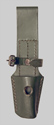 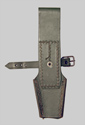 |
Green leather belt frog for carrying the M1909 Mauser bayonet.
Argentine collector-researcher, Gustavo Pablo Fierro, has greatly expanded the collecting community’s understanding of Argentine belt frogs. The Correaje Argentino de Cuero (Green Leather Belting) was introduced ca. 1970 and served until superseded by the nylon Correaje Tempex (Tempex Belting) by the mid-1980s. Although the change to Tempex equipment was well under way, the Green Leather equipment saw extensive use during the 1982 Falklands War. This example was intended for the Mauser bayonet. Later examples intended for the FAL bayonet had the left seam hidden (or tucked under) to allow the FAL Type A bayonet's flash-hider prongs to straddle the front piece. This frog was not classified by Carter. |
9.375 | 240 | 2.75 | 70 | None. |
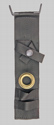 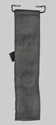 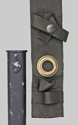  |
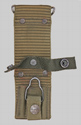
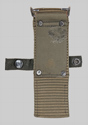
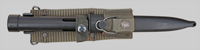
Nylon belt frog proposed by Tempex GmbH to the Argentine Navy for use with the FAL Type A and C bayonets, but was not adopted.
The body is made of material very similar to that used in automotive seat belts.The unusual brass grommet design secures the scabbard with the frog stud facing inwards. This frog was not classified by Carter. |
8.75 | 222 | 1.875 | 48 | None. | |
   |
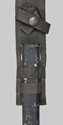
Olive green nylon web belt frog used with the FAL Type C bayonet.
The Correaje Tempex ((Tempex Belting) web equipment saw use during the 1982 Falklands War, although it had not yet completely superseded the Correaje Argentino de Cuero (Green Leather Belting). This is a clone of the Tempex GmbH frog, manufactured in Argentina. While Tempex frogs were used in the 1982 Falklands War, clones like this example were made later for issue to Argentine Forces. The quality of materials and construction on this example is far below that of the true Tempex frog. Monocrom S.A. was one of the Argentine manufacturers, however, there were other unidentified makers as well. This frog was not classified by Carter. |
7.00 | 178 | 2.187 | 56 | None. | |
| Australia | 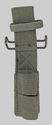 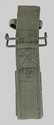 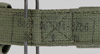 |
Olive green web belt frog for carrying the L1A2 bayonet.
This frog was used by Australian troops to carry the L1A2 bayonet in Vietnam. Based on the Pattern 1937 frog, a U.S. M1910-style wire belt hanger was added below the existing belt loop, enabling the frog to be used with either Australian or U.S. web equipment. Australian forces served during the Vietnam War from 1966–72. Although long and heavy, compared to the U.S. M16, Australian forces favored the L1A2 for its reliability and the power of it's 7.62 mm. NATO cartridge. Carter classified this frog as #17 |
7.375 | 187 | 1.50 | 38 | Reverse: Illegible markings and Broad Arrow. |
| Austria | 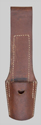 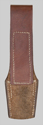 |
Tooled brown leather belt frog for carrying the M1895 bayonet.
This frog is classified as #29 by Carter. According to Carter, Austria, the Czechoslovak Republic, and Hungary all used the #29 frog. The vast majority are unmarked. These frogs are generally presumed Austrian, absent evidence that they are not. |
8.50 | 216 | 2.50 | 64 | None. |
| Belgium | 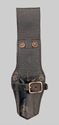 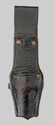 |
Dark brown leather belt frog for carrying the M1916 bayonet.
Constructed with four copper rivets, with large washers. Incorporates a securing strap with a plated steel buckle. The frog originally had a hilt strap, inside the belt loop. This example is missing the hilt strap. Carter classified this frog as #43, indicating that this frog was issued with the M1916 bayonet. |
8.00 | 203 | 2.375 | 60 | None. |
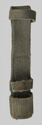 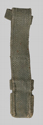  |
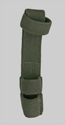
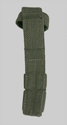
Post-war web belt frog that came on the M1924 Mauser Export bayonet. This frog could also be used with the FN Model 1949 and FAL bayonets.
Based on the British Pattern 1937 design, this frog is made of olive green cotton webbing. The upper scabbard loop is very narrow, measuring 0.625 in. (15.9 mm.) wide. The hilt strap floating loose inside the belt loop is characteristic of Belgian frogs. The hilt strap on this example was inserted through the existing belt loop and sewn together, so may be a repair. This frog was not classified by Carter. |
7.125 | 181 | 1.125 | 29 | None. | |
  |
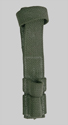
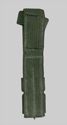
Post-war belt frog for use with the FN Model 1949 and FAL bayonets.
Based on the British Pattern 1937 design, this example is made of olive green cotton webbing. It has a unique reinforcement providing a double thickness of webbing on the reverse where the frog would contact the equipment belt. The wide hilt strap floating loose inside the belt loop is characteristic of Belgian frogs. This frog was not classified by Carter. |
6.75 | 171 | 1.125 | 29 | None. | |
  |
This frog is nearly identical to the frog above, except it is made of synthetic webbing. The synthetic thread sparkles in bright light.
This frog was not classified by Carter. |
7.00 | 178 | 1.25 | 32 | None. | |
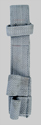 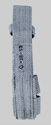  |
Post-War Pattern 1937 web belt frog in a blue-grey color.
This example appears to be post-War (1952) owing to the marking. The maker identified by "XB" is not known. This frog was not classified by Carter. |
7.50 | 191 | 1.25 | 32 | Reverse: "Broad Arrow and "XB-52" | |
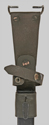 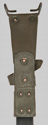 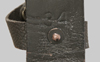 |
This unusual green leather belt frog came on a FN Model 1949 bayonet. The origin of this frog remains a mystery.
The frog was made for use with U.S. web equipment. The frog is constructed with 8 large copper rivets. The belt hanger and hilt strap are of pebble-grain leather. The belt hanger measures 2.125 in. (55 mm.) wide at the top. This frog was not classified by Carter. |
7.50 | 190 | 1.375 | 35 | Reverse: "34" | |
| Britain | 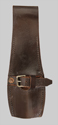 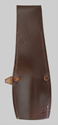 |
Brown leather belt frog for use with the Pattern 1907 bayonet.
Designated the Brown Leather Sword Bayonet Frog Mark II, this frog was adopted in 1912 for use at the Royal Military College at Sandhurst and the Royal Military Academy at Woolrich. The frog is constructed of brown leather, with a brass buckle and copper rivets. This pattern remained in use until 1969, when it was replaced by a white plastic frog. |
9.25 | 235 | 3.00 | 76 | None. |
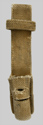 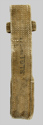 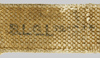 |
Pattern 1937 web belt frog made for carrying the No. 4 socket bayonet. This is representative of the typical Second World War web frog used by the British Army.
This is the second of the two P1937 subtypes that Carter classified as #154, with 1.25 in. (32 mm.) upper and lower loops. This example was made by the Blackman Leather Goods Co. Ltd. It was made with a finished slit in the upper loop for use with the No. 4 spike bayonet. Carter classified this frog as #154. |
7.25 | 184 | 1.25 | 32 | Reverse: "B. L. G. Ltd" and date (illegible) | |
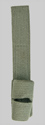 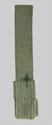  |
This Pattern 1937 web frog is a hybrid between the No. 5 and No. 6 Pattern 1937 belt frogs.
It has the two 1.25 in. (32 mm.) wide scabbard loops of the No. 5, but has no eyelet or hilt strap. This frog was not classified by Carter. |
8.00 | 203 | 1.25 | 32 | Reverse: Solid Arrow. | |
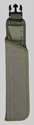 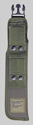  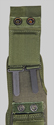  |
Olive green cloth-coated polyurethane over-scabbard for use with the L3A1 (SA80) socket bayonet.
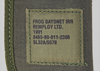
This frog completely encases the scabbard and has a Fastex connector that attaches the scabbard and frog. The frog is secured to the soldier's field equipment by two straps on the reverse that incorporate steel tabs, lift-the-dot fasteners, and Velcro. The fabric has an Infra-Red Reflective coating that makes the frog less visible when viewed through night-vision technology. This example was made in 1991 by Remploy LTD., a former sheltered-workshop for people with disabilities that, today, is a joint venture where the employees are part-owners of the company. Early L3A1 (SA80) frogs used brass clips to secure the frog to the soldier's equipment. However, attaching or removal of the frog required dismantling of the equipment. This later example's attachment system enables easy attachment and removal. This frog is also found in DPM (Disruptive Pattern Material) camouflage. This frog was classified by Carter as #480 |
13.25 | 337 | 2.75 | 70 | Reverse:
"Frog Bayonet IRR
|
|
| Bulgaria | 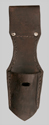 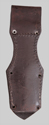 |
Brown leather belt frog for use with the M1895 bayonet.
The front appears to be a replacement piece. The back shows old rivet holes, while the front is only stitched. This frog was not classified by Carter. |
7.875 | 200 | 2.50 | 64 | Reverse: Rectangle |
| Canada | 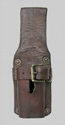 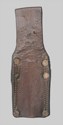 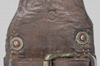 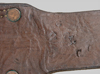 |
Pattern 1915 belt frog for use with the Pattern 1907 bayonet. This frog could also be used to carry the Pattern 1903 bayonet, as well as the Pattern 1888 bayonet, upon which this frog came.
Constructed of brown leather, secured by stitching and copper rivets. Incorporates a strap and large brass roller buckle. Carter classified this frog as #187. |
6.75 | 171 | 2.375 | 60 | Belt Loop (front): Canadian Broad Arrow acceptance mark, "6" and "22"
Belt Loop (reverse): randomly placed "6" "22" "L" "C" |
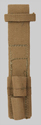 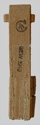 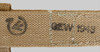 |
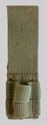
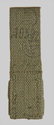
Pattern 1937 khaki web belt frog made for carrying the No. 4 socket bayonet.
This frog has the No. 4 scabbard eyelet formed by fabricating the upper loop from two pieces of webbing stitched together. This example was made in 1943 by the Granby Elastic Web Co. Ltd., Granby, Quebec. Granby Elastic Web was founded in 1910. A peacetime producer of elastic textiles, they produced military goods during both World Wars, finally closing in 1969. The frog measures 8.00 in. (203 mm.) long by 1.50 in. (38 mm.) wide. Carter classified this frog as #158. |
8.00 | 203 | 1.50 | 38 | Reverse: C-Broad Arrow and "GEW 1943" | |
  |
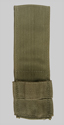
Pattern 1951 olive green web belt frog for carrying the No. 4 socket bayonet.
Carter classified this frog as #190. |
5.50 | 140 | 1.50 | 38 | Illegible maker's mark and "1952" | |
 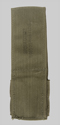 |
Green nylon web belt frog for carrying the C1 bayonet on Canadian Pattern 1982 Web Equipment.
Although the frog’s design closely mirrored the Pattern 1964 belt frog, this nylon belt frog was used with the Pattern 1982 Web Equipment. The NATO Stock Number is 8465-21-888-7106 and Description: Carrier, Bayonet Scabbard—Holder, Scabbard Bayonet (C1) 82 Web Carter classified this frog as #487. |
6.50 | 165 | 2.00 | 51 | Reverse: illegible marking | |
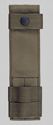 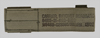 |
Green nylon web belt frog for carrying the C7 bayonet on Canadian Pattern 1982 Web Equipment.
The C7 bayonet introduced a lightweight plastic scabbard, which made the bayonet top-heavy when carried in the frog attached to the equipment belt. The addition of a hilt strap stabilized the bayonet during movement. The NATO Stock Number is 8465-21-896-8168 and Description: Carrier, Bayonet Scabbard—Carrier, Scabbard Bayonet (C7) 82 Web. This example was made in 2002. Carter classified this frog as #488. |
7.75 | 197 | 2.00 | 51 | Reverse:
"Carrier, Bayonet Scabbard 8465-21-896-8168 W8486-023385/002/PB 12/02" |
|
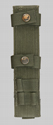 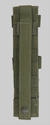 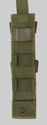  |
Green nylon web belt frog for carrying the C7 bayonet on the Canadian Forces Tactical Vest (TV). This frog may also be used to carry the C7 bayonet on an equipment belt.
The NATO Stock Number is 8465-21-920-5771 and Description: Carrier, Bayonet Scabbard. The Tactical Vest with which it is used was adopted ca. 2003. This frog was not classified by Carter. |
8.75 | 222 | 2.00 | 51 | Label:
"8465-21-920-5771 Bayonet Carrier/Porte Baionnette Date of Manufacture AT 09/06" |
|
| Denmark | 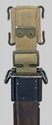 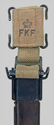 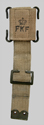 |
Strap-type belt frog for securing the U.S. M1 bayonet (and it's Danish clone, the M1950 bayonet) to the Danish Army's British Pattern 1937 style web equipment belt.
This is a 1950s example, made of tan webbing. The pictures at left show the frog in use. FKF is the abbreviation for the Forsvarets Krigsmaterial Forvalning (Defense War Material Administration). This marking was used prior to 1960. |
8.00 | 203 | 1.625 | 42 | Reverse" crown over "FKF" |
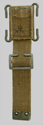  |
This example is made of khaki green webbing and dates from the 1960s.
HTK is the abbreviation for the Hærens Tekniske Korps (Army Technical Corps). This marking was used 1960-69. |
8.00 | 203 | 1.625 | 42 | Reverse" crown over "HTK" | |
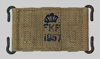 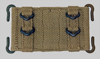 |
Rectangular frog adaptor for securing the U.S. M7 scabbard (and it's Danish clone) to the Danish Army's British Pattern 1937 style web equipment belt.
This example is made of 1950s tan webbing. |
2.25 | 57 | 4.00 | 102 | Reverse" crown over "FKF" over "1957" | |
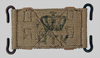 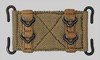 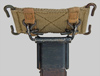 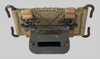 |
This example is from the 1960s and is made of two different shades of tan webbing. | 2.125 | 54 | 3.875 | 98 | Reverse" crown over "HTK" | |
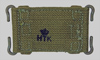 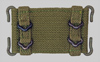 |
This example is from the 1960s and is made of olive green webbing. | 2.25 | 57 | 4.00 | 102 | Reverse" crown over "HTK" | |
| Ethiopia | 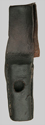 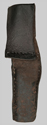 |
Brown leather belt frog used for carrying the British No. 5 Mk. I knife bayonet.
According to the seller, this frog came on a British No. 5 bayonet he had obtained from Royal Tiger Imports (RTI). RTI had recently brought in a trove of British and Italian rifles and bayonets from Ethiopia, so that is probably where this frog originated. Some of the stitching has rotted away in storage, but the leather is still pretty supple. This frog was not classified by Carter. |
7.25 | 185 | 1.875 | 48 | None. |
| Belt Frogs— Page 2 Page 3 | |||||||
| Return to Bayonet Identification Guide Index | |||||||
© Ralph E. Cobb 2009 All Rights Reserved |
|||||||