| Country | Pictures (click to enlarge) |
Description | Length | Width | Markings | ||
| in. | mm. | in. | mm. | ||||
| Poland | 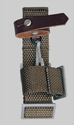 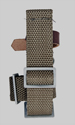 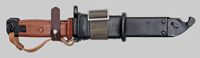 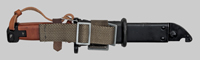 |
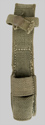
Brownish/Green nylon web bayonet frog to allow the 6H4 (AKM Type II) bayonet to be carried on modern MOLLE load bearing equipment.
The MOLLE load-bearing system is the western standard, variations of which are used by the USA, Canada (Tactical Vest), Britain, and many other NATO countries. MOLLE = MOdular Lightweight Load-carrying Equipment. Poland has modernized its military equipment significantly since joining NATO in 1999. The 6H4 bayonet is still the standard, used today with the 5.56 mm. NATO caliber karabinek szturmowy wz. 1996 Beryl (assault carbine pattern 1996 Beryl). Some 300,000 7.62 mm. Kalashnikov AKM assault rifles are still used by reserve forces, for training, and in war emergency stores. This probably influenced Poland’s continued use of the 6H4 bayonet. This frog was not classified by Carter. |
5.25 | 133 | 1.125 | 29 | None. |
| Portugal | 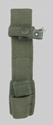 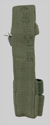 |
Web belt frog for carrying the FAL Type A and m/948 bayonets. Will also accommodate the M1904, m/937, and m/938 bayonets.
Based on the British Pattern 1937 frog, the Portuguese design incorporates a glove fastener on the hilt strap. This frog was not classified by Carter. |
6.50 | 165 | 1.187 | 30 | Illegible marking on reverse. |
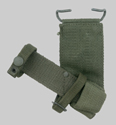 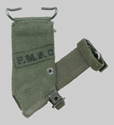 |
Web belt frog for carrying the FAL Type A and m/948 bayonets. Will also accommodate the M1904, m/937, and m/938 bayonets.
This design incorporates a belt hanger that positions the frog at a 45-degree angle. Portugal adopted this concept in the 19th Century, for use by horse cavalry. This modern frog was most likely intended for use by mechanized troops. According to author/researcher Martin Brayley, FMSC stands for Fábrica Militar de Santa Clara. FMSC was a government factory located in the Campo de Santa Clara district of Lisbon. This factory manufactured quartering material, equipment, leather goods, etc. In 1969, FMSC was absorbed into the Oficinas Gerais·de Fardamento e Equipamento (OGFE) [General Uniform and Equipment Workshops]. OGFE was abolished in 2014, having become outdated, inefficient, and unable to compete with private industry; resulting in unsustainable financial losses. The belt hanger measures 5.50 in. (140 mm.) long by 2.25 in. (57 mm.) wide. This frog was not classified by Carter. |
4.75 | 121 | 1.187 | 30 | Reverse: "F. M. S. C." | |
| Rhodesia (now Zimbabwe) | 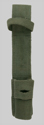 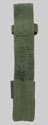 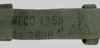 |
Pattern 1944 olive green web belt frog made for the post-War scabbards.
This example came on a FAL Type C bayonet used by the Rhodesian Army. According to South African collector, James D.N. MacKenzie, the RNG-Triangle mark represents Northern Rhodesian Government. This frog was made in 1956 by the Mills Equipment Company. AA2016 is the stores catalogue number. The AA prefix was always used for webbing. The frog measures 8 inches (200 mm.) long by 1 3/8 inches (35 mm.) wide. Carter classified this frog as #167. |
8.00 | 203 | 1.375 | 35 | Reverse: "MECO 1956" and "R" over "N G" inside a triangle and "AA2016" |
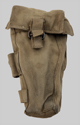 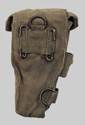 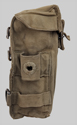  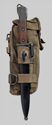 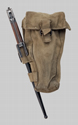 |
Web belt pouch with integral frog for carrying the FAL Type C bayonet.
According to Carter, Pattern 1961/64 web equipment was the production version of an experimental design, used prior to So. Africa's fielding of the Pattern 1970 web equipment system. The pouch is made of khaki webbing. The fittings are made of blackened brass. Carter classified this pouch/frog as #579. This example was made in 1962. The identity of the maker represented by "L.B. & D.I.F." is not known. However, "D.I.F." likely identifies D. I. Fram & Co. Ltd., a Johannesburg maker of South African webbing. Hopefully further research will clarify what "L. B." signifies and how the two relate. As the images at left illustrate, the pouch has one straight side and one tapered side. The frog is on the tapered side, with heavy blanket-stitching to reinforce the frog stud opening. This one-side-tapered arrangement resulted in the left and right side pouches not being interchangeable. The So. African seller indicated that this piece came from Rhodesia (now Zimbabwe). Collector/Researcher Wolfgang Roux confims that both Rhodesia and So. Africa used these, with the khaki version being used by Rhodesian forces and the olive green version used by So. African forces. Pattern 1961/64 webbing would have been used during the early phase of the Rhodesian Bush War, which began in 1964. |
8.00 | 203 | 4.00
& 2.00 |
102
& 51 |
Inside of Cover: "L.B.& D.I.F." over ? and "62" | |
| Romania | 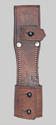 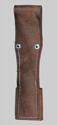 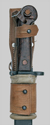 |
Leather belt frog for use with the AKM Type I knife bayonet. Heavy tan leather with hilt strap. The frog wraps around the scabbard’s rubber insulator and fastens with metal thorns.
This frog was not classified by Carter. |
7.75 | 200 | 1.875 | 48 | None. |
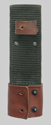 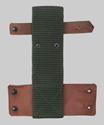 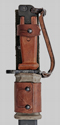 |
Hybrid canvas/leather frog for use with the AKM Type I knife bayonet. Dark Green canvas back, with tan leather front piece and hilt strap.
This frog was not classified by Carter. |
7.75 | 200 | 2.125 | 54 | None. | |
| Slovenia |    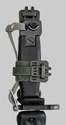 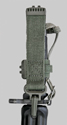 |
Web belt hanger for use with the AKM Type II bayonet.
This belt hanger is made of olive green webbing with integral plastic fasteners that secure the frog to the soldier's equipment and secure the hilt. A plastic clip secures the scabbard to the frog. This innovative modernization of the traditional AKM belt hanger was manufactured by the Slovenian firm Arex d.o.o. in Šentjernej. d.o.o. is an abbreviation of Druzba z omejeno odgovornostjo (equivalent to Limited Liability Company or LLC in the USA). Slovenia did not manufacture AKM bayonets. They primarily used the Yugoslavian AKM Type II bayonet, as pictured at left. This belt hanger was not classified by Carter. The Yugoslavian Wars began in Slovenia in 1991. When Yugoslavian Army forces attempted to seize key installations and border crossings, Slovenian forces responded very effectively, blocking the advance of Yugoslavian columns; repeatedly surrounding and laying siege to Yugoslavian troop concentrations. After just 10 days, Slovenian forces had taken over 4,600 Yugoslavian troops prisoner. Intense diplomatic action by the Europeans resulted in a cease fire and the securing of Slovenia’s independence. Yugoslavia was allowed three months to withdraw their remaining troops, however, were forced to leave their heavy weapons behind. This largely spared Slovenia from the decade-long series of civil wars that would devastate so much of Yugoslavia. |
6.25 | 159 | 1.00 | 25 | Fastener: "Arex" and "Pat. by Arex" |
| South Africa | 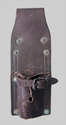 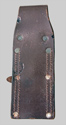 |
Dark brown leather belt frog for carrying the Pattern 1907 bayonet.
Carter classified this frog as #575. The rivets are steel, as is the roller type buckle. |
7.50 | 190 | 2.75 | 70 | None. |
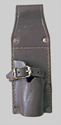 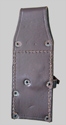 |
Dark brown leather belt frog with the cut away front section for carrying the British No. 9 Mk. I bayonet and the South African No. 9 bayonet. The socket faces to the right when carried.
Carter classified this frog as #577. Constructed with seven domed steel rivets. Incorporates a steel roller type buckle. According to Carter, these were worn by the South African Police. |
7.25 | 185 | 2.625 | 67 | None. | |
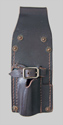 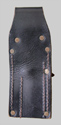 |
Brown leather belt frog with the cut away front for carrying the South African M1 bayonet, a variant of the FAL Type A bayonet.
Carter classified this frog as #576. Constructed with seven copper rivets. Incorporates a steel roller type buckle. |
7.50 | 190 | 2.75 | 70 | None. | |
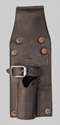 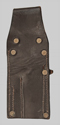 |
Brown leather belt frog with the cut away front and third row of front piece stitching for carrying the British No. 4 Spike bayonet. Constructed with seven copper rivets. Incorporates a steel roller type buckle. The front piece incorporates additional stitching to narrow the scabbard pouch vs. the M1 frog above. This frog was not classified by Carter. |
7.50 | 190 | 2.75 | 70 | None. | |
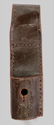 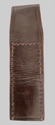 |
Brown leather belt frog for carrying the FAL Type B and S1 (Uzi submachine gun) bayonets.
This frog was not classified by Carter. This example came on a FAL Type B bayonet I obtained from South Africa. |
6.875 | 175 | 2.00 | 51 | None. | |
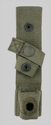 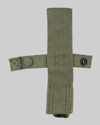 |
Olive green web belt frog used with the Pattern 1970 web equipment. Used for carrying the M1, R1, and S1 bayonets.
Carter classified this frog as #582. The distinctive frog stud opening is heavily overstitched. The frog slips over the equipment belt and is secured with a glove fastener facing the inside of the frog's belt loop. This equipment was used during the 1970s and 1980s. |
6.50 | 165 | 1.50 | 38 | None. | |
| Sweden | 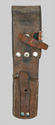 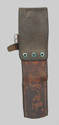  |
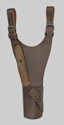
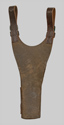
Leather belt frog for carrying the M1896 bayonet.
Carter classified this frog as #406. The "B" marking indicates modification to fit the wider m/59 equipment belt. |
9.25 | 235 | 2.375 | 60 | "B" on scabbard tab
(crown) over "T. 3" and (crown) over "I. 28" on inside of belt loop. |
  |
Dark brown leather belt frog worn by NCO's to carry the Swedish M1896 bayonet.
Carter classified this frog as #400. |
11.50 | 292 | 4.50 | 114 | None. | |
| Switzerland | 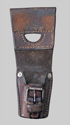 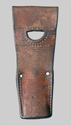 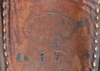 |
Leather belt frog for carrying the various Schmidt-Rubin bayonets. This example came on this M1889 bayonet.
Made in 1917 by Saddler Fritz Pauli, Biberist, Solorthurn Canton, Switzerland. Carter classified this frog as #410. |
7.375 | 187 | 3.00 | 76 | Reverse: "Fritz Pauli" over "Sattler" over "Bieberist" all inside an oval, over "17".
Also "Sch" over Swiss cross, inside a rectangle. |
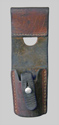 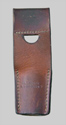 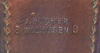 |
Leather belt frog for carrying the Stgw. 57 bayonet.
Made in 1989 by A. Bucher, Wolhusen. Carter classified this frog as #588. |
7.25 | 185 | 2.50 | 65 | Reverse: "A. Bucher" over "8 Wolhusen 9" | |
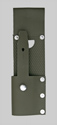 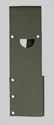  |
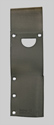
Plastic belt frog introduced in 1990 with the Stgw. 90 bayonet. It is also found with the Stgw. 57 bayonet.
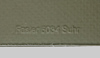
Constructed of plastic reinforced with cloth, using aluminum rivets and an aluminum frog stud. This undated example was made by the textiles firm of Werner Fasler, Tramstrasse 5, 5034 Suhr. Carter classified this frog as #589.
|
7.625 | 194 | 2.25 | 57 | Reverse: "Fasler 5034 Suhr" | |
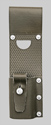   |
This example came on the Stgw. 90 bayonet pictured below. Unlike the example above, this example is dated as having been produced in 1991.
The frog was made by the Swiss firm Wechner AG, located in Arth. Wechner was a manufacturer of bags, suitcases, travel items etc., both of leather and imitation leather. The company was dissolved in 1998 and its assets liquidated. |
7.625 | 194 | 2.25 | 57 | Reverse: "Wechner AG" over "CH-6145 Arth 91" | |
| Turkey | 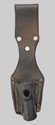  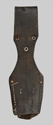 |
Leather belt frog modified for use with the No. 4 Mk. II bayonet.
This is a typical Turkish leather belt frog used with the M1935 bayonet that has been modified by stitching the front piece to better secure the small, round No. 4 scabbard. This frog was not classified by Carter. |
9.25 | 235 | 2.625 | 67 | None. |
| USA | 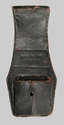 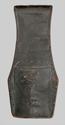   |
Leather belt frog for carrying the M1840 Non-Commissioned Officer (NCO) sword. Although not for a bayonet, this frog is so closely patterned after European bayonet frogs, it is sometimes mistaken as such.
This frog was adopted in 1868, when the Ordnance Department decided that leather would no longer be used for sword and bayonet scabbards. From that point forward, blackened steel scabbards were produced for the M1840 NCO sword. The steel scabbard had a frog stud, rather than the sword hanger loops used with the leather scabbard. This frog was also used to carry the M1840 Bandsman (Musician) Sword until the late 1890's. The bandsman sword was shorter than the M1840 NCO sword and lacked the handguard. Use of the NCO Sword was curtailed after 1875, being reserved for wear by senior staff NCOs (1st Sgt., Quartermaster Sgt., and Sgt Major) at regimental or general headquarters. As a result, these frogs are uncommon. This example was produced at Rock Island Arsenal (RIA). RIA started dating items after 1902, so this undated example likely pre-dates 1902. I don’t know how long the M1868 Sword Frog remained in service, but have observed one made at RIA that was dated 1907. A 1917 printing of the Ordnance Department’s publication, Horse Equipments and Equipments for Officers and Enlisted Men, revised July 3, 1908, still shows this frog in use. The “E.H.S.” marking identifies leather goods inspector, Emil H. Schmitten. According to the Rock Island Armory, Schmitten worked ca.1903–1905. However, the existence of this example demonstrates that he was likely working prior to 1902. |
7.00 | 178 | 3.125 | 79 | Front:"Rock Island" over "Arsenal"
Rear: "AC" over "E.H.S." |
| Yugoslavia | 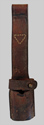 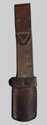  |
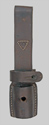
Brown leather belt frog for use with the M1924 and M1924Б bayonets. Yugoslavia designated this frog M1930.
This pre-Second World War frog has a long belt loop and a notch in the top edge of the frontpiece for the frog stud. The strap secures the scabbard to the frog. Carter classified this frog as #422. |
9.625 | 244 | 2.00 | 51 | None. |
 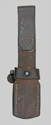  |
Brown leather belt frog for use with the M1948 bayonet.
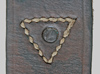
This post-War frog has a shorter belt loop than the M1924 and has a hole in the frontpiece for the frog stud. The strap secures the hilt to the frog. Carter classified this frog as #423.
|
8.625 | 219 | 1.875 | 48 | "BK" inside a circle, within a stitched inverted triangle. | |
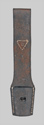 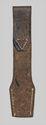   |
Brown leather belt frog for use with the M1956 submachine gun bayonet.
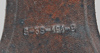
This frog was not classified by Carter. According to my Serbian collector friend, Nebojsa Milanovic, the Cyrillic “BK” inside the stitched triangle stands for Vojna Kontrola (Military Control). The official nomenclature number indicates that this frog was made in Kragujevac. He says that unmarked frogs also exist and they were made in a different factory. |
7.50 | 190 | 1.75 | 44 | "BK" inside a circle, within a stitched inverted triangle.
"S-38-191-9" |
|
| Unknown/ Unidentified | 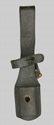 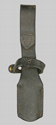  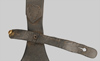 |
Brown leather belt frog that was advertised as Yugoslavian, but does not match known Yugoslavian frog patterns.
The long straight belt loop, triangle stitching, and brass thorn are consistent with known Yugoslavian frogs. However, the placement of the hilt strap and shape of the front piece are not. This frog was not classified by Carter. |
9.75 | 248 | 2.00 | 51 | None. |
 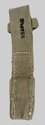 |
Olive green web belt frog that came on this South African FN–FAL Type C bayonet with an early FN-produced steel scabbard.
The frog exhibits characteristics of both the Portuguese Infantry Belt Frog and the South African Pattern 1970 Frog, but is not an exact match to either. This frog was not classified by Carter. |
7.50 | 191 | 1.375 | 35 | Reverse: illegible mark | |
| Return to Bayonet Identification Guide Index | |||||||
© Ralph E. Cobb 2009 All Rights Reserved |
|||||||