| Country | Pictures (click to enlarge) |
Description | Length | Width | Markings | ||
| in. | mm. | in. | mm. | ||||
| Germany | 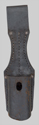 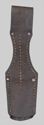 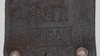 |
Brown leather belt frog for carrying the M1898/05 sword bayonet. This example came on this M1898/05 a/A bayonet.
Carter classified this frog as #267. According to Carter, The "BD III" marking, dated 1916, is referred to as a Garnitur (Clothing Mark). This mark indicates that the frog was issued by the Bekleidungs-Depot des III, Bayerischen Armee-Korps (Clothing Depot of the III Bavarian Army Corps), based near Nuremburg. It is possible that frogs were supplied to the Depot before being issued, rather than being made there. The frog is also marked to the Königliches Bayerisches Infanterie-Regiment, von der Tann“ Nr. 11 (11th Royal Bavarian Infantry Regiment, Von der Tann), which formed part of the III Bavarian Army Corps. |
9.25 | 235 | 2.625 | 67 | Frog (Reverse): "B1JR" over "149" inside a rectangle and "BD III" over "1916" |
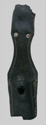 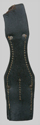 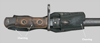 |
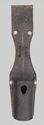
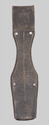
Brown leather belt frog for carrying the M1884/98 III knife bayonet.
Has 4 steel rivets and is of sewn construction, without a hilt strap. Carter classified this frog as #308. The maker and year marks have been worn away. However, Carter recorded production dates from 1939–43. This frog came on a Belgian M1916 Gendarmerie bayonet. The bayonet and frog had obviously been together a long time. This pairing suggests that it may have been issued to local Belgian "police" who helped maintain order during the German occupation. As shown in the images at left, there is some damage; and both the frog and the outward-facing wooden bayonet grip show evidence of charring. |
8.25 | 210 | 2.00 | 81 | None. | |
   |
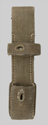
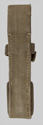
Brown leather belt frog for carrying the M1884/98 III knife bayonet.
Carter classified this frog as #311. This example was made by Gebruder Klinge of Dresden in 1937. The frog has four aluminum rivets and is of sewn construction. Hilt strap is missing. |
8.875 | 225 | 2.00 | 51 | Reverse: "Gebruder Klinge" over "Dresden" over "1937" | |
     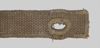 |
Web belt frog for carrying the M1884/98 III knife bayonet. Web frogs were used in North Africa by the Deutsche Afrika Korps (DAK) during the Second World War, because leather wouldn't hold up in the hot, dry desert climate.
Carter classified this frog as #316. According to Carter, the color of these frogs varied, with the earliest type being olive drab in color. As the Afrika Korps only existed for two years, these frogs are very scarce. Fakes are far more common than legitimate examples. This example came on this 1939 Elite-Diamant bayonet. |
8.375 | 213 | 1.625 | 41 | None. | |
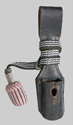 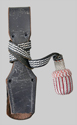  |
Black patent leather belt frog and Fire/Police troddel (knot). The troddel has a red striped ball, black strap with silver/red thread.
Carter classified this frog as #293. This was a very common frog, sold commercially for use with dress bayonets. This example came on this Third Reich Period Fireman's Dress Bayonet. |
8.00 | 203 | 2.00 | 51 | None. | |
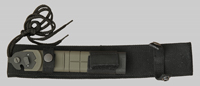 |
Black web frog for attachment of the B2K knife bayonet to MOLLE load bearing equipment.
The bayonet carrier is designed for use with the MOLLE = MOdular Lightweight Load-carrying Equipment load-bearing system, variations of which are used by many countries. In 2004, Jörg Eickhorn received a U.S. Patent on his bayonet frog, which he described as a Belt for a Multifunctional Tool. |
11.25 | 286 | 2.375 | 60 | None. | |
| Greece | 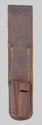 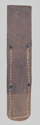 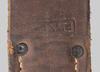 |
Brown leather belt frog for carrying the British No. 4 spike bayonet.
Greece was provided quantities of the .303 caliber Lee-Enfield No. 4 rifle for use during the Greek Civil War of 1946–49.
Has four steel rivets and is without a hilt strap. This frog was not classified by Carter. The marking "ΑΒΥΠ" are the Greek letters Alpha Beta Upsilon Pi, an abbreviation for Αποθήκη Βάσεως Υλικού Πολέμου. (War Materiel Base Warehouse). |
8.125 | 206 | 1.625 | 41 | Front: "ΑΒΥΠ" |
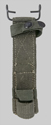 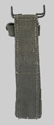 |
Olive green web belt frog for carrying the FN–FAL Type A and Type C bayonets.
Greece purchased FN–FAL rifles produced in Belgium and subsequently manufactured the FAL under license by the Greek firm PYRKAL (ΠΥΡΚΑΛ). FALs were used by the Greek Army and the Greek Coast Guard 1973–1999, before Greece adopted the German G3A3 in 2000. This frog was not classified by Carter. |
6.625 | 168 | 1.50 | 38 | None, | |
| Haiti | 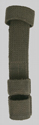 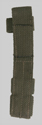 |
Green web belt frog used to carry the Uzi submachine gun bayonet.
This appears identical to the Post-war Belgian belt frog used with the SAFN 1949 and FAL bayonets. This further suggests that the Haitian Uzi bayonets were likely produced by FN Herstal. Based on the British Pattern 1937 design, this example is made of olive green cotton webbing. It has a unique reinforcement providing a double thickness of webbing on the reverse where the frog would contact the equipment belt. The wide hilt strap floating loose inside the belt loop is characteristic of Belgian frogs. This frog was not classified by Carter. |
6.75 | 171 | 1.125 | 29 | None. |
| Hungary | 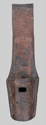 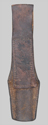 |
Brown leather belt frog for carrying the M1895 or M1935 bayonet. This example came on this M1935 Cavalry bayonet.
Carter classified this frog as #29. According to Carter, Austria, the Czechoslovak Republic, and Hungary all used the #29 frog. The vast majority are unmarked. The identification of this example as Hungarian is based on the fact that it came on a Hungarian bayonet and had obviously been on the scabbard for a very long time. |
8.50 | 216 | 2.50 | 64 | None. |
| India | 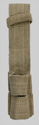 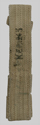 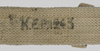 |
Pattern 1937 web belt frog for carrying the Pattern 1907 or No. 4 bayonet. Light Khaki color. This is the typical Second World War web frog used by the British Commonwealth.
This example is the first of the two subtypes that Carter classified as #154. This subtype has a 1.25 in. (32 mm.) upper loop and a 1.50 in. (38 mm.) lower loop. According to Graham Priest's book, Spirit of the Pike, Indian textile firms utilized a different species of cotton, which resulted in this rather coarse weave webbing. K.E.F. is believed to be a private firm, however, its identity is not yet known. Hopefully, further research will shed some light on this. |
1.50 | 38 | Reverse: "K.E.F. 1943" | ||
| Indonesia | 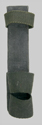 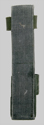 |
Web belt frog used by Indonesia on the SP.1 bayonet.
Although copied after the British Pattern 1937 frog, this is a most unusual variant.
The frog is constructed of three different types of webbing. The body is made from dark blue (or faded black) cotton. The scabbard loops are made from dark green cotton. The hilt strap is made from olive green nylon. This frog was not classified by Carter. |
6.75 | 170 | 1.25 | 32 | None. |
| Iran (Persia) |
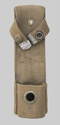 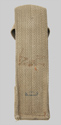 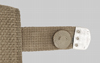 |
Web belt frog used by Iran on the G3 bayonet.
Constructed of tan webbing, the hole in the frontpiece is fitted with a tan-painted metal grommet. The hilt strap is secured by a stippled, tan-painted glove fastener patterned after those used by AES in Germany. This frog was not classified by Carter. |
6.75 | 170 | 2.00 | 51 | Illegible ink stamp. |
| Italy | 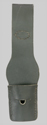  |
Green-gray leather belt frog used by the Italian Army during the Second World War for carrying the M1891 and M1938 bayonets.
Carter classified this frog as #337. |
9.375 | 240 | 2.75 | 70 | None. |
| Japan | 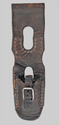 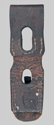 |
Leather belt frog for carrying the Type 30 bayonet used on the Type 38 and Type 99 rifles.
Carter classified this frog as #351. According to Carter, this type frog was probably made post-1940. An oval opening in the frog was to allow a cloth strap on the tunic to pass under the belt, through the frog opening, to a button on the uniform. This was supposed to keep the weight of the bayonet from pulling the soldier's belt down at the side. |
8.00 | 203 | 2.25 | 57 | None. |
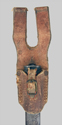 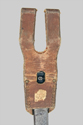  |
Composition belt frog for carrying the Type 30 bayonet used on the Type 38 and Type 99 rifles.
Carter classified this frog as #361. The frog is made of layers of cloth, impregnated with glue, as a substitute for leather. The frontpiece is attached with stitching and reinforced with rivets. However, the belt loops are formed using glue alone. Although in quite good condition, the frog is stiff as wood and can no longer be removed from the scabbard without damage. |
7.75 | 197 | 2.875 | 73 | None. | |
| Lithuania | 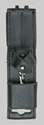 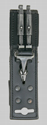 |
Leather belt frog for carrying the AKM Type II bayonet.
Lithuania did not manufacture bayonets. They used the Russian AKM Type II bayonet.
This frog is made of black leather, with an integral clip that secures the scabbard to the frog. The reverse features slide keepers, similar to those introduced by the USA with the M1956 Load-Carrying Equipment. This frog was not classified by Carter. |
7.75 | 197 | 1.875 | 48 | None. |
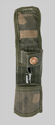 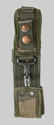  |
Leather belt frog for carrying the AKM Type II bayonet.
This frog is made of camouflage-pattern ballistic nylon, with copper glove fasteners. It has a very complex belt attachment. This frog was not classified by Carter. |
8.25 | 210 | 2.00 | 51 | Snap Closures: "Lift The Spot" | |
| Return to Bayonet Identification Guide Index | |||||||
© Ralph E. Cobb 2009 All Rights Reserved |
|||||||