| Pictures | Type | Description | Blade Length |
Overall Length |
Muzzle |
Markings | |||
  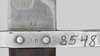    |
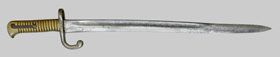
M1895 | Knife bayonet for use on the 8 mm. M1895 Mannlicher straight-pull rifle, which was produced in great quantities prior to and during the First World War.
The M1895 bayonet was the first knife bayonet to feature an inverted blade profile, where cutting edge faces upward when fixed. Made by Fegyver És Gépgyár Reszvenytarsasag (Weapons and Machinery Manufacturing Co.) of Budapest. The scabbard is a Frankenstein of sorts, with the body made by Moravske Ocelarny (Moravian Steelworks) and the frog stud a replacement salvaged from a scabbard by another, unknown, Austrian maker. |
9.625 | 244 | 14.125 | 359 | .590 | 15.0 | Ricasso (left): "F.G." over "GY."
Ricasso (right): Hapsburg Eagle Crosspiece (left): "38" and "2548" Scabbard (body): "MO" inside oval Scabbard (frog stud): Circle-Ü |
        |
35.M |
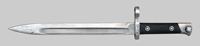
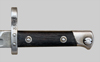
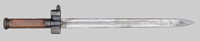
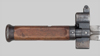
Bayonet for the 8 mm. Mannlicher Puska 35.M (Mannlicher Rifle Model 1935), adopted by Hungary, just prior to the Second World War. This bayonet also mounted to the 9 x 25 mm. Király / Danuvia Géppisztoly 39.M and 43.M (King / Danuvia Model 1939 and 1943 submachine gun).
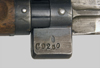
This example was made in 1940 by Femaru Fegyver És Gépgyár Reszvenytarsasag (Hardware, (Weapons, and Machinery Manufacturing Co.) of Budapest. This example is the cavalry variant, with an auxiliary front sight atop the muzzle ring. This bayonet utilizes the French Berthier crosspiece and press stud arrangement. However, the remaining features are quite unique. The flattened cruciform blade profile makes for a very stout blade, much stronger than a typical cruciform blade. The round pommel unscrews to allow replacement of the one-piece wooden grip. The rifle has a stud on front of the upper band, which inserts into the bayonet's pommel to secure the bayonet in place. The scabbards were painted a light green. A small amount of the original paint remains near the top, having been protected by the frog. |
13.375 |
340 | 18.875 |
479 | .600 |
15.2 | Crosspiece (left): "C 9250" over (Crown of St. Stephen)
Scabbard (frog stud): (Crown of St. Stephen) |
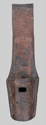 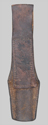 |
M1895 & M1935 Belt Frog | Brown leather belt frog for carrying the M1895 or M1935 bayonet. This frog came on the M1935 Cavalry bayonet above.
The frog measures 8.50 in. (216 mm.) long by 2.50 in. (64 mm.) wide at the widest point. Carter classified this frog as #29. |
n/a | n/a | n/a | None. | |||
 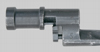   |
48.M (M1891/30) | Socket bayonet for use with the Puska M48 and the M53 sniper variant of the 7.62 mm. M1891/30 Mosin-Nagant rifle.
The M1891/30 was Russia's standard service rifle during the Second World War and was used extensively post-War by Warsaw Pact countries. Approximately 220,000 rifles were manufactured 1950–53 by Femaru es Szerszamgépgyár NV (Hardware and Machine Tools L.L.C.), making these bayonets somewhat scarce. The post-war Hungarian bayonets exhibit notably better workmanship than their Russian cousins and and a blued finish. |
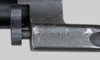
17.00 | 432 | 19.875 | 505 | .590 | 15.0 | Socket (right): "DG 2035" and inspection mark
Socket (left): "02" Press Stud: "02" |
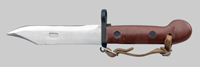 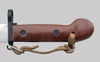 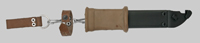  |
AKM Type I | Knife bayonet for use on the AKM variant of the 7.62 mm. Kalashnikov AK47 assault rifle.
Reddish-brown composition grip. Black steel Type I scabbard with a tan rubber insulator. Tan leather retention strap and belt hanger. The Hungarian belt hanger is unique, having a separate hilt strap and belt loop. These bayonets are typically found with the hilt strap present, but are missing the belt loop. I was able to obtain this original belt loop from a seller in Budapest. The leather belt loop measures 2.75 in. (70 mm.) long by 0.75 in. (19 mm.) wide. A copy of the Russian 6X3 bayonet, these were made 1963–1970 by Fegyver es Gazkészülékgyar (Hungarian Weapons and Gas Appliance Co.). This example is marked with the firm's commercial trademark, "F.E.G." |
5.875 | 149 | 11.125 | 283 | .695 | 17.7 | Crosspiece: "Made in Hungary F.E.G." |
| Back | Next | ||||||||
| Return to Bayonet Identification Guide Index | |||||||||
| © Ralph E. Cobb 2010 All Rights Reserved | Top | ||||||||