| Pictures (click to enlarge) |
Type | Description | Blade Length |
Overall Length |
Muzzle |
Markings | |||
| in. | mm. | in. | mm. | in. | mm. | ||||
     |
Model 98/29 |
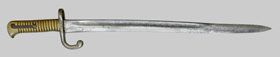
Sword bayonet used primarily with the 8 mm. Persian Mauser Model 98/29 rifle.
Persia (Iran) reportedly obtained Model 98/29 rifles from the Czechoslovak Reublic 1930–38 before the German occupation stopped deliveries. Initial shipments of bayonets to Persia (Iran) were existing Czechoslovak Army VZ–23 bayonets taken from Czechoslovak Army stores. Once the supply of serviceable VZ–23 bayonets were exhausted, Zbrojovka Brno produced new-made M98/29 bayonets to fulfill remaining export orders. Former Czechoslovak Army VZ–23 bayonets exported to Persia (Iran) had an edge-up blade profile and scabbard with the same frog stud as the Czech VZ–22 bayonet. New-made Model 98/29 bayonets exported to Persia (such as this example) had blades with a conventional edge-down profile and scabbard with a wire frog loop. Many examples have the Pahlavi Crest on the pommel end. This example has apparently had the pommel renumbered, obliterating the crest. Many books refer to this bayonet as VZ–23 "Long." However, the Czechoslovak designation was VZ–23. As this was the only Czechoslovak bayonet officially designated VZ–23, the "Long" suffix is superfluous. |
15.75 |
400 | 21.00 |
533 | .610 |
15.5 | Pommel: "9926 ?" in Farsi (? is a Farsi character. I just don't know what it means).
Scabbard: Circle-Z. |
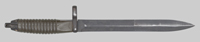    |
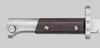
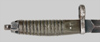
G3 | Knife bayonet for use on the 7.62 mm. NATO caliber G3 selective-fire rifle.
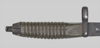
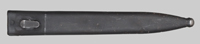
The Iran G3 bayonet differs from the German G3 bayonet in having a double-edged blade that is 2.50 in. (64 mm.) longer. It has the 12–groove plastic grip, however, olive green in color. The press catch is at the 9 O'clock position. It has the broad plain crosspiece of the early German G3 bayonet. The scabbard is crudely constructed of two halves of stamped sheet steel welded together. The throatpiece is spot-welded in place. The crudeness and construction methods suggest Iranian manufacture. The Shah adopted the G3A6 rifle in 1971. At some point, Iran began manufacturing the G3 at the State Arms Factory in Mosalsalasi. Production continued well into the Islamic Republic period. The G3 has been supplemented by AKM variants and clones of the Chinese clone of the U.S. M16 (go figure). Iran's smorgasbord of 7.62 mm. NATO, 7.62 mm. Soviet, and 5.56 mm. NATO caliber rifles would be a logistical nightmare, should Iranian forces ever have to conduct large-scale operations. In 2009, British bayonet historian R.D.C. Evans published an excellent and comprehensive article on G3 bayonets that is available for download at no cost. |
8.75 | 222 | 14.375 | 365 | .875 | 22.2 | None. |
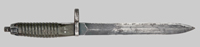  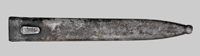 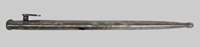  |
G3 | This example has seen very hard use. It was found in Iraq after the 2003 invasion that toppled Saddam Hussien.
Quantities of Iranian G3 rifles and bayonets have been captured in Iraq, suggesting that it could have been acquired during the Iran-Iraq War of 1980–88 or more recently smuggled into Iraq for use during the post-invasion insurgency. Given the hard use exhibited by this example, it more likely was an Iraqi souvenir from the Iran-Iraq War of 1980–88. |
8.75 | 222 | 14.375 | 365 | .875 | 22.2 | None. |
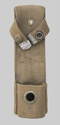 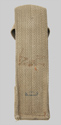 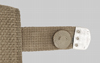 |
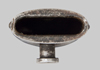
Belt Frog | Web belt frog that came with the G3 bayonet, pictured second above.
Constructed of tan webbing, the hole in the frontpiece is fitted with a tan-painted metal grommet. The hilt strap is secured by a stippled, tan-painted glove fastener patterned after those used by AES in Germany. The frog measures 6.75 in. (170 mm.) long by 2.00 in. (51 mm.) wide. This frog was not classified by Carter. |
n/a | n/a | n/a | Illegible ink stamp. | |||
| Back | Next | ||||||||
| Return to Bayonet Identification Guide Index | |||||||||
| © Ralph E. Cobb 2010 All Rights Reserved | Top | ||||||||