| Pictures (click to enlarge) |
Type | Description | Blade Length |
Overall Length |
Muzzle |
Markings | |||
in. |
mm. |
in. |
mm. |
in. |
mm. |
||||
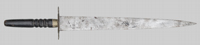 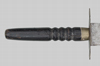 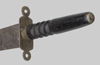  |
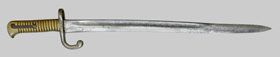
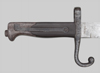
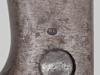
Plug Bayonet | European plug bayonet, possibly from one of Italy's sovereign city-states of the late 17th Century. I believe this bayonet is most likely military, due to its plain features. It has a double-edged, unfullered blade. The thin brass crosspiece has pierced finials. The ribbed wood grip is approximately .780 in. (19.8 mm.) diameter.
The ribbed grip tends to be more common on Italian plugs, although they are found on some others as well. It may be an 18th Century hunting piece, however, its utilitarian styling speaks of military origin. However, it is not one of the documented military styles, so it is unclear who made and used this particular bayonet. Surviving military plug bayonets are very scarce. Because of this, I may never be able to precisely identify or date this piece. |
12.125 | 308 | 16.875 | 429 | n/a | None. | |
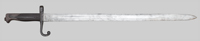      |
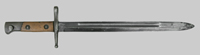
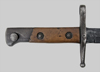
M1870 | Sword bayonet for use with the 10.4 mm. M1870 Vetterli and M1870/87 Vetterli-Vitali rifles. Also mounts to the 6.5 mm. M1870/87/16 Vetterli-Carcano rifle.
This example was made at Reale Fabbrica d' Armi di Torino (Arms Factory of Turin). This example has it's original composition grip scales. This variation, with the long spring and without the cut out lower muzzle ring, was once thought to have been introduced in 1875. However, this variation is now known to be the M1870/87 Tipo Regolamentare (Regulation Type). This model is contemporary to the 1887 Vetterli-Vitali rifle, which eliminated the lead guide that required the cut out lower muzzle ring. Many M1870 bayonets were subsequently shortened and/or had the lower quillon removed, making unaltered examples very desirable to collectors. |
20.25 | 514 | 25.375 | 645 | .690 | 17.5 | Ricasso (left): proofmark
Ricasso (right): proofmark and "Torino" Crosspiece: "DC 641" Pommel: "RC" inside an oval |
      |
M1891 |
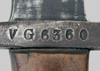
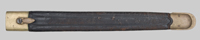
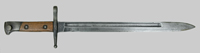
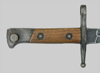
Knife bayonet for use on the 6.5 mm M1891 Mannlicher-Carcano rifles and most M1891 carbines.
This bayonet will NOT mount to the M1891 Cavalry Carbine (Moschetto da Cavalleria), 2nd model M1891 TS Carbine (Moschetto per Truppe Speciali), or the M1938 Short Rifle (Fucile Corto). These bayonets had nearly a 50 year service life. Scabbards can be leather with either brass or steel mounts, ribbed steel, or smooth steel. This example does not have any maker markings. |
11.875 |
302 | 16.375 |
416 | .510 |
13.0 | Crosspiece: "VG 6360" |
     |
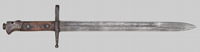
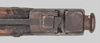
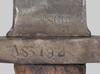
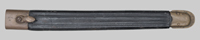
M1891 | This example was made at Fabbrica D'Armi Di Terni (Firearms Manufacturing of Terni) and has a ribbed steel scabbard. | 11.75 | 298 | 16.25 | 413 | .510 | 13.0 | Ricasso (Left): "Terni" inside an oval.
Crosspiece: "DF643" |
     |
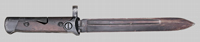
M1891 TS | Knife bayonet for use on the 6.5 mm. Mannlicher-Carcano M1891 TS Carbine (Moschetto Modello 91 per
Truppe Speciali or Carbine M1891 for Special Troops). M1891 TS Carbines were intended for Artillery and Engineers.
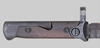
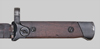
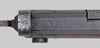
This bayonet is for use with the M1891 TS Carbine 2nd variant, which had a unique transverse bayonet lug requiring the bayonet to be placed over the muzzle, then slid sideways on to the bayonet lug from left to right. This arrangement required the bayonet's press stud to be at the rear of the pommel. The bayonet is sometimes referred to as the M1891/97, because the M1891 TS Carbine was first produced in 1897. However, this is a misnomer, as the the earliest TS Carbines had a conventional bayonet lug. The 2nd M1891 TS Carbine variant, with the unique bayonet mounting system, was first produced in 1900. This example was made at Fabbrica Nationale d'Armi, Brescia (National Arms Factory at Brescia). Based on the serial number, the carbine with which this example was last issued was made at Brescia in 1917. This rather odd mounting system was not continued on subsequent Italian bayonets nor was something similar produced by other countries. Many 2nd variant M1891 TS Carbines were subsequently converted to use the conventional M1891 bayonet, making surviving examples uncommon today. |
11.75 | 298 | 16.50 | 419 | .510 | 13.0 | Ricasso: "Brescia"
Crosspiece: "AS 5192" |
    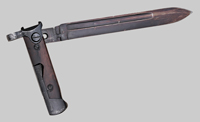 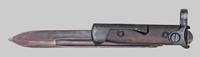 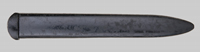 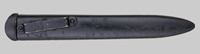 |
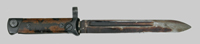
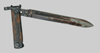
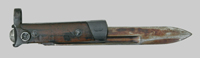
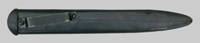
M1938 | Unique folding knife bayonet for use on the Mannlicher-Carcano M1938 Short Rifle (fucile corto). These rifles were produced in both 6.5 mm. and 7.35 mm.
Research by Dennis Ottobre published in the Society of American Bayonet Collectors (SABC) Journal, Volume 103, Spring 2018, identified five variants of the M1938 bayonet: three where the blade folds into the handle like a pocket knife and two which are fixed bayonets. This example is the first of the folding types, with the unusual latch-lock device for mounting the bayonet. The latch lock was replaced in subsequent variants by a conventional coil-spring press stud. The folding feature intended the bayonet to remain fixed to the rifle all the time. This did not work well in practice, so the folding feature was discontinued and a scabbard provided. Non-folding (fixed) variants include examples constructed using earlier folding bayonet parts and examples newly-made as fixed bayonets. Scabbards can be found with either a frog stud or steel belt loop (like this example). Most scabbards have a smooth steel body and steel throatpiece. However, uncommon examples also exist with a ribbed steel body or pot-metal throatpiece. |
6.875 | 165 | 11.375 | 289 | .505 | 12.8 | Tang: "PS" inside oval and "H9762" |
        |
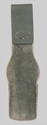
M1938 | This example is the more common second folding variant, with a coil-spring press stud for mounting the bayonet. | 6.875 | 175 | 11.375 | 289 | .505 | 12.8 | Tang: "PS" inside oval. "187" and small circle with raised "PB" |
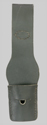  |
Belt Frog | Green leather belt frog used by the Italian Army during the Second World War for carrying the M1891 and M1938 bayonets.
9.375 in (240 mm.) long x 2.75 in. (70 mm.) wide. Carter classified this frog as #337. |
n/a | n/a | n/a | None. | |||
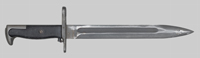       |
M1 | Knife bayonet for use on the caliber .30–06 U.S. M1 Garand rifle. This bayonet is an Italian-made copy of the US M1 bayonet.
The USA provided 122,185 M1 Rifles to Italy between 1950 and 1963 under the Military Assistance Program (MAP). Beretta and Breda also manufactured M1 Garand rifles and developed the BM59 selective-fire rifle. The scabbard is of Italian manufacture, patterned on the U.S. M7 scabbard. The scabbard has a web belt hanger, rather than the U.S. M1910-style wire belt hanger. |
9.625 | 244 | 14.125 | 359 | .625 | 15.9 | Ricasso (left): "78493"
Ricasso (right): "64" |
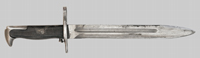 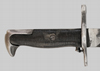    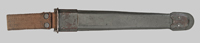 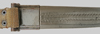 |
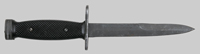
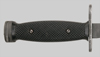
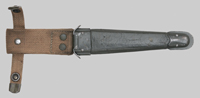
M1 | This example appears to be a marriage where the blade from one bayonet was welded to the hilt of another in order to produce a serviceable bayonet. As a result of the extensive reworking, any original markings have been removed.
The scabbard has a leather body, constructed similar to the M1871 and M1891 scabbards. The leather body and steel mounts are painted green. These are often said to be reworked M1871 scabbard bodies. However, the tapered profile differs from the M1871 leather scabbard bodies. These were more likely new-made, using machinery left over from wartime M1891 scabbard production. |
9.375 | 238 | 14.00 | 356 | .630 | 16.0 | Ricasso (right): "39" |
       |
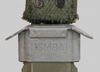
M4 | Bayonet-knife for use on the caliber .30 U.S. Carbine M1.
The USA provided 146,863 M1 Carbines to Italy between 1950 and 1963 under the Military Assistance Program (MAP). The M1 Carbine had a lengthy service life in Italy, well into the 1990s. Carbines remaining in Italian stores were returned to the USA in the mid-2000s and sold to collectors via the Civilian Marksmanship Program. This example is probably a U.S.G.I. bayonet that has been heavily reworked. Any markings it may have had are gone, the blade has been reground, and the peening on the tang is not U.S.G.I. The crosspiece profile is consistent with U.S. M4 Second Production, which differs significantly from the crosspiece profile of Italian M4 production (below). The scabbard has a leather body, similar to the M1 scabbard pictured above. The leather body and steel mounts are painted green. These are often said to be reworked M1891 scabbard bodies. However, the tapered profile is unlike any M1891 leather scabbard body. These were more likely new-made, using machinery left over from wartime M1891 scabbard production. The khaki tan-colored web belt hanger is patterned on the US M8A1 design. |
6.25 | 159 | 11.25 | 286 | .590 | 15.0 | None. |
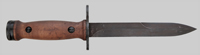 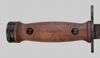     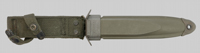  |
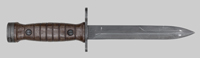
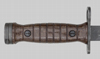
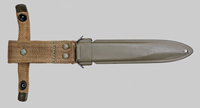
M4 | This example was made in 1955 at Arsenale Esercito Torino (Turin Army Arsenal).
Italy produced M4 bayonets from 1955–1960. Most were equipped with brown plastic grips that mimic the profile of the wartime U.S. leather grip. A very few examples have surfaced that have a smooth wood grip, as does this bayonet. Most of the wood grip examples observed have been dated 1955, so it may be that wood grips were used as a substitute in early production until the plastic grips were available. The crosspiece on Italian M4 production has a different profile than either U.S. M4 production variants. The U.S. M8A1 scabbard with this example was assembled at the Pennsylvania Working Home for the Blind 1965–68. The scabbard's M1910-style wire belt hanger has been deleted. |
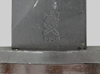
6.625 | 168 | 11.50 | 292 | .590 | 15.0 | Ricasso (left): "A.E.T." over flaming-bomb & crossed-canons over "1955"
Ricasso (right): "30186" |
      |
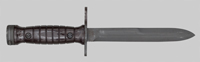
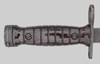
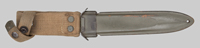
M4 | This example was made in 1958 at Arsenale Esercito Torino (Turin Army Arsenal).
The grip scales are the brown plastic type most common on Italian M4 bayonets. The workmanship on Italian M4 bayonets is quite good, in sharp contrast to the crudely-reworked U.S. bayonet above. The scabbard is an Italian-made U.S. M8 clone, with the body made of fiberglass with an olive green gel coat. The belt hanger is made of khaki tan cotton webbing. |
6.50 | 165 | 11.25 | 286 | .590 | 15.0 | Ricasso (left): "A.E.T." over flaming-bomb & crossed-canons over "1958"
Ricasso (right): "84378" |
     |
BM59 AR70 | Knife bayonet for use on the 7.62 mm. NATO caliber BM59 selective-fire rifle and 5.56 mm. NATO Caliber AR70 assault rifle.
Closely patterned after M4 bayonets produced at the Turin Army Arsenal, the crosspiece has a large muzzle ring to accommodate the BM59's "tri-compensator" muzzle device. Not much is known about the production of these bayonets. The BM59 had a very long service life with the Italian Army, finally being retired in 1990. The Italian Army began using the AR70 in 1979 and it continues in use to the present day. The BM59 was also used by Indonesia, where it was designated SP.1. Indonesia produced their own bayonet for use with the SP.1. |
6.625 | 168 | 11.50 | 292 | .870 | 22.1 | Scabbard (belt hanger): "30128" |
  |
BM59 AR70 |
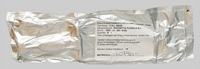
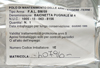
This example is still in its original package, dated June 1999. | n/a | n/a | n/a | See label image at left. | |||
| Back | Next | ||||||||
| Return to Bayonet Identification Guide Index | |||||||||
| © Ralph E. Cobb 2009 All Rights Reserved | Top | ||||||||