| Pictures (click to enlarge) |
Type | Description | Blade Length |
Overall Length |
Muzzle |
Markings | |||
| in. | mm. | in. | mm. | in. | mm. | ||||
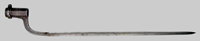 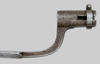 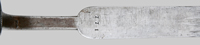   |
m/1815-26 Navy | Socket bayonet for the 18.55 mm. (.73 caliber) m/1815–26 Jaeger Musket, as used by the Swedish Navy.
The socket measures 2.50 in. (64 mm.) long, with a straight slot and basal locking ring. The heavy blade measures 1.00 in. (25.4 mm.) wide and has a crude face flute. This bayonet was originally made as the m/1815–26, with a 27.25 in. (695 mm.) overall length, for use by the Infantry Jaegers. Jaegers were light infantry, whose role was similar to today's special forces. The Jaeger musket was shorter than the infantry musket, so required a longer bayonet for defense against mounted cavalry. According to Per Holmback, noted authority on Scandinavian bayonets, in 1854 the Swedish Crown ordered 2000–3000 m/1815–26 muskets provided to the Navy. m/1815–26 bayonets were shortened 1855–56, to go with the Navy muskets, and this example appears to be one of them. This example carries the mark of Johan Mellberg, inspection armorer at the Götaland artillery regiment, stationed in Jönköping beginning in 1816. |
17.25 | 438 | 22.00 | 559 | .910 | 23.1 | Ricasso: "771"
Elbow (right): "IM" Elbow (face): 2 squares Socket: "I I/15" |
  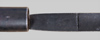      |
m/1855 | Socket bayonet for use with the 15.5 mm. (.61 caliber) Swedish Räfflat Miniégevär (Rifled Minie Gun) m/1855 and m/1856.
The m/1855 bayonet's medial locking ring represents a departure from the use of basal locking rings on Swedish socket bayonets. The socket length measures 2.625 in. (67 mm.). According to Per Holmback, 5000 bayonets were made for the army, with another quantity (unsure, perhaps 4000) for the Navy. This example is an Army bayonet, as it lacks a Navy (Flotten) property mark. The crown-M ricasso mark identifies this example as having been made by the Liege, Belgium, firm of P. J. Malherbe (who also made the m/1855 rifles). The leather scabbard is missing the endmount. What is present measures 20.75 in. (527 mm.) long. |
21.125 | 537 | 23.75 | 603 | .855 | 21.7 | Ricasso: Crown-M and "29".
Elbow (left): "I 2 77" Elbow (right): illegible mark Scabbard (body): "P" |
   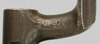 |
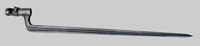
m/1860 | Socket bayonet for use with the 12.17 mm. m/1860 percussion rifle designed by Fabian Jakob Wrede. This bayonet was also used with the m/1860-64 Hagström breech loading conversion; and, the m/1860–68 and m/1860–64–68 Remington rolling block conversions.
This example was made in 1864 at Husqvarna Vapenfabrik. The m/1860 bayonet's heavy construction and long triangular blade simply dwarfs the U.S. M1873 socket bayonet, as shown in this side-by-side comparison image. The socket length measures 2.562 in. (65 mm.). Only about 20,000 m/1860 Wrede rifles were manufactured prior to adoption of the m/1864 Hagström needle-fire breech loader. About 4,000 Wrede rifles were altered to the Hagström breechloading system from 1864–66. Many of the m/1860 Wrede rifles and m/1860–64 Wrede-Hagström conversions were subsequently altered to the Remington rolling block system, using "kits" supplied by Remington. These were designated m/1860–68 and m/1860–64–68. The "AC" ricasso marking identifies Adam Carlsson, who was a Bayonetmaker/Master (Bajonettsmeder/mästare) at Husqvarna in the 1860s. As a Bayonetmaker/Master, he would have supervised the forging, welding, and grinding operations associated with bayonet production. Carlsson was born in 1807. He was a master of pistol production at the Jönköpings Factory in 1833; so had a long career by the time this piece was made. The "PJF" mark on the elbow identifies Peter Johan Fahlgren, who is recorded as a bayonet inspector of m/1860 and m/1867 bayonets at Carl Gustafs Stads Gevarsfaktori (Carl Gustafs City Rifle Factory). It is unclear how his mark came to be on a Husqvarna piece, perhaps, during repair. |
23.25 | 591 | 25.812 | 656 | .748 | 19.2 | Ricasso: "1841" over "H" over "1864" over "AC"
Elbow: "GG" and "PJF" |
  |
m/1867 |
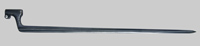
Socket bayonet for use on the 12.17 mm. m/1867 Remington rolling block military rifle.
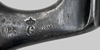
According to Per Holmback, noted authority on Scandinavian bayonets, M1867’s were manufactured in quite large quantities by both Husqvarna and Carl Gustaf Stad. They also bought 10,000 bayonets from Remington Arms. Co. of Ilion, New York, and this is one of those. The Remington order was delivered on September 2, 1868. The Remington made bayonet is recognized by the steel blade and iron socket. The Swedish-made bayonets were all steel. The iron socket measures 2.625 in. (67 mm.). The iron has a more porous surface than the steel of the elbow and blade. The weld line between the steel and iron is clearly visible in the lower photo. |
18.125 |
460 | 20.75 |
527 | .720 |
18.3 | None. |
     |
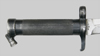
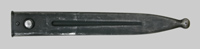
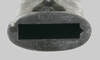
m/1867-89 | Socket bayonet for use with the 8 mm. M1867–89 rolling block rifle. This bayonet is a conversion of the M1867 socket bayonet used with the 12.17 mm. Remington rolling block rifle.
102,000 M1867–89 conversions were done 1889–1894 at Carl Gustafs Stads Gevarsfaktori (Carl Gustafs City Rifle Factory) in Eskilstuna. Based on the inspection markings, this example was produced during 1893 or 1894. The conversion entailed removing the old socket and brazing a new socket in place. The join is plainly visible. The M1867–89 socket bayonet is historically significant as the only socket bayonet to incorporate a coil-spring press stud. The socket measures 1.875 in. (48 mm.) long. The unit marking "27 RB No. 275" is an abbreviation for: Beväringsvapen Nummer 275, 27th Regementet (Weapon No. 275, 27th Infantry Regiment). The inspectors whose initials appear on this example are: Wilhelm Pontus Bruno, an inspection officer with Carl Gustaf Stad from 12/31/1892 – 1/19/1896; and, Gustaf Emil Miller, who worked at Carl Gustaf Stad from 6/20/1891 – ca. 1920. |
19.375 | 492 | 21.25 | 540 | .615 | 15.6 | Socket: "27 RB" over "No. 275"
Elbow (left): "7574" Elbow (right): "PB" Crown-C "GM" |
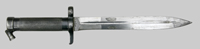       |
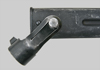
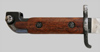
m/1896 | Knife bayonet for use on the 6.5 mm. m/1896 Swedish Mauser rifle. The m/1896 bayonet was also used with the m/1938 Short Rifle and AG42b Ljungmann self-loading rifle.
According to Scandanavian bayonet collector/researcher Per Holmback, M1896 bayonets were produced by: —Eskilstuna Jernmanufactur AB (1899–1912) Eskilstuna produced the first 280,000. A total of approximately 665,000 were produced by all three manufacturers. The earliest examples had a flat spring catch. This was replaced by a conical spring catch, by far the most common type encountered today. This example was made by the firm, Eskilstuna Jernmanufakur AB (Eskilstuna Iron Manufacturing, Inc.). The scabbard was made by the firm of Erik Anton Berg (EAB) of Eskilstuna. The unit marking on the crosspiece identifies the bayonet as belonging to Rifle #360, 5th company, 21st Infantry Regiment. |
8.375 | 213 | 13.25 | 337 | .615 | 15.6 | Ricasso: "EJ"(anchor)"AB" and (crown) over "416"
Crosspiece: "5/I 21" and "No. 360" Scabbard: "E.A.B." on throat. (crown) on ball tip. |
    |
m/1896 Scabbard Retainer | Retaining clip used to secure the bayonet in the scabbard. | n/a | n/a | n/a | Three crowns. | |||
         |
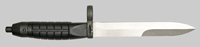
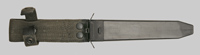
m/1914 | Sword bayonet for use with the 6.5 mm. M1894/14 Mauser Carbine. This bayonet also mounts to the 9 mm. Carl Gustaf Submachine Gun m/1945C (Kulsprutepistol m/1945C).
The odd hilt design gives away that this is a bayonet designed for a rifle that wasn't originally designed to mount a bayonet. In 1914, M1894 Carbines were altered by the addition of a nose cap that incorporated a bayonet mount. The hilt incorporates a locking device to secure the bayonet to the scabbard. This example is early production at Eskilstuna Jernmanufactur AB (Eskilstuna Iron Manufacturing, Inc.), as evidenced by the maker's trademark on the spine. Most were marked on the ricasso. It is not known when EJAB changed from marking the spine to marking the ricasso. Later examples produced by Carl Gustaf Stads were marked on the ricasso. This example is marked to the 50th Infantry Regiment, a so called dubbleringsregemente (double regiment) formed during the Second World War. |
13.125 | 333 | 18.125 | 460 | .625 | 15.9 | Spine: "E"-anchor trademark
Crosspiece (right): "I - 50" Crosspiece (left): "625" Tang (upper): crown Scabbard (throat): crowned-"C" Scabbard (ball finial): "149" and crown |
        |
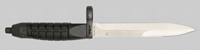
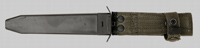
m/1965 | Knife bayonet for use on the 7.62 mm. NATO caliber AK4 (Automatkarbin 4) selective-fire rifle. The AK4 is a variant of the German G3A3.
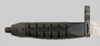
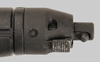
This example was made in 1968 by AB Bahco in Enköping. It has the 6-groove black plastic grip and broad-notched crosspiece. The press catch is at the 1:30 position. The blade is patterned after the U.S. M4 bayonet-knife and very finely made, being left in the white. The Bahco trademark is applied using an electropencil. The scabbard has a black plastic body with an angular tip. The scabbard incorporates a locking device to secure the bayonet in the scabbard. The belt hanger is made of nylon webbing. AB is an abbreviation for Aktiebolag, which is the equivalent of Corporation in the USA. Bahco is an acronym for "Bernt August Hjort & Co.," the firm's original name. Bahco is a manufacturer of hand tools, established in 1886. The firm's founder, Johan Petter Johansson, invented the plumber's wrench in 1888 and the adjustable wrench (i.e., crescent wrench) in 1891, both of which are still widely used today. Bahco is still in business, having been purchased by Snap-On Inc. in 1999. Beginning in 1966, Sweden produced the G3A3 under license by the national defence organization, Förenade Fabriksverken (FFV), at Carl Gustafs Stads Gevärsfabrik and Husqvarna Vapenfabrik. |
6.50 | 165 | 12.00 | 305 | .870 | 22.1 | Blade: Bahco trademark and "422 6 8 016"
Flashguard: 3 Crowns property mark |
        |
m/1965 | This example is from the second procurement of the m/1965 bayonet obtained from Carl Eickhorn Waffenfabrik AG of Solingen, West Germany, 1975–76.
This example was made in 1975. This must have been one of the final contracts fulfilled by Eickhorn prior to its bankruptcy. |
6.50 | 165 | 12.00 | 305 | .870 | 22.1 | Blade: Eickhorn Squirrel trademark and "593 75 009"
Flashguard: 3 Crowns property mark |
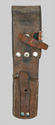   |
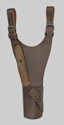
Belt Frog | Leather belt frog for carrying the m/1896 bayonet.
Measures 9.25 in. (235 mm.) long by 2.375 in. (60 mm.) wide. Carter classified this frog as #406. |
n/a | n/a | n/a | Frog: "B" on scabbard tab. (crown) over "T. 3" and (crown) over "I. 28" on inside of belt loop. | |||
 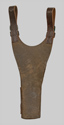 |
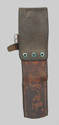
NCO Belt Frog | Dark brown leather belt frog worn by NCOs to carry the Swedish m/1896 bayonet.
Measures 11.50 in. (292 mm.) long by 4.50 in. (114 mm.) wide. Carter classified this frog as #400. |
n/a | n/a | n/a | None. | |||
| Back | Next | ||||||||
| Return to Bayonet Identification Guide Index | |||||||||
© Ralph E. Cobb 2010 All Rights Reserved |
Top | ||||||||