| Pictures (click to enlarge) |
Type | Description | Blade Length |
Overall Length |
Muzzle |
Markings | |||
| in. | mm. | in. | mm. | in. | mm. | ||||
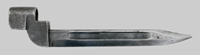     |
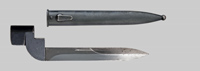
No. 9 Mk. I | Socket bayonet for use with the .303 caliber Lee-Enfield No. 4 rifle.
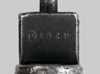
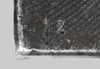
This example is a British No. 9 Mk. I, made in 1949 at the Royal Ordinance Factory, Poole. It is marked on the socket underside, with the government arrow inside a "U" property mark. The mark on this example is a less common type, with the arrow pointing downwards, rather than the proper (and more common) upwards arrow. Although observed on various equipment, it is not known how the downward arrow mark came to be used. |
7.75 | 197 | 9.875 | 251 | .595 | 15.1 | Socket (right): "J" arrow "2" (viewer's mark)
Socket (underside): "A" and "arrow-U" and "8" Ledge: “P” inside a small circle and "1949" |
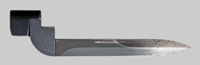    |
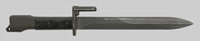
South Africa Pattern No. 9 | Socket bayonet for use with the .303 caliber Lee-Enfield No. 4 rifle. The South African blade profile differs significantly from the British No. 9 Mk. I bayonet pictured above.
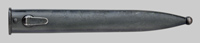
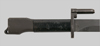
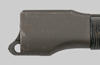
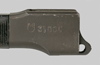
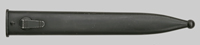
The bayonets were made by Armaments Corporation of South Africa (ARMSCOR), Lyttelton Engineering Works, in Pretoria. ARMSCOR is the State-owned arms manufacturer in South Africa. According to Skennerton, the bayonets were made up in the 1960's using blades salvaged from FN-made Uzi submachine gun bayonets (known in So. Africa as the S1 bayonet). However, it has not been conclusively documented whether old S1 blades were actually used or whether the S1 blade was just copied. The blade attaches to the socket with two steel pins. I was able to acquire an unassembled Uzi bayonet blade from a seller in Tel-Aviv, Israel, to compare with the S.A. No. 9. The Uzi blade is dimensionally identical to the blade of my S.A. Pattern No. 9, as shown in this comparison image. A close study also shows that, if the blade were used for the S.A. No. 9, the forward grip hole would need to be welded and ground flat, then two new holes machined for pinning the Uzi blade to the No. 9 socket. This also substantiates that it is entirely plausible that salvaged Uzi blades could have been used for manufacturing the S.A. No. 9 bayonet. The British No. 5 Mk. I scabbard would not work with the So. African No. 9 blade, so other scabbards were substituted. There was no dedicated S.A. No. 9 scabbard. The scabbard on this example is from a M1 bayonet, South Africa's variant of the FAL Type A bayonet. One of the pictures at left shows that the M1 scabbard is longer than necessary for the No. 9 blade. The nylon multipurpose R1 scabbard was also used with the So. Africa No. 9 bayonet. |
6.625 | 168 | 8.625 | 219 | .595 | 15.1 | None. |
     |
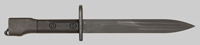
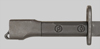
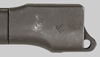
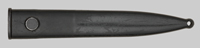
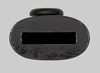
M1 (FAL Type A) | Knife bayonet for use on the 7.62 mm. NATO caliber Fabrique Nationale - Fusil Automatique Leger (FN Light Automatic Rifle or FN–FAL) selective-fire rifle.
The first South African FAL’s were purchased from FN ca. 1961 and designated M1. These first contract rifles were the early FAL without a flash suppressor, the same as the M2 FAL initially adopted by the Belgian Army. The FN-made South African M1 bayonet is parkerized and has ribbed black plastic grips. The South African "M" inside a "U" property mark represents "Union (of South Africa) Military. It also bears "SAP" on the pommel, signifying use by the South African Police. The first contract M1 rifles were much less numerous than the later second contract and R1 variants. When South Africa destroyed excess FN-FAL rifles during Operation Moulon in 2001, over 200,000 R1s were documented vs. only 3,700 M1s. |
7.75 | 197 | 12.375 | 314 | .595 | 15.1 | Pommel (right): "SAP"
Pommel (left): Superimposed "M" "U" and "31805" |
      |
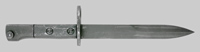
FAL Type B | Knife bayonet for use on the FN–FAL selective-fire rifles purchased from FN via a commercial contract for the South African Police. These rifles were equipped with the long Belgian "Browning-style" flash hider.
The Type B bayonet differs from the M1 bayonet in having a shorter blade, larger muzzle ring, and lacking the flash hider prongs. The long flash hider had a tendency to burst (i.e., banana peel). It was not popular, only being adopted in small numbers by Chile, Cuba, South Africa, and the West German Bundesgrenzschutz (Federal Border Guard). The T-48 FAL rifles used in the 1950s U.S. Army Trials that resulted in adoption of the M14 selective fire rifle were also equipped with the long flash hider and Type B bayonet. Not having been produced in large numbers, the Type B bayonet is uncommon today. This example bears a FN production mark on the tang, signifying manufacture by FN in the second quarter of 1962. It also bears a partial "SAP" on the pommel, signifying use by the South African Police. The scabbard has a plastic body with a round, flat metal frog stud. These are also observed on Uzi bayonets produced by FN for Israel and for export contracts. I obtained this example directly from South Africa. The scabbard was in the S1 leather belt frog pictured below. |
6.625 | 168 | 11.25 | 286 | .700 | 17.8 | Tang (upper): Reversed "2" with line over top and to left
Pommel: partial "SAP" |
 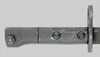 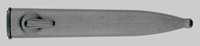 |
S1 (Uzi) | Knife bayonet for use with the 9 mm. Uzi submachine gun, designated S1 in South Africa.
The South African S1 bayonet has sheet steel grip scales. It used the multipurpose R1 scabbard, with a plastic body and integral teardrop frog stud; and a universal throatpiece allowing use with the R1, S1, FAL Type B, and S.A. No. 9 bayonets. Initially, Uzi submachine guns and bayonets were purchased from Fabrique Nationale d'Herstal (FN Herstal) in Belgium. South Africa subsequently obtained a license from FN Herstal to produce the Uzi at the state-owned ARMSCOR factory in Lyttleton. The license was supposedly revoked in 1963 following passage of United Nations Security Council Resolution 181, calling for a voluntary arms embargo against South Africa. Nonetheless, ARMSCOR continued producing the Uzi into the 1980s. According to a So. African contact, ARMSCOR made the S1 bayonet from 1968–1976. This example came in the Pattern 1970 Web Equipment belt frog pictured below. |
6.625 | 168 | 11.00 | 279 | .640 | 16.3 | None. |
 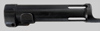   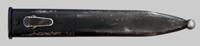   |
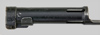
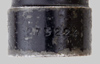
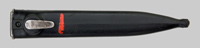
R1 (FAL Type C) | Socket bayonet introduced with the second contract FN-FAL selective-fire rifles procured from FN in 1963. These rifles had the 22 mm. NATO combo-device, so used the FAL Type C bayonet.
Subsequent FN-FAL rifles were produced under license at the State-owned arms factory, ARMSCOR, and were designated R1. These were the same configuration as second contract FN rifles. This example has an early FN-produced second contract steel-bodied scabbard, as evidenced by the Belgian proofmark on the throatpiece. The South African "M" inside a "U" property mark represents "Union (of South Africa) Military." |
6.75 | 171 | 11.50 | 292 | .890 | 22.6 | Socket: Superimposed "M" "U" and 113704"
Scabbard (throatpiece): "[1]" |
     |
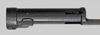
R1 (FAL Type C) | This R1 lacks South African property markings, however, has a uniquely South African scabbard.
This example is parkerized, with black paint over the parkerizing on the socket only. The scabbard is an unusual pattern believed manufactured in South Africa. It is unusual in having a shiny plastic body, a transverse leg-tie hole in the ball finial, and a steel frog stud. South African-made R1 scabbards have the throatpiece oriented so that the socket faces inward when carried. Other countries' FAL Type C scabbards had the throatpiece oriented so that the socket faces outward when carried. |
6.375 | 162 | 11.375 | 289 | .890 | 22.6 | Socket: "275224"
Scabbard (body): "66" in an oval |
     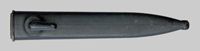  |
R1 (FAL Type C) | This R1 came in the nylon multipurpose R1 scabbard, with an integral teardrop frog stud and a universal throatpiece allowing use with the R1, S1, FAL Type B, and S.A. No. 9 bayonets. | 6.75 | 171 | 11.50 | 292 | .890 | 22.6 | Socket: Superimposed "M" "U" and "222912"
|
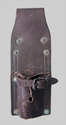 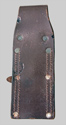 |
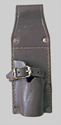
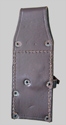
P1907 Belt Frog | Dark brown leather belt frog for carrying the Pattern 1907 bayonet.
The frog measures 7.50 in. (190 mm.) long by 2.70 in. (70 mm.) wide. The rivets are steel, as is the roller type buckle. Carter classified this frog as #575. |
n/a | n/a | n/a | None. | |||
  |
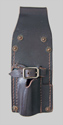
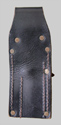
No. 9 Belt Frog | Dark brown leather belt frog with the cut away front section for carrying the British No. 9 Mk. I and South African Pattern No. 9 bayonets. The socket faces to the right when carried.
The frog measures 7.25 in. (185 mm.) long by 2.625 in. (67 mm.) wide. Constructed with seven domed steel rivets. Incorporates a steel roller type buckle. Carter classified this frog as #577. According to Carter, these were worn by the South African Police. |
n/a | n/a | n/a | None. | |||
  |
M1 Belt Frog | Brown leather belt frog with the cut away front for carrying the M1 bayonet.
Constructed with seven copper rivets. Incorporates a steel roller type buckle. The frog measures 7.50 in. (190 mm.) long by 2.70 in. (70 mm.) wide. Carter classified this frog as #576. |
n/a | n/a | n/a | None. | |||
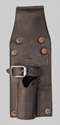 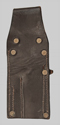 |
No. 4 Belt Frog | Brown leather belt frog with the cut away front and third row of front piece stitching for carrying the British No. 4 Spike bayonet.
Constructed with seven copper rivets. Incorporates a steel roller type buckle. The front piece incorporates additional stitching to narrow the scabbard pouch vs. the M1 frog above. The frog measures 7.50 in. (190 mm.) long by 2.70 in. (70 mm.) wide. The M1 (FAL Type A) bayonet pictured above came in this frog. However, South African collector/researcher Wolfgang Roux indicates this frog was made for use with the No. 4 spike bayonet. This frog was not classified by Carter. |
n/a | n/a | n/a | None. | |||
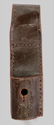 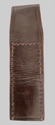 |
S1 Belt Frog | Brown leather belt frog for carrying the S1 and FAL Type B bayonets.
The frog measures 6.875 in. (175 mm.) long by 2.00 in. (51 mm.) wide. This frog was not classified by Carter. This example came on the FAL Type B bayonet pictured above. |
n/a | n/a | n/a | None. | |||
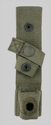 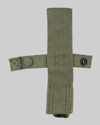 |
Pattern 1970 Web Belt Frog | Olive green web belt frog used with the Pattern 1970 web equipment. Used for carrying the M1, R1, and S1 bayonets.
The frog slips over the equipment belt and is secured with a glove fastener facing the inside of the frog's belt loop. This equipment was used during the 1970s and 1980s. The frog measures 6.50 in. (165 mm.) long by 1.50 in. (38 mm.) wide. The distinctive frog stud opening is heavily overstitched. Carter classified this frog as #582. |
n/a | n/a | n/a | None. | |||
| Back | Next | ||||||||
| Return to Bayonet Identification Guide Index | |||||||||
| © Ralph E. Cobb 2010 All Rights Reserved | Top | ||||||||