| Pictures (click to enlarge) |
Type | Description | Blade Length |
Overall Length |
Muzzle |
Markings | |||
| in. | mm. | in. | mm. | in. | mm. | ||||
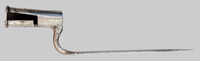 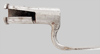   |
18th Century Socket Bayonet | Socket bayonet for an unknown musket.
Dating from the Mid-Late 1700s, not much is known about these scarce socket bayonets. This bayonet could be for a hunting musket or, perhaps, an officer's fusil. Sturdy 3.30 in. (84 mm.) socket with a crude hand-cut two step slot for a bottom stud. Wide double-edged blade with a flattened diamond profile. Blade width is 1.50 in. (38 mm.). Neat arrow terminal where the elbow joins the blade. This example has a couple of holes in the socket probably from mounting to a display. The socket has been flared at the rear, so perhaps, was mounted to a flagstaff. |
8.00 | 203 | 11.25 | 286 | .890 | 22.6 | None. |
 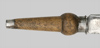  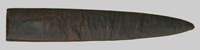 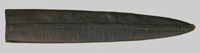 |
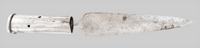
Plug Bayonet | Hunting plug bayonet, most likely dating from the mid-19th Century.
This bayonet once had a thin, flat steel crosspiece, which has been filed away. The grip is made of fruitwood [woods of fruit bearing trees in the Rose family (Rosaceae), such as apple, pear, peach, and plum]. The lower portion of the scabbard is present. This covers the edged portion of the blade, stopping just short of the ricasso. I suspect that "La-Cerena" may refer to La Serena, a community in the Exremadura region of Western Spain. Plug bayonets from this region of Spain are less common than those of the neighboring provinces of Toledo (to the East) and Andalusia (to the South). |
9.50 | 241 | 14.25 | 362 | n/a | Ricasso: "Camilo Acero" "La-Cerena" | |
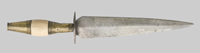 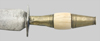 |
Peasant Knife |
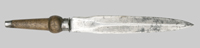
Small hunting or peasant knife that resembles a plug bayonet. Double-edged blade with brass and bone grip. However, the ovoid grip form was not used on plug bayonets.
Made ca. 1850 in the Alabcete region of Spain. At one time, these were thought to be plug bayonets, but are no longer classified as such. However, they are still sometimes advertised for sale as plug bayonets on eBay and other venues. |
5.75 |
148 | 9.00 |
229 | n/a |
None. |
|
     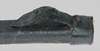 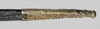 |
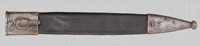
M1871 | Socket bayonet for use on the 11.5 mm. M1871 rolling block rifle.
In his book, Socket Bayonets of the Great Powers, Shuey indicates that M1871 bayonets made in the USA had 2.625 in. sockets, where the Spanish-made bayonets had a 3 in. socket. This is corroborated by Juan L. Calvó in his 2003 article (in Spanish), 24 Tipos de Cubo en Bayonetas Encontradas en España (24 Types of Socket Bayonets Found in Spain). This example has a 3.00 in. (76 mm.) socket. Calvó also indicates that the blade width of Spanish-made bayonets was 19.5 mm., where the USA-made bayonets had blades 20.5 mm. wide. The blade width of this example is 0.77 in. (19.5 mm.). Leather scabbard with a securing tab and brass endmount. |
21.50 | 546 | 24.50 | 622 | .680 | 17.3 | Socket: "84"
Ricasso: punch mark Blade: looks like letter "O" Scabbard (endmount): "H" |
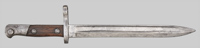 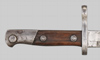   |
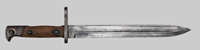
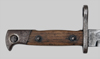
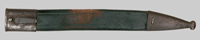
M1890 Trials | Knife bayonet used with 7.65 mm. Turkish-pattern M1890 Mauser rifles purchased by Spain for trials.
In his book, Armamento Reglamentario Y Auxiliar Del Ejercito Español, Libro N.° 3, Modelos Portatiles De Retrocarga 1855-1922 (Regulation and Auxiliary Armament of the Spanish Army, Book 3, Portable Breechloading Models 1855-1922), Spanish author/researcher, Juan L. Calvó, indicates that Spain purchased 1,200 7.65 mm. Turkish-pattern M1890 Mauser rifles from Germany pursuant to an order placed on December 2, 1891. Knife bayonets for these rifles were made by the Solingen firm, Weyersberg, Kirschbaum & Co. Designated Cuchillo Bayoneta Mauser Turco Model 1890, this bayonet became the pattern for the subsequent M1892/93 and M1893 bayonets. Trials with the M1890 rifles and bayonets were conducted by the Regimiento de Saboya N.° 2 (Savoy Regiment No. 2) and the Batallón de Cazadores de Puerto Rico No.° 19 (Light Infantry Battalion of Puerto Rico No. 19). These trials bayonets and the Argentine M1891 pattern bayonets (Bayoneta Mauser Filipinas) used by Spain's Fuerzas de Ultramar in the Philippines are the only Spanish Mauser bayonets documented as being produced by WKC. |
10.00 | 254 | 15.25 | 387 | .610 | 15.5 | Ricasso: "Weyersberg" over "Kirschbaum & Co" over "Solingen"
Crosspiece: "N364" |
    |
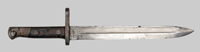
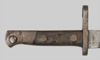
M1892/93 | Knife bayonet for use on the 7 mm. Spanish M1893 Mauser rifle made famous during the Spanish-American War of 1898.
Designated Cuchillo Bayoneta Modelo 1892/93, these were made by Simpson & Co. of Suhl, Germany, and also at Artilleria Fábrica de Toledo in Spain. The M1892/93 hilt was patterned closely after the German M1871/84 bayonet, with the distinctive "humpback" and pronounced pommel beak. The scabbard is leather with steel mounts. The small cross stamped on the crosspiece is the Santiago Cross or Cruz Espada (Sword Cross). |
10.00 | 254 | 14.875 | 378 | .610 | 15.5 | Ricasso: "Simpson & Co." over "Suhl"
Crosspiece: Santiago cross and "D8382" Lower Quillon: "F" |
    |
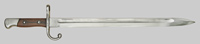
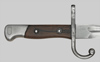
M1893 | Also for use on the 7 mm. Spanish M1893 Mauser rifle, the Cuchillo Bayoneta Modelo 1893 was made at Artilleria Fábrica de Toledo.
The M1893 hilt mirrored the M1890 Trials bayonet, eliminating the M1892/93's humpback hilt and pronounced pommel beak. The year of production was included with the maker mark through 1906, after which it was discontinued. The scabbard is leather with steel mounts. Spanish scabbards are constructed of two thin pieces of leather bonded together. With age, the bonding often goes away, which accounts for so many of the scabbards encountered today lacking stiffness. |
10.125 | 257 | 15.00 | 381 | .615 | 15.6 | Ricasso: "ARTILLERIA Fca DE TOLEDO" over "1898"
Crosspiece: "2A 00882" Scabbard: "42" on throat. |
   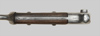  |
Philippine Mauser Bayonet | Sword bayonet used on 7.65 mm. Argentine M1891 Mauser rifles obtained by Spain and 7 mm. Spanish M1893 Mauser rifles supplied to Fuerzas de Ultramar (Overseas Forces) in Africa, Cuba, and the Philippines.
This Spanish bayonet is commonly referred to as the “Philippine Mauser Bayonet,” on account of its service there. It appears that there were two procurements by Spain involving these wood-grip sword bayonets. In 1893, Spain obtained 10,000 Argentine M1891 rifles and 5,000 carbines that had already been manufactured for Argentina, but not yet delivered. According to Calvó, bayonets for these rifles were supplied by Weyersberg, Kirschbaum, & Co. (WKC) of Solingen. These included both aluminum-grip M1891 bayonets, complete with Argentine markings; and an unspecified quantity of wood-grip M1891 bayonets that were not Argentine-marked. According to Webster's, Argentine Mauser Rifles, Spain secured immediate shipment of 5,000 rifles. These weapons were sent to Spanish Melilla and Cuba. There is no conclusive explanation for why wood grips were used on these bayonets. WKC may have been pressured to hastily assemble additional bayonets to supplement the Argentine M1891 bayonets already completed in order to reach the 5,000 required for immediate shipment. According to Calvó, in 1895, a Royal Order authorized the Maestranza de Artillería de Manila (Manila Artillery Arsenal) to procure 600 Spanish Mauser M1893 rifles equipped with sword bayonets from Ludwig Loewe & Co. The order further acknowledged the increased cost for substitution of sword bayonets for the knife bayonet. In his 2013 article, The Spanish “Philippine” Bayonet… and its Rifle, Hector J. Meruelo, shows images of Spanish Artillerists in the Philippines wearing these bayonets. These wood-grip bayonets are all marked with the WKC trademark and a small Santiago Cross. These wood-grip bayonets are all marked with the WKC trademark and a small Santiago Cross. Other markings may include a number on the lower tang and/or rifle serial number on the crosspiece. |
15.625 | 400 | 20.50 | 521 | .610 | 15.5 | Ricasso (left): "Weyersberg" over "Kirschbaum & Co." over "Solingen"
Crosspiece (left): Santiago Cross Tang (lower): "17" |
 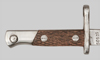    |
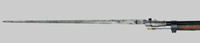
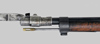
M1913 | Sword bayonet for use on the 7 mm. Mauser M1916 Short Rifle. Also designated for use with the 8 mm. Mauser M1943 Short Rifle.
This example was made at Artilleria Fábrica Nacional, Toledo, Spain. The maker marking on this example was instituted mid-1920, so the bayonet was made after that. The M1913 bayonet was one of only a few bayonet types to utilize checkered wood grips. The scabbard is leather with steel mounts. Adopted in 1913 as the Machete Bayoneta Modelo 1913, this bayonet was intended for a bayonet-equipped version of the M1895 Carbine proposed in 1913. However, with adoption of the M1916 Short Rifle in 1916, the M1913 bayonet was designated for use with it, instead, It was subsequently also designated for use with the M1943 Short Rifle. |
15.625 | 397 | 20.50 | 521 | .610 | 15.5 | Ricasso (Left): "Arilleria" over "Fca Nacional" over "Toledo" set inside a rectangle
Ricasso (Right): "92939" Crosspiece: "91" |
 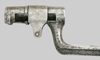 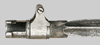    |
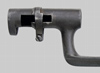
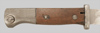
M1871/93 | Socket bayonet for use with the 7 mm. M1893 Mauser rifle. This bayonet is a conversion of the M1871 Remington rolling block socket bayonet.
It is not known when these non-regulation conversions were done. The most likely period seems to be during the Spanish Civil War of 1936–39. However, this is speculative. The number produced is unclear. Little is known about this uncommon socket bayonet. The conversion entailed removing the bridge; widening and lengthening the mortise; and adding a wide locking ring; all to accommodate the broad Mauser front sight base. The modifications are apparent in this comparison image. This bayonet is historically significant as one of only two socket bayonet types ever used with a Mauser rifle. Both were conversions, there never being a socket bayonet actually designed for use with a Mauser. The other Mauser socket bayonet is the Uruguayan M1871, a conversion of the British Pattern 1853 Enfield socket bayonet used with the 11 mm. M1871 Mauser rifle. |
21.75 | 552 | 24.625 | 625 | .685 | 17.4 | Elbow: "41?" |
    |
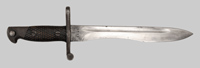
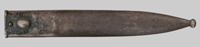
German Standard-Modell | Knife bayonet for use on the 8 mm. Mauser Standard-Modell short rifle. They were also used with the M1943 and M1944 rifles.
This is a German M1884/98 Third Pattern bayonet, the same as was used by the Wehrmacht. Spain received these from Germany during the 1930s. Calvó described this type as Cuchillo Bayoneta Standard Modelo Alemán (German Standard-Modell Knife Bayonet). Examples are found both with and without a flashguard. German-made examples with a muzzle ring are also encountered. This example was made without a flashguard and with metal in the white. It is completely unmarked, save for a single script "o" on the lower blade spine. The script-o is suspected to represent Ostmark (Eastern March), coined by German propaganda to re-name Austria as a German Province following Germany's Anschluss (annexation) of 1938, suggesting possible manufacture there. These unmarked but obviously German-production export bayonets, produced in violation of the Treaty of Versailles, are sometimes referred to as "sneak" bayonets. The scabbard originally furnished was identical to the German M1884/98 Third Pattern. However, the scabbard with this example is from a Spanish M1943 bayonet. These bayonets were not a standard Spanish bayonet (versión nacional), and apparently had no official model designation. |
9.875 | 251 | 15.00 | 381 | n/a | Blade Spine (lower): script "o" | |
      |
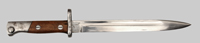
M1941 | Knife bayonet for use on the 8 mm. Mauser M1943 rifle.
Designed as a replacement for the M1907 Artillery Bolo, the Machete Bayoneta Modelo 1941, retains the M1907 Artillery Bolo's blade profile and heavy crosspiece for cutting vegetation. Short bolo knives such as this were horribly inefficient cutting implements and were universally hated by those who had to use them. These bayonets were produced at Fábrica de armas de Toledo (Toledo Arms Factory). Grips are typically of wood; however, plastic grips are also encountered. The fact that this was the standard bayonet used with the M1943 Short Rifle explains why these rifles are typically found with a Ricchieri Adapter pinned to the bayonet bar. |
9.625 | 244 | 14.375 | 365 | .615 | 15.6 | Ricasso (Left): (crown) over "FN" over "Toledo" Ricasso (Right): "4639" over "U" Scabbard: "4617" over "U" |
     |
M1943 | Knife bayonet primarily used with the 8 mm. Mauser M1943 rifle. They were also be used with the earlier Standard-Modell rifle.
Information and context regarding bayonets made for use with the M1943 and M1944 short rifles is drawn from two publications by Spanish author/researcher, Juan L. Calvó: Armamento Reglamentario Y Auxiliar Del Ejercito Español, Libro N.° 4, Modelos Portátiles de Repetición Automáticos Y Ametralladores 1922-1974 ... (Regulation and Auxiliary Armament of the Spanish Army, Book 4, Portable Automatic Repeater Models and Machine Guns 1922-1974 ...) and Bayonetas Españolas (Spanish Bayonets). Calvó’s chronology lists this type coming after the M1941, describing it as Cuchillo bayoneta Modelo 1943, fabricado en Toledo con destino a mosquetón Mauser Modelo 1943 (Model 1943 knife bayonet, manufactured in Toledo for the Mauser Model 1943 short rifle). He further indicates that the Cuchillo bayoneta Standard que en su versión nacional, marcada en Toledo, se asemeja al modelo polaco VZ-24, contando con ojo en la guarda (Standard-Modell knife bayonet in its national version, marked in Toledo, resembles the Polish Wz-24 model with a muzzle ring). M1943 rifles were reportedly made 1943–58. Many M1943 rifles were fitted with a bayonet adapter to allow use of M1941 bayonets instead. This type is sometimes described in collecting publications as M1936. However, it appears that these were not made until later. |
9.875 | 251 | 15.125 | 384 | .620 | 15.7 | Ricasso (Left): (crown) over "FN" over "Toledo"
Ricasso (Right): "694" over "J" Crosspiece: "U" Scabbard (throat): "56" |
      |
Spanish Standard-Modell | Substitute knife bayonet primarily used on the 8 mm. Mauser M1944 rifle.
They could also be used with the Standard-Modell and M1943 rifles.
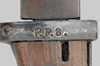
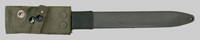
Calvó described this type as Cuchillo Bayoneta Standard Modelo Español (Spanish Standard-Modell Knife Bayonet). Copied from the German M1884/98, the blade is thinner and lighter. The method of construction is less robust than the German bayonets. The scabbard is patterned after the M1884/98, except that it has no visible throatpiece. The Spanish scabbard is narrower than the German scabbard. Calvó’s chronology lists these bayonets coming after the M1943 and refers to them as bayonetas ersatz, denominado de recuperaćion (substitute bayonets of the recovery). After the Spanish Civil War, Franco had quickly reduced the Army to a small peacetime force of 250,000. As World War II began to engulf Europe, in late 1942, Franco launched a large military expansion to 750,000 men. Spain adopted a modern rifle and bayonet (the M1943), but had limited capacity in their government factories. This expansion appears to have been the “recovery” that Calvó refers to as necessitating procurement of substitute bayonets. Calvó documented three substitute bayonet variations: Two were based on the M1884/98, having a straight pommel, and differing only by the presence or absence of a flashguard. Grips are typically of wood; however, Calvó documents that these are also rarely found with plastic grips (per Calvó, “Raramente este cuchillo bayoneta aparece con cachas de baquelita ...”) A third ersatz variation was based on the Polish Wz–24, having a slant pommel. The substitute bayonets are all devoid of maker markings (per Calvó, “... todos los modelos de recuperaćion... carece de marcas de fábrica.”). Being non-regulation substitutes, they apparently had no official model designation. The maker(s) and place of manufacture (Spain or imported) are unknown. |
9.875 | 251 | 15.125 | 384 | n/a | Crosspiece: ""P.R.8" and "5851" | |
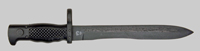      |
M1964 (CETME Model C) | Knife bayonet for use on the 7.62 mm. NATO caliber CETME Model C selective-fire rifle. Also used on the FR–7 and FR–8 training rifles.
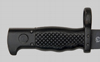
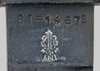
The first version of the CETME, designated Model 1958, did not mount a bayonet. These bayonets are often referred to as the M1969. However, according to Calvó, the official designation was Machete Bayoneta Modelo 1964. The M1964 bayonet has checkered plastic grips and an unfullered bolo blade. The scabbard has an integral web belt frog. This bayonet has a very unusual rectangular mounting slot. CETME is an acronym for Centro de Estudios Técnicos de Materiales Especiales (Center for Technical Studies of Special Materials). CETME was the Spanish government design and development establishment where German designer, Ludwig Vorgrimler, modified the German StG45(M) assault rifle to create the CETME. The two crests stamped into the blade are the Toledo Coat of Arms and the factory crest of the Instituto Nacional de Industria (INI), Empresa Nacional de Santa Barbara de Industrias Militares (in English, National Industrial Institute, National Business, Santa Barbara Military Industries). Santa Bárbara Sistemas was purchased from the Spanish Government by General Dynamics Corp. in 2001, who operated it until its closure in 2013. |
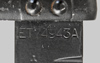
8.75 | 222 | 13.25 | 337 | .875 | 22.2 | Ricasso (Right): Toledo Coat of Arms
Ricasso (Left): "ET91467B" over Instituto Nacional de Industria (INI) Crest |
Click on the image to view information and additional images on the Guatemala Page. |
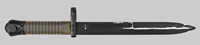
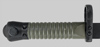
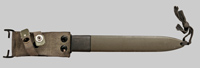
CETME Model C Export | Variant of the CETME Model C knife bayonet produced for export sales.
The CETME Model C export bayonet differs from the M1964 bayonet in the following respects: Absence of Spanish serial number; and, Black scabbard body (M1964 is green). They were produced at the Empresa Nacional de Santa Barbara de Industrias Militares (in English, National Business, Santa Barbara Military Industries) factory in Toledo, Spain. This example bears both the Fábrica de armas de Toledo (Toledo Arms Factory) and Santa Barbara crests. |
8.875 | 225 | 13.50 | 343 | .870 | 22.1 | Ricasso (Left): (crown) over "FN" over "Toledo"
Ricasso (Right): Santa Barbara Crest |
        |
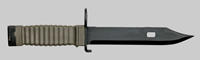
CETME Model L | Knife bayonet for use with the 5.56 mm. NATO caliber CETME Model L assault rifle, a Spanish variant of the HK33.
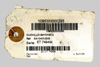
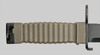
The CETME Model L superseded the 7.62 mm. NATO caliber CETME Model C rifle beginning in 1986. The CETME Model L was not well-liked and was reported to have performed poorly in the 1990–91 Persian Gulf War. Post-war attempts to reduce production costs exacerbated the rifle’s problems, leading to adoption of the Heckler & Koch G36 rifle in 1999 and the CETME Model L's eventual retirement. The CETME Model L bayonet's blade is patterned after the U.S. M4 bayonet-knife, but is 2.25 in. (57 mm.) longer than the more common H & K G3 bayonet. It has an 11–groove green plastic grip. It has a broad plain crosspiece secured by two domed rivets, similar to the Rheinmetall G3 bayonet. The blade, guard, and pommel are painted black. The scabbard is closely patterned after the M1964 scabbard. The CETME Model L bayonet was produced by the state-owned Santa Bárbara Sistemas factory, under auspices of the Instituto Nacional de Industria (INI). When I received this example, it still had the Spanish inventory tag attached. The tag included the bayonet's NATO Stock Number: 1095-33-000-0293 and Description: Cuchillo-Bayoneta (Knife-Bayonet). |
8.875 | 225 | 14.00 | 356 | .875 | 22.2 | Ricasso (Left): "ET74943A"
Blade (Left): Instituto Nacional de Industria (INI) Crest Blade (Right): Toledo Coat of Arms |
     |
G36 (KCB–77 M1/KH-JS) |
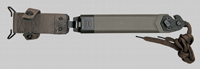
Knife bayonet for use with the 5.56 mm. NATO caliber G36E assault rifle (Fusil d'Asalto Mo. 36), adopted in 1999 to replace the problematic CETME Model L.
The G36E (export model) used by Spain has a NATO-specification bayonet lug, unlike the German Army (Bundeswehr) G36 bayonet developed on a trial basis by modifying the East German AKM Type II bayonet. Bayonets produced for Spain by the German firm A. Eickhorn GmbH, Solingen (AES) were issued NATO Stock Number 1095-12-353-9348 and designated Cuchillo de Bayoneta (Knife-Bayonet) KCB–77 M1/KH-JS. The AES model number suffix KH identifies products with the detachable scabbard, where the plastic body unclips from the belt hanger for wire-cutting, allowing the web belt hanger to remain in place. The meaning of KH has not been identified. The significance of JS has also not been identified, but may be je Spanisch (per Spanish) to identify the KCB–77 M1/KH variant produced for Spain. This example was produced under license by Aitor in Spain. This example is believed to have been made by Aitor before their bankruptcy in 2000. It has a high level of fit and finish, prolific markings, and a serial number in the grip. The highest serial number I have observed is 175, suggesting that the quantity produced was small. Aitor was purchased by Grupo Pieclu in 2003 and resumed KCB–77 bayonet production as Aitor-Pieclu. Aitor-Pieclu bayonet production has lower quality finish, carries only the Aitor trademark on the blade, and no serial number in the grip. German-made examples are distinctive in having AES’ characteristic plastic screwbolt in the grip. Examples produced by Aitor and Aitor-Pieclu lack the plastic screwbolt in the grip. The identity of the additional “E” trademark beneath the Aitor trademark is not known. The markings, C. Si. Mn. P. S., represent Carbon, Silicon, Manganese, Phosphorus, and Sulfur, common elements of spring steel alloy. Manganese combined with Phosphorus and Sulfur reduces brittleness. Silicon adds strength and helps steel return to its original shape after bending or twisting. |
6.75 | 171 | 12.00 | 305 | .870 | 22.1 | Ricasso:
Aitor Trademark Unknown Trademark "C. Si. Mn. P. S." "Bayoneta 988008" Grip: "00097" |
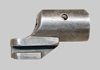 |
Ricchieri Adapter | Bayonet adapter designed by Argentine Gen. Pablo Ricchieri to allow use of M1893 style bayonets with later M1898 rifles. These are often found pinned to the bayonet lug of Spanish M1943 Short Rifles, to enable use of the M1941 and M1913 bayonets. | n/a | n/a | n/a | None. | |||
| Back | Next | ||||||||
| Return to Bayonet Identification Guide Index | |||||||||
| © Ralph E. Cobb 2010 All Rights Reserved | Top | ||||||||