| Pictures (click to enlarge) |
Type | Description | Blade Length |
Overall Length |
Muzzle |
Markings | |||
| in. | mm. | in. | mm. | in. | mm. | ||||
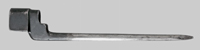 |
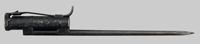
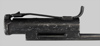
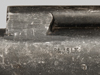
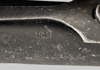
No. 4 Spike Bayonet | Socket bayonet for use with the caliber .303 Lee-Enfield No. 4 rifle. These saw extensive use during the Second World War and into the 1950s, when the Lee-Enfield was superseded by the 7.62 mm. NATO caliber FN–FAL selective-fire rifle. | 8.00 | 203 | 10.00 | 254 | .595 | 15.1 | |
       |
STEN Mk. I | Socket bayonet for use with the 9 mm. caliber STEN Mk. II submachine gun.
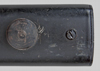
The STEN Mk. I bayonet was fabricated out of sheet steel and utilized a rod-style blade copied from the No. 4 Mk. II* socket bayonet. Although the STEN rod was of a larger diameter, this enabled the STEN Mk. I bayonet to use the existing No. 4 scabbard. Even more crude than the later No. 4 Mk. III bayonet, the STEN Mk. I represented the ultimate in Second World War bayonet simplicity. The firm of B. & J. Sippel Ltd. produced the sheet steel parts. Spikes marked with the lowercase ”L” are believed to be made by Laspee Engineering Co. of Isleworth. This example was assembled by the firm Grundy Ltd. of Teddington. The socket bears Grundy’s dispersal code, “S41”. The socket also bears a partial Broad Arrow acceptance mark. The large forward projection on the stamped spring steel catch serves as a fingerguard, so the bayonet can also be used as a hand weapon. 75,280 bayonets were believed produced during 1943–1944, 55,800 by Grundy Ltd. and 19,480 by N.J. Edmonds Ltd. Nearly all of the bayonets were believed scrapped, making period examples like this one quite rare today. Many reproductions and fakes have been produced, owing to the near unobtainability of period examples. Sippel, a German firm owned by two Jewish brothers, relocated from Germany to Sheffield in 1931. Sippel was a peacetime manufacturer of stamped cutlery that continued into the 1970s. Today, their old Sipelia Works factory is a homeless shelter. In his British patent filings up to 1940, Benno Sippel refers to himself as being of “German Nationality”; but his later filings read, “Stateless, formerly of German Nationality.” Post-War, Grundy Ltd. became manufacturers of inexpensive steel tanks and metal school lunch boxes. Their “cellar tanks,” used by pubs during the 1960s and 1970s to store and dispense cheap beer purchased in bulk quantities, became so ubiquitous that all such tanks became known as “Grundies.” Imported to the USA in the 1990s, these tanks fueled the American micro-brewery movement, as vessels for brewing the craft beers so popular today. In the USA, a small steel brewing vessel is still often referred to as a “Grundy.” |
8.00 | 203 | 12.00 | 305 | .740 | 18.8 | Socket: "B & J. S. Ltd" and "S41" and partial Broad Arrow
Blade: lowercase "L" Spring: " B & J. S. L" |
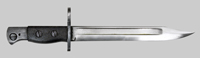 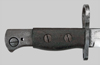      |
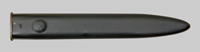
No. 5 Mk. I |
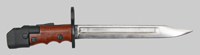
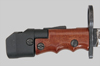
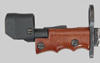
Knife bayonet for use on the .303 caliber Lee-Enfield No. 5 Mk. I rifle. The No. 5 Mk. I was also used with the 9 mm. Sterling L2 submachine gun.
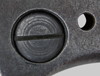
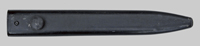
This example was made by the Wilkinson Sword Co. Ltd., 53 Pall Mall, London. The scabbard is the early No. 5, without the thick brass throatpiece found on post-war scabbards. Unlike most bayonets, the wooden grip scales wrap completely around the tang. Early examples have the grip secured by a single screw and a press stud without the screw slot. These early examples are very scarce today. 316,122 No. 5 Mk. I bayonets were produced by the end of 1945. Wartime production was carried out by four manufacturers: —Wilkinson Sword Co.—188,354 An unknown quantity were produced post-war at the Royal Ordinance Factory, Poole. No. 5 Mk. I bayonets were also commercially produced by Sterling Ltd. for sale with the 9 mm. Sterling (Patchett) machine carbine and at Rifle Factory Ishapore in India. Ishapore bayonets were made in small quantity. More recently, a large quantity of RFI-marked reproductions has surfaced. The vast majority of RFI-marked No. 5 Mk. I bayonets encountered today are reproductions. |
7.875 |
200 | 11.875 |
298 | .895 |
22.7 |
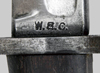
Ricasso (Left): "S294" over "W.S.C."
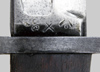
Ricasso (R. Side): Crown over "??" and "X" bending proof and broad arrow proofmark. Press Stud: broad arrow proofmark Wilkinson marked their No. 5 bayonets with the initials “W.S.C.” and/or their dispersal code “S294”. Viners marked theirs with “VNS” or their dispersal code “N79”. Radcliffe (about which very little is known) marked theirs with their dispersal code, “N187”. Elkington marked theirs with their dispersal code, “M78”. ROF, Poole marked theirs with a “P” inside a small circle. Sterling bayonets are marked on the blade with “Sterling” inside a rectangle. |
        |
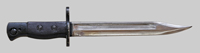
No. 7 Mk. I/L | The No. 7 Mk. I/L was a very innovative and complex design, with a unique swiveling pommel. Part knife bayonet and part socket bayonet, the No. 7 Mk. I/L would mount to the Lee Enfield No. 4 rifle and the Mk. V Sten submachine gun.
The No. 7 Mk. I/L (number seven, mark one, land service) was intended to address a number of desires: Despite all of it's ingenuity, the No. 7 Mk. I/L came to prove the old adage that a camel is a horse, as designed by committee. Although capable of mounting to the No. 4 rifle, these bayonets were not issued as such, only being used with the No. 4 rifle for ceremonial purposes. The grip scales are made of a resin impregnated cloth composite, Paxolin, and have deep finger grooves to allow use as a fighting knife. Examples are also found with black grips. 176,000 No. 7 Mk. I/L bayonets were produced. The design was perfected by the Wilkinson Sword Co., who produced 1,000 bayonets in 1944. Mass production was carried out by four manufacturers from 1945–1948: Birmingham Small Arms, Ltd. —25,000; This example was produced by Elkington & Co. of Birmingham. Elkington & Co. are one of the most important names in English silver and certainly the most important in silver plate - they invented the electroplating process in the 1830s. |
7.875 | 200 | 12.25 | 311 | .885
.595 |
22.5
15.1 |
Ricasso: "No. 7 Mk. I/L" and broad arrow proofmark and "M–78"
Pommel: "M–78" and broad arrow proofmark. B.S.A. marked theirs with their dispersal code, "M47B". Elkington marked theirs with their dispersal code, “M–78”. ROF, Poole marked theirs with a “P” inside a small circle. I haven't discovered ROF Newport's marking.
|
       |
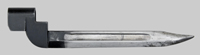
No. 8 | Knife bayonet for use with the 7.92 mm. Self-Loading Experimental Model (SLEM) rifle.
2,400 No. 8 bayonets were made at Royal Ordnance Factory, Poole in 1946 for use in rifle trials. The SLEM rifle was not adopted for service. The No. 8 bayonet uses many No. 5 bayonet parts in its construction. However, the No. 8 crosspiece has a smaller muzzle ring, positioned farther from the hilt than the No. 5 bayonet. The pommel was made by the Scottish Motor Traction Co. of Edinburgh, indicating that it was a No. 5 pommel taken from existing stores of spare No. 5 bayonet parts. |
8.00 | 203 | 11.875 | 302 | .580 | 14.7 | Ricasso: Circle-P and "1946"
Crosspiece: "29" Pommel: "SMT" in diamond and Broad Arrow and "F3" viewer's mark. |
 |
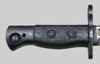
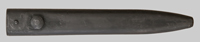
No. 9 Mk. I | Socket bayonet for use with the .303 caliber Lee-Enfield No. 4 rifle. | 8.00 | 203 | 10.125 | 257 | .595 | 15.1 |
|
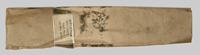 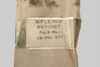 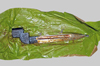 |
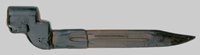
No. 9 Mk. I | This example is unissued, coated with PX4 mineral oil (grease), in a bright green waxed "primary pack" paper wrapper. | n/a | n/a | n/a | Label:
Rifle. No 4. |
|||
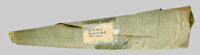 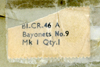  |
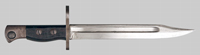
No. 9 Mk. I | This example is unissued, sealed in PX15 hard wax coating. The paper wrapper is waxed on the inside, but is not brightly-colored like the previous example. This preservation method was used only briefly, during the 1980s, but proved too costly. | n/a | n/a | n/a | Label:
BI. CR 46A |
|||
    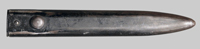  |
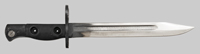
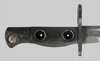
Sterling Submachine Gun | Knife bayonet for use on the 9 mm. Sterling L2 submachine gun manufactured by Sterling Armaments Co. for export.
The Sterling L2 was widely exported, with 400,000 produced before production ceased. Sterling went bankrupt in 1988. Loved for its reliability, the Sterling first entered British service in 1944 (as the Patchett machine carbine) and served British forces until 1994. Closely patterned on the No. 5 Mk. I bayonet, these bayonets were commercially produced for Sterling by Hopkinson Ltd. This is an early example that used the No. 5 blade and wood grips secured by screws. Sterling briefly produced a variant with riveted plastic grips, but found them unsatisfactory. Later examples used the L1 Series blade and riveted sheet steel grips, with rivet spacing identical to the L1 Series bayonets. Many Sterling bayonets lack the clearance hole in the pommel or exhibit only a witness mark of where it would be, if drilled. While the etched Sterling windowpane blade marking is found on many examples, some earlier examples like this predate its adoption. The scabbard is a copy of the No. 5, but has a more crudely shaped point. This example appears to have actually been used in some sort of military or police force, as evidenced by the rack numbers pressed into the wood grips. |
7.875 | 200 | 11.75 | 298 | .890 | 22.6 | Grip (upper): "3502" and "148"
Grip (left): "148" |
  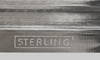    |
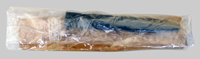
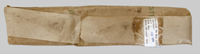
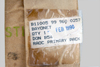
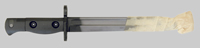
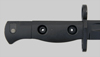
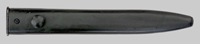
Sterling Submachine Gun | This is a later example that uses the L1A1 blade and riveted sheet steel grips, with the wider rivet spacing identical to the L1 Series bayonets. The hilt and crosspiece are finished in black paint, except for the press stud which is parkerized.
The blade is polished bright and carries the etched Sterling windowpane blade marking. The "H" and "C" cast into the pommel signify manufacture by Hopkinson and that the pommel is a casting (rather than a forging). The scabbard is a copy of the No. 5, but has a more crudely shaped point. |
8.00 | 203 | 11.875 | 302 | .905 | 23.0 | Blade: "Sterling" inside a rectangle
Pommel: "H" over "C" |
           |
L1A3 | Knife bayonet for use on the 7.62 mm. NATO caliber L1A1 variant of the FN–FAL selective-fire rifle.
This example was made in 1959 at the RSAF, Enfield. It was repacked in 1990 and was never subsequently issued. "9600257" is the NATO stores number for the L1A3 bayonet. The L1A3 introduced the recessed press stud, whereas, the L1A1 had a protruding press stud. Australia used a slight variation, designated L1A2, which has the protruding press stud. This No. 5 scabbard is interesting in having the "broad arrow" mark on the frog stud and in having a squarish finial that is separate from the scabbard body. |
8.00 | 203 | 12.00 | 305 | .585 | 14.9 | Ricasso: broad arrow proofmark and superimposed "ED" followed by "59"
Right Grip: "L1A3 9600257 and superimposed "ED" Pommel (Left): broad arrow proofmark and "B" |
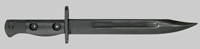    |
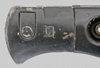
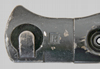
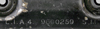
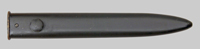
L1A3 Short Fuller | This example was made in early 1967 at the RSAF Enfield.
In the mid-1960s, the L1A3 blade fuller was shortened, creating a very long ricasso. It was perceived that the fuller extending almost to the crosspiece weakened the blade. However, as shown below, the L1A4 was produced in the 1970s with the long fuller. Late L1A3 bayonets also introduced a simplified crosspiece, lacking the "waist" found on earlier examples. The L1A4 also used the simplified crosspiece. |
8.00 | 203 | 11.875 | 302 | .585 | 14.9 | Ricasso: superimposed "ED" followed by "66"
Right Grip: "L1A3 9600257 and superimposed "ED 67" Left Grip: "L1A3 9600257 and superimposed "ED 67" |
       |
L1A4 | This example was made in 1973 by Hopkinson Ltd., Trimils Works, of Sheffield.
The L1A4 differs from the L1A1, L1A2, and L1A3, by having the pommel secured to the tang by rivets. The pommel was brazed to the tang on earlier marks. The "H" inside a diamond is the Hopkinson Ltd. Maker's mark. "S.M." identifies the Hopkinson contract for L1A4's and "9600259" is the NATO stores number for the L1A4 bayonet.
|
8.00 | 203 | 12.00 | 305 | .585 | 14.9 | Ricasso: "H" inside a diamond. And "73"
Right Grip: "L1.A.4 9600259 S.M." Pommel (Left): "R" inside a square Pommel (Right): "C" inside a square. |
  |
Scabbard No. 5 Mk. I | The No. 5 Mk. I scabbard was used with British knife bayonets for over 40 years, from the No. 5 Mk. I in 1944 through the L1A4 in the 1980s.
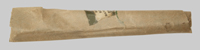
Like the No. 9 Mk. I bayonet above, the label lacks a NATO stores number, indicating packaging prior to 1951.
|
n/a | n/a | n/a | Label:
Rifle. No 4 |
|||
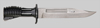 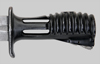  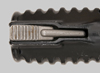 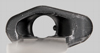 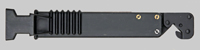 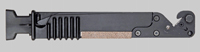 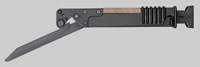 |
L3A1 (SA80) | Socket bayonet for use with the 5.56 mm. NATO caliber SA80 family of assault rifles.
The bayonet is a one-piece forging. The blade is offset to allow the hilt to encircle the rifle's muzzle. The hilt is painted black, while the blade is in the white. The blade has a serrated edge and wire-cutter feature. The L2A1 scabbard has a plastic body that incorporates a wire-cutter, fold-out saw blade, and sharpening stone. The scabbard slips into an over-scabbard (full-length belt frog) and is secured to the frog by a Fastex connector. The SA80 was adopted by the British Army in 1985 to replace the venerable L1A1 (FN–FAL). 350,000 were produced by the time production ceased in 1994. The SA80 rifles borrowed much of their mechanical design from the Armalite AR–18, which the Irish Republican Army had used very effectively against UK forces. |
6.875 | 175 | 10.75 | 273 | .870 | 22.1 | None. |
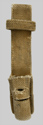 |
British Belt Frogs | Examples of Second World War and post-War British belt frogs are on the Bayonet Belt Frogs Page |
n/a | n/a | na/ | ||||
| Back | Next | ||||||||
| Return to Bayonet Identification Guide Index | |||||||||
| © Ralph E. Cobb 2010 All Rights Reserved | Top | ||||||||