| Pictures (click to enlarge) |
Type | Description | Blade Length |
Overall Length |
Muzzle |
Markings | |||
| in. | mm. | in. | mm. | in. | mm. | ||||
   |
M1871 First Pattern |
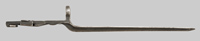
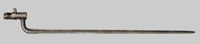
Cruciform socket bayonet for use on the 11.4 mm. Beaumont rifle.
The Beaumont was an early, single-shot bolt-action rifle. In 1881, Beaumont rifles were converted into repeaters by adding the, then revolutionary, Vitali box magazine. This was the first use of a box magazine on a military rifle. The Vitali box magazine system was subsequently used by Italy on their Vetterli rifles. This example is of the first pattern bayonet, with a conventional one-piece iron locking ring. The socket length is 2.625 in. (67 mm.). According to Dutch bayonet collector/ researcher Erwin Muetstege, the initial design used a conventional, one-piece locking ring made of iron, which was copied from the Snider bayonet. In 1875, the War Department changed to the two-piece locking ring, made of steel. This was done to make the locking ring easier to replace in the field. |
20.125 |
511 | 22.75 |
578 | .700 |
17.8 | Socket: "N 131"
Shank: Proofmarks |
    |
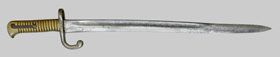
M1871 Second Pattern | This example is of the second pattern, with its unique two-piece steel locking ring. The socket length is 2.625 in. (67 mm.).
|
20.25 | 514 | 22.875 | 581 | .700 | 17.8 | Socket: "S 117"
Shank: proofmarks |
 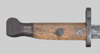       |
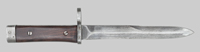
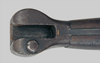
M1895 Infantry | T-back sword bayonet for use on the 6.5 mm. M1895 Mannlicher rifle. The attachment system is very similar to that used on the British Pattern 1888 bayonet.
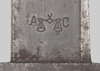
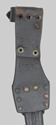
This example was made by firm of Alexander Coppel of Solingen Germany. Prior to 1905, M1895 bayonet production was by Steyr, W.K.C., and Coppel. In 1904, production began at Artillerie Inrichtingen in the Netherlands and continued until the Germans overran Holland in 1940. Early examples had a hooked lower crosspiece, but this was deleted beginning in 1900. Many M1895 bayonets are marked "Hembrug." This was the trademark of Artillerie Inrichtingen, in Zaandam, referring to a swing bridge across the North Sea Canal that provided railroad access to the factory. The Crown-B inspection mark is attributed to inspector E.B. Brossois. Inspector E.B. Brossois traveled to the contractors in Austria and Germany to inspect early shipments of the M1895 bayonet. The overall scabbard length, including the integral leather belt hanger, is 18.75 in. (475 mm.). The belt hanger measures 5.50 in. (140 mm.) long by 2.00 in. (50 mm.) wide at the widest point. |
14.00 | 356 | 18.75 | 476 | .550 | 14.0 | Ricasso (Left): "A" (scales) "C" [Alex Coppel commercial trademark] Ricasso (Right): Crown over "B" Crosspiece: "2718 M" Belt Hanger (Reverse): "7712" |
      |
M1895 No. 3 & No. 4 Carbine | T-back sword bayonet for use on the 6.5 mm. M1895 Mannlicher No. 3 and No. 4 Carbines. The attachment system is very similar to that used on the British Pattern 1888 bayonet.
On this M1895 variant, the pommel was turned 90 degrees. This was done because troops issued carbines tended to carry them across their back and the infantry bayonet pommel orientation damaged their uniform. This example was made by firm of Alexander Coppel of Solingen, Germany. According to Kiesling, the No. 3 Carbine was issued to Fortress Artillerymen, Engineers, and the Pontonniers en Torpedisten (bridge-construction and waterways defense). The No. 4 carbine was issued to bicycle troops, motorcyclists, and armored car units. The Crown-B inspection mark is attributed to inspector E.B. Brossois. The Crown-L is attributed to inspector Wiersma. Inspector Wiersma began work c. 1898 and continued into the First World War period. The presence of these two inspector marks dates this example to date this example to the 1898–1904 period. |
19.00 | 483 | 23.75 | 603 | .550 | 14.0 | Ricasso (Left): "A" (scales) "C" [Alex Coppel commercial trademark]
Ricasso (Right): Crown over "L" Crosspiece (Left): "152" Crosspiece (Right): "6432 B" Pommel: Crown over "B" |
|
Click on the image to view information and additional images on the USA Second World War Page. |
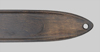
M1941 | Triangular bayonet for the caliber .30-06 Johnson Model 1941 self-loading rifle, used by the Netherlands. | 7.75 | 197 | 11.75 | 298 | .570 | 14.5 | |
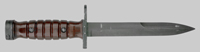 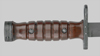   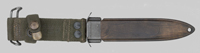  |
M4 | Bayonet-knife for use on the caliber .30 U.S. Carbine M1.
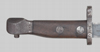
The USA provided 84,523 M1 & M2 Carbines to the Netherlands between 1950 and 1963 under the Military Assistance Program. The Netherlands M4 bayonet is patterned after its U.S. cousin, but is a distinctly different design. The most obvious difference are the red phenolic grip scales, patterned after the U.S. leather grip. The crosspiece is much heavier, requiring a stepped muzzle ring, due to the extra thickness. The pommel is secured with solid pins, where the U.S. bayonet uses rolled pins. Examples are found with grip scales secured by rivets or (like this example) with screw bolts. These were made by the German firm, E. & F. Hörster, in 1951–52. This example has the Hörster commercial trademark on the crosspiece, although not all are so marked. The scabbard is patterned after the U.S. M8A1, however, the metal is blued. The scabbard body is made of Durofol, a laminated wood developed in Germany during the Second World War. It is made by impregnating beech veneers of 0.2 to 0.3 mm. thickness with 25 to 35 percent of a water-soluble phenolic resin cured under both high pressure and temperature. Post-War, Durofol KG, J. Brangs & Co. of Solingen became the exclusive manufacturer, which later became Durofol Presswerk GmbH. |
6.625 | 168 | 11.50 | 292 | .590 | 15.0 | Crosspiece: "H" bisected by a sword, inside an oval. |
|
Click on the image to view information and additional images on the Sudan Page.
Click on the image to view information and additional images on the Portugal Page. |
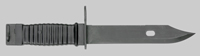
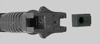
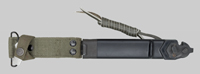
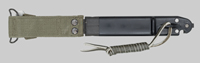
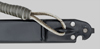
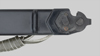
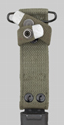
AR–10 | Knife bayonets for use on the 7.62 mm. NATO caliber Armalite AR–10 selective-fire rifle produced 1958–62 by Artillerie Inrichtingen in the Netherlands.
240 AR–10 rifles of varying configurations were used in Dutch Army trials. Some used the Sudanese contract bayonet, some used the Portuguese contract bayonet, and some did not mount a bayonet. |
7.125 | 181 | 11.75 | 298 | .855 | 21.7 | |
 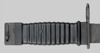         |
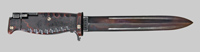
KCB–70 M1 | Knife bayonet for use with the 5.56 mm. NATO caliber Stoner 63A weapons system. The bayonet will also mount to the 5.56 mm. NATO caliber U.S. M16 assault rifle.
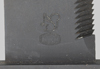
The Stoner rifle and bayonet was produced by the Netherlands firm (Nederlandsche Wapen-en Munitiefabriek) De Kruithoorn N.V. (NWM) [in English, Dutch Weapons and Ammunition Factory 'The Powderhorn' L.L.C.]. NWM contracted with the famous German blademaker, Carl Eickhorn Waffenfabrik AG, to design a bayonet for the Stoner 63A that incorporated the advanced features found on the Russian AKM Type II bayonet. Accordingly, the ricasso marking includes the commercial trademarks of both firms. Approximately 3,600 Stoner 63A weapon systems were produced by NWM, with production ending in 1971. KCB-70 is an abbreviation of "Knife-Cutter-Bayonet of 1970". The NWM KCB–70 M1 is distinguished from later KCB–77 variants by the shiny black plastic grip and scabbard. This plastic proved too brittle. Many of the examples encountered today have cracks in the plastic grip or scabbard body. A tougher matte black plastic was used on later production, which proved more durable. Because the KCB–70 M1 was designed specifically for use with the Stoner 63A rifle, it featured a hollow in the grip to store the Stoner's sight adjustment tool. The KCB–70 M1 was the first of what became a long line of KCB bayonets, produced and marketed by Eickhorn and its successors for more than 30 years. The KCB–77 M1 and KCB–77 M1/L on the Post-War Germany page; and, the KCB–77 M6 on the Saudi Arabia page are examples of the later KCB–77 series. |
6.875 | 175 | 11.875 | 302 | .870 | 22.1 | Ricasso: Eickhorn (squirrel) trademark over "NWM" trademark |
| Back | Next | ||||||||
| Return to Bayonet Identification Guide Index | |||||||||
| © Ralph E. Cobb 2010 All Rights Reserved | Top | ||||||||