| Pictures (click to enlarge) |
Type | Description | Blade Length |
Overall Length |
Muzzle |
Markings | |||
| in. | mm. | in. | mm. | in. | mm. | ||||
|
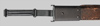
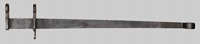
M1903 |
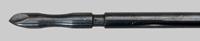
Rod bayonet for use on the .30–03 caliber U.S. Rifle M1903. The bayonet stowed in the rifle's forestock.
After using a M1898 Krag rifle to break his opponent's M1903 bayonet, President Theodore Roosevelt ordered that a proper bayonet be designed and fitted to the M1903. Nearly all existing M1903 rifles were converted to use the M1905 bayonet and surviving examples of the rod-bayonet M1903 rifle are exceedingly rare. This is an original M1903 rod bayonet, made 1903–1905 at Springfield Armory, with the beautiful high-polish blue characteristic of the period. |
11.75 |
298 | 23.50 |
597 | n/a |
None. |
|
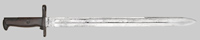 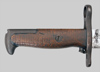       |
M1905 | Sword bayonet developed for use on the .30–06 caliber U.S. Rifle M1903, as revised in 1905/06. The M1905 bayonet was also used with the M1 Garand and M1903A3 rifles.
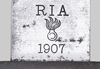
The M1905 bayonet came about following President Roosevelt’s unexpected rejection of the M1903 rifle’s original rod bayonet in January 1905. M1892 bayonet was deemed too short for the M1903 rifle, so a longer version was designed. The M1905 bayonet also differed from the M1892 by incorporating a mechanism for locking the bayonet in the scabbard and by securing the grips with a screw. There were two distinct production runs of M1905 bayonets. The first production run occurred at the national armories: —Rock Island Arsenal (1906–1914; 1917–1919) Records do not agree on how many were produced. The likely figure is somewhere around 1.5 or 1.6 million from 1906–22. A second production run occurred 1942–43. Many different scabbard variations were produced over the M1905 bayonet’s nearly 40-year service life. This example was made in 1907 at Rock Island Arsenal. It is in as-issued condition, with a brightly polished blade, rawhide-covered wooden scabbard with a russet leather cover and Model 1903 type II belt attachment. As evidenced by the markings, the bayonet and scabbard have likely been together continuously since manufacture in 1907. The vast majority of M1905 bayonets and scabbards were reworked and altered during the two world wars. Totally original specimens such as this example are scarce. According to the Rock Island Arsenal Museum, “J.N.S.” identifies leather goods inspector, John Nicholas Schmidt. |
16.00 | 406 | 20.625 | 524 | .620 | 15.7 | Ricasso: "RIA" with Ordnance Dept. "Shell-and-Flame" over "1907" and "US" over "94061"
Scabbard: "R.I.A." over "1907" and "J.N.S." (unknown leather goods inspector at Rock Is. Arsenal) |
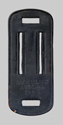  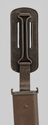 |
M1905 Scabbard Belt Protector | Leather belt protector to enable wearing the early (pre-1910) M1905 bayonet scabbard with the leather garrison belt.
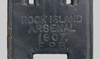
This example was made at Rock Island Arsenal in 1907. It measures 4.625 in. (117 mm.) high by 1.875 in. (48 mm.) wide. The “F.P.B.” marking identifies leather goods inspector, F.P. Baumbach, whom records indicate began employment at the Arsenal in 1899. |
n/a | n/a | n/a | "Rock Island Arsenal 1907 F.B.P." |
|||
  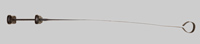 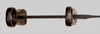   |
M1906 Fencing Bayonet | Fencing bayonet used with fencing muskets constructed from .45 caliber Springfield rifles, with the barrel shortened and weighted to simulate the length and handling properties of the M1903 Springfield rifle. The bayonet's length and profile simulate the M1905 bayonet.
The need for a new fencing bayonet arose ca. 1905, as the supply of M1855 socket bayonets used to produce the Type III fencing bayonet were exhausted. The M1906 fencing bayonet was completely fabricated, using no part of a service bayonet in its construction. The hilt has dual muzzle rings that secure to the rifle's barrel via set screws. The blade is flexible spring steel with a horizontal button end. A wood disc was inserted into the button; and button and blade both covered in russet-colored leather. Metal fabrication occurred at Springfield Armory (SA). Leather covers were fabricated and installed in the Rock Island Arsenal (RIA) Harness Shop. According to Ordnance Dept. reports, 3,008 fencing bayonets (type unspecified) were reported produced during the 1907–08 fiscal year. Some of these were the M1906, as examples with 1907-dated covers have been documented. 4,900 M1906 fencing bayonets were reported produced during the 1908–09 fiscal year. The M1906 suffered from excessive breakage, which proved dangerous to fencers. In November 1909, the Ordnance Dept. indicated that they had solved the breakage problems by doubling the thickness of the blade and covering only the knob in leather. In his book, The American Bayonet, Hardin gave the improved bayonet the collector’s designation, M1909. 4,600 were reported produced 1909–11, before production ceased. Despite both of these M1906 variants being produced in significant numbers, they are very scarce today. The example pictured at left is of the original M1906 variant. The leather cover and wooden disc are missing; however, the blade thickness conforms to the M1906 gauge dimensions in Hardin. No example of the improved M1906 (Hardin M1909) has ever been documented. The original M1906 and first improvement (Hardin M1909) were apparently not retained in government stores. They were not surplussed in quantity, as were both previous and subsequent fencing bayonets. They were most likely withdrawn from service and destroyed on account of their proving dangerous to users. |
16.125 | 410 | 19.125 | 485 | .765 | 19.4 | None. |
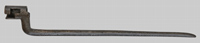  |
Bannerman Cadet Socket | Socket bayonet for use with non-firing cadet (Quaker) rifles made for military schools for young boys.
Made of cast-iron; and sporting a thick coat of dark paint, this small socket bayonet has a blunted point, as it was made only for drill and parade use. The socket length is 1.625 in. (41 mm.). These are commonly associated with New York surplus dealer, Francis Bannerman, due to their listing in early Bannerman catalogs (ca. 1907). |
11.50 | 292 | 13.125 | 333 | .700 | 17.8 | None. |
|
Click on the image to view information and additional images on the Canada Page. |
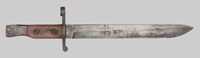
Ross Mk. I | Knife bayonet for use on the Canadian Ross Mk. I .303 caliber straight-pull rifle.
In 1917, the U.S. Government purchased 20,000 surplus Ross Mk. I rifles and bayonets from Canada for use in troop training due to the shortage of American rifles. These were supplied to the State of New York and to training camps in Massachussets and Ohio. These Ross bayonets bear "U.S." and the Ordnance Dept. "shell and flame” acceptance marks in addition to Canadian markings. |
10.125 | 257 | 14.625 | 351 | .570 | 14.5 |
|
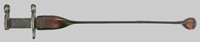   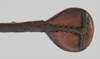 |
M1912 Fencing Bayonet | In September 1912, the Ordnance Dept. reported that the M1906 design had again been changed on account of continuing issues with breakages. In his book, The American Bayonet, Hardin gave the second M1906 improvement the collector’s designation, M1912.
The blade was reduced in thickness; made more flexible and spring-tempered. The blade and button were both covered with leather. Instead of the vertical blade orientation, the blade emerged from the hilt and twisted 90-degrees to a horizontal orientation before terminating in a vertical button. A horizontal blade/vertical button had proven successful on the Type III fencing bayonet. In September 1913, the Ordnance Dept. reported that tests of the bayonets at the School of Musketry had not yet been completed. After two years of development, 11,000 of this variant (Hardin M1912) were reported produced during fiscal years 1913–14 and 1914–15. These were apparently successful, as they saw extensive use and were retained in government stores after the First World War. This example was covered at RIA in 1914. The inspector identified by “H.E.K.” was Henry E. Kelsey. A civilian, he inspected leather goods at RIA 1901–20 (the RIA Harness Shop closed in 1920). Janzen’s Notebook erroneously labels a Hardin M1912 example with only the button leather remaining as the M1909. This has caused confusion among the collecting community. Hardin’s description of the M1909 (see M1906, above) is correct and is consistent with documentary evidence. This variant (Hardin M1912) was the last regulation U.S. fencing bayonet design adopted by the Ordnance Dept. In 1916. the Ordnance Dept. adopted the one-piece “wooden gun” for bayonet fencing to supersede the fencing muskets and bayonets then in use. Read more about U.S. Fencing Bayonets in my article: Regulation U.S. Fencing Bayonets 1852–1915. |
16.00 | 406 | 19.00 | 483 | .770 | 20.0 | Ricasso: "R.I.A." over "1914." over "H.E.K." |
 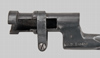  |
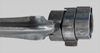
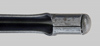
M1891 Remington | Socket bayonet for use with the 7.62 mm. M1891 Mosin-Nagant rifle. This example was produced in the USA by the Remington Arms Co., in Bridgeport, Connecticut, for the Imperial Russian Government.
In 1915, Russia contracted with Remington and with the New England Westinghouse Co. to produce the 7.62 mm. M1891 Mosin-Nagant rifle and the accompanying bayonets. When the Communist Revolution of 1917 overthrew the government of Czar Nicholas II, the contract was cancelled, leaving Remington and N.E. Westinghouse holding a large quantity of M1891 rifles and bayonets; with factories tooled-up to produce Russian arms. The U.S. Government purchased all of the rifles and bayonets on hand, plus any more they could produce while their factories were converted to produce Browning machine guns. The tiny circle-R and serial number, and the absence of any Russian markings, identifies this example as having been produced by Remington. Some of the U.S.-purchase bayonets were marked with the Ordnance Dept. "Shell and Flame" device, however, many were not. As this example illustrates, the fit and finish of the Remington bayonet is better than on Russian-produced M1891 bayonets. |
17.00 | 432 | 19.75 | 502 | .585 | 14.9 | Socket: "571004" and circle "R" |
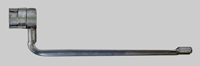    |
Daisy #40 | Socket bayonet for use with the Daisy #40 military style BB gun. The bayonet is made of stamped blued steel, with a functional locking ring and small rubber tip. No scabbard was produced.
The socket length is 1.375 in. (35 mm.).
Produced by the Daisy manufacturing Company Inc. of Plymouth, Michigan, approximately 150,000 #40 rifles and bayonets were made from 1916–1934. The #40 is said to be one of the most sought after items by today’s collectors of Daisy BB guns. Examples of the bayonet are far less common than rifles, with many having been lost (or confiscated and disposed of by concerned parents). |
8.50 | 216 | 9.875 | 251 | .890 | 22.6 | None. |
 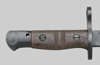   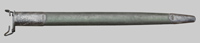   |
M1917 First Production | Sword bayonet for use on the .30–06 caliber U.S. Rifle Model of 1917 and 12-gauge combat shotguns (trench guns). Much of the conventional wisdom regarding the M1917 bayonet was clarified by Dan Morrison in his 2017 book, The U.S. Enfield Bayonet. The M1917 bayonet came about due to the U.S. entry into the First World War. U.S. makers were producing the Pattern 1914 rifle and Pattern 1913 bayonet for the British. Upon entering the War, the rifle and bayonet were designated Model of 1917 and production taken over to equip U.S. forces. The M1917 rifle was nearly identical to the British Pattern 1913 rifle, so was often referred to in U.S. service as the "Enfield.” The M1917 bayonet was identical to the British Pattern 1913 bayonet, except for the U.S. markings. Vertical grooves in the grip scales that differentiated this bayonet from the British Pattern 1907 bayonet, avoiding confusion in British service, were retained on U.S. production. The pommel, crosspiece, and ricasso are blued, remainder of the blade is parkerized. The M1917 bayonet’s service life with combat shotguns resulted in two distinct M1917 production variants made 50 years apart. As shown in this comparison image, the passage of time resulted in significant differences. The first production was 1917–1918; the second production 1966–70. M1917 first production manufacturers were: —Remington Arms Co. Approximately 1.9 million M1917 bayonets were produced 1917–1918. An additional 545,000 British Pattern 1913 bayonets were also retained and re-marked for issue to U.S. forces. Two leather scabbard variations were made 1917–1918. The leather scabbard at left is of the second pattern, where the M1910 belt hanger was integral with the topmount. First pattern scabbards had a leather belt hanger riveted to the topmount (pictured below). In U.S. service, the leather scabbard body was painted green. During the Second World War, when stocks of leather M1917 scabbards ran out, it was found that the M1917 bayonet tended to split the plastic M3 Scabbard due to the M1917 blade being both longer and thicker near the point than the M1905 blade. A plastic M1917 scabbard was adopted in 1945. Beckwith Manufacturing Co. made approximately 179,000 in the months before the War ended. This example was made in 1917 by the Remington Arms Co. The "GF inside an oval identifies the maker of the metal scabbard mounts, the General Fireproofing Co. of Youngstown, Ohio (a peacetime producer of steel furniture). The initials "U.V.K." on the scabbard body are of an unknown U.S. government inspector. |
17.00 | 432 | 21.75 | 552 | .605 | 15.4 | Ricasso (Right): "US" with Ordnance Dept. "Shell-and-Flame"; eagle's head & "26"
Ricasso (Left): "Remington" inside a circle; "1917" Scabbard (both mounts): "GF" in oval. Scabbard (body): "U.V.K." |
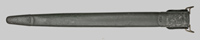    |
M1917 Maxim Scabbard (First Pattern) | First pattern scabbard for the M1917 bayonet, with a leather belt hanger riveted to the the topmount in order to adapt the British-style scabbard to the U.S. M1910 equipment belt.
This scabbard was designed and patented by U.S. inventor Hiram Percy Maxim, inventor of the "Maxim Silencer" and son of Hiiram Stevens Maxim whose machine gun played such a large part in both World Wars. View copy of Maxim's scabbard patent. The belt hanger proved too weak and a second pattern scabbard was designed, incorporating the wire belt hanger into the topmount. An example of the later scabbard accompanies the M1917 bayonet above. This example bears the U.S. government inspector mark "EJB", whose identity remains unknown. |
n/a | n/a | n/a | Body: "EJB" | |||
  |
M1917 Maxim Scabbard Belt Hanger | This is an unused M1917 first pattern scabbard leather belt hanger.
This example was made by the Jewell Belting Co. of Hartford, CT, in 1918. The identity of an inspector "H.E." is not known. This mark could be a partial “H.E.K.”, who was inspector Henry E. Kelsey. |
n/a | n/a | n/a | "Jewell" over "1918" and "H.E." | |||
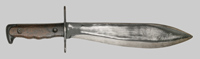 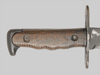   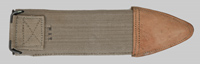   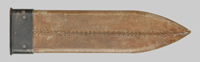 |
M1917 C.T. Bolo | Heavy bolo knife for use by machine gun and artillery crews to clear vegetation when emplacing their guns.
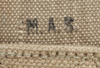
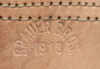
This example was made by the Fayette R. Plumb Co., St. Louis, MO, in 1918. The heavy blade is blued, with a false edge. Serrated wood grips with finger grooves. Scabbard is made of wood and rawhide, with a brass throat. The scabbard cover was made in 1918 by Brauer Bros., also of St. Louis. The cover is made of canvas and leather, incorporating the M1910 wire belt hanger. According to noted U.S. military knife authority Frank Trzaska, the C.T. stands for "Commercial Tolerances." This signifies that the knife was made to less exacting commercial tolerances, rather than the more stringent tolerances used at Springfield Armory. On the C.T. design, the pommel and tang were made as one piece, rather than the pommel being brazed to the tang as was the case with the M1910 bolo made by Springfield Armory and M1917 bolos produced by other manufacturers. |
10.25 | 260 | 15.00 | 381 | n/a | Ricasso (Left): "Plumb" over "St. Louis" over "1918" Ricasso (Right): "U.S. MOD" over "1917 C. T." Scabbard Cover: "Brauer Bros." in an arc over "1918" on leather tip and "M.A.S." on canvas belt hanger |
|
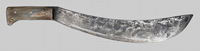   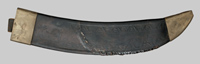  |
Collins No. 1005 Machete | These machetes were used by U.S. Army Engineers to supplement the bolo knives and bayonets, which were notoriously ineffective brush-cutting implements.
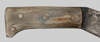
The manufacturer is the famous Collins & Company of Hartford, CT. These machetes are often said to have been used in the Spanish-American War, but this is apparently not correct. According to U.S. military knife expert, Carter Rila, the Collins No. 1005 was adopted by the US Army in 1918, too late to see service in the First World War. It was obsolete by the time the U.S. entered the Second World War. Extraordinarily heavy, roughly machined curved blade. Green horn grips held on by brass rivets. Tooled leather scabbard with brass mounts. |
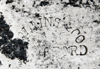
15.00 | 381 | 20.00 | 508 | n/a | Ricasso: "Collins & Co." in an arc over "Hartford"
Scabbard: Large cartouche with "Collins & Co. over a hand grasping a forging hammer over "Legitimus" |
|
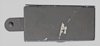  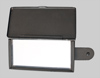  |
M1918 Rifle Periscope (Trench Mirror) | Officially designated Periscope, Rifle, M1918, this folding mirror was used by U.S. and British troops during The First World War. The mirror attaches to the M1905, Pattern 1907, or Pattern 1913 (U.S. M1917) bayonet and allows viewing over the parapet, without exposing the soldier to enemy fire. The mirror folds flat to fit in a shirt pocket, when not in use.
The mirror measures 3.75 in. (95 mm.) wide by 2.00 in. (51 mm.) high. The swiveling tab is 3.125 in. (80 mm.) long. |
n/a | n/a | n/a | None. | |||
| Back | Next | ||||||||
| Return to Bayonet Identification Guide Index | |||||||||
| © Ralph E. Cobb 2010 All Rights Reserved | Top | ||||||||