| USA | U.S. M4 Bayonet | Bayonet-knife for use on the caliber .30 U.S. Carbine M1. The M4 bayonet was also used on the selective-fire M2 Carbine which was developed post-War.
Initially, the M1 Carbine did not accept a bayonet. Beginning in June 1944, the front band included a bayonet lug. Most earlier carbines were subsequently retrofitted with the bayonet-lug front band. The M4 bayonet was an adaptation of the M3 combat knife, made by changing the guard and pommel to enable mounting as a bayonet. As discussed below, adapting the M3 "butt plate" (pommel) for bayonet use proved more daunting, due to the strong forces exerted in bayonet fighting and the thinness of the plate. The first production run of M4 bayonets was 1944–45, with a subsequent run by Camillus Cutlery Co. in 1953. All tolled, just under 2.5 million were produced. Producers include: —Aerial Cutlery Co. Production of the M4 bayonet latch plate was very complex. They were machined out of steel forgings or bar stock. The T-slot required especially intricate and precise machining, the outer oval profile was time-consuming to machine, and precise heat-treatment was also required. For adequate strength, the T-slot fillets (corners) had to be uniform and precisely radiused; and the heat-treatment within a narrow hardness range. This was beyond the capabilities of the bayonet contractors. The majority of latch plates were produced by Standard Products Co. of Port Clinton, Ohio. Utica Cutlery appears to have briefly produced latch plates, then stopped. When Standard Products could not supply enough latch plates, the government also contracted with Hemphill Products of Providence, Rhode Island. |
||||||||
| Pictures (click to enlarge) |
Type | Description | Blade Length |
Overall Length |
Muzzle |
Markings | ||||
| in. | mm. | in. | mm. | in. | mm. | |||||
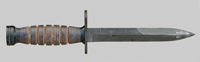 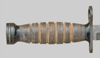   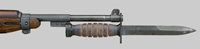 |
Imperial Knife Co. | This example was made by the Imperial Knife Co., Providence, Rhode Island.
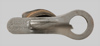
This example's pommel was made by subcontractor, Standard Products Co. of Port Clinton, Ohio. The number identifies the heat-treatment lot. Standard Products Co. also produced M1 Carbines during the Second World War. |
6.75 | 171 | 11.625 | 295 | .590 | 15.0 | Guard: ordnance 'bomb' with "USM4" over "Imperial"
Pommel: "Sp" and "148 |
|
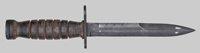    |
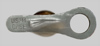
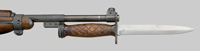
Camillus Cutlery Co. 1953-Contract | Camillus Cutlery Co. of Camillus, New York, was awarded contract DA-19-058-ORD-7479 for $468,676 in April 1953 to produce 166,098 M4 bayonets. Production extended into 1954, as March 1954 packaging dates have been observed. These were the last government-contract M4 bayonets made with the leather grip. Bayonets from this contract are also the first to include the M4 guard modifications adopted in 1952 to eliminate guard breakage experienced during the Korean War.
Prior to receiving the production contract, Camillus completed two related projects. In December 1952, the Ordnance Dept. had Camillus rebuild 30 unserviceable M4 bayonets to include the new guard for use as test samples in changing M4 bayonet specifications. In April 1952, Springfield Armory had advised the Ordnance Dept. that the cost to convert M3 knives into M4 bayonets would equal the cost to manufacture new bayonets. Nonetheless, in January 1953, the Ordnance Dept. had Camillus perform a test run converting 250 unserviceable M3 knives into M4 bayonets before awarding Camillus a contract to manufacture new bayonets. Camillus manufactured and finished the blades in-house. Leather grip washers were supplied by Simplex Manufacturing Co. of Auburn, NY, who had supplied Camillus’ grip washers during the Second World War. Bayonets produced under this contract did not incorporate plastic grip spacers. Latch plates and guards are documented as being manufactured and finished by L. C. Smith. The L.C. Smith shotgun factory in Fulton, NY, had closed in 1950, so the annotation “L. C. Smith” likely refers to the L. C. Smith & Corona factory that was still operating in Syracuse, NY; and, where M1903A3 rifles had been manufactured during the Second World War. During the 1990s, Camillus reproduced the 1953-contract M4 bayonet for commercial sale. However, subtle variations make identification of the reproductions relatively easy. The most obvious differences are the peen; and, the guard and latch plate markings. The reproduction has a flat peen, where the period piece has a starburst peen. The middle stem of the letter “M” in CAMILLUS on the reproduction guard goes all the way down to the base line, where the middle stem on a period piece only descends part way. The “X” on the latch plate of the reproduction is placed vertically, where it is placed horizontally on a period piece. |
Guard: "U.S. M4" over "Camillus"
Pommel: Horizontal X |
|||||||
 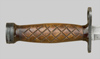    |
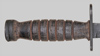
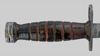
Wooden Grip | This example has been modified with a wood grip. This was an apparent attempt to find a grip material more resistant to rot than the leather grip.
The grip is made of what appears to be an Asian hardwood, with diamond-pattern cross-hatching. The grip is one piece, requiring removal and re-peening of the latch plate for installation. Given that the M3 Knife to M4 bayonet conversions were done in Japan, these wood grip conversions were also likely done there as well. The process for installation of the wood grip is a subset of the M3 Knife to M4 bayonet conversion process. While no documentation regarding this conversion has been found, Korean War images of M4 bayonets with this grip date the conversion to the Korean War period. M.H. Cole’s, U.S. Military Knives Book 4, page 115, includes an image of a U.S. soldier in Korea wearing one of these on his belt. A U.S. Army photograph of Turkish soldiers in Korea also shows the wood-grip M4 bayonet in combat service. |
Guard: "USM4" over "Case" Pommel: "Sp" and "43B" |
|||||||
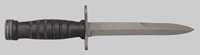 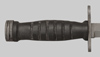  |
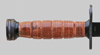
Hard Rubber Grip | This example has been modified with a hard rubber grip.
The rubber grip conversions were once thought to have been a U.S. Army experiment during the Korean War. However, this has largely been discounted. No documentation regarding this conversion has been found. Information obtained from importers consistently points to the rubber grips having been applied in South Korea. Some rubber grip conversion bayonets observed, such as the example pictured at left, appear to have been assembled from salvaged parts. This is consistent with Korea’s need to supplement foreign military aid with what could be produced using the meager resources they had during the 1950s and 1960s. Examples observed also include bayonets of Post-Korean War vintage (1953-contract Camillus) or include what appear to be a post-Korean War latch plate, demonstrating that the rubber grips were applied no earlier than the mid-1950s (more likely the 1960s). |
None. | |||||||
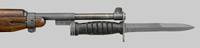
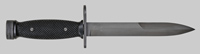
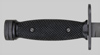
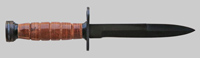
| M4 Second Production | Although the M4 bayonet was issued in significant numbers during the Second World War, it saw service almost exclusively as a knife. Very few M1 Carbines equipped with bayonet lugs ever made it to the field before War's end. It wasn't until the Korean War, that the M4 saw service as a bayonet, revealing several design issues. Breakage of the guard was addressed by guard modifications developed by Springfield Armory in 1952. These went into production with the 1953 Camillus M4 contract. However, two significant design issues remained:
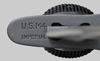
1) The guard was secured by only an interference fit on to the blade and pressure from the compressed leather grip; 2) There was simply no practical way to repair the leather grip. During the Second World War, the decision was made to scrap any M3 knife that required disassembly of the leather grip in order to make it serviceable. With the M4 bayonet, years in storage, the M4 bayonet’s longer guard, and the M4’s use as a bayonet all likely exacerbated the tendency for the guard to work loose. While the reduction in interference fit included in the 1952 guard modifications served to eliminate breakages, it made the guard even less secure, increasing the stresses placed on the leather grip washers when the guard was struck. Inability to repair the leather grip made the original M4 bayonet unsustainable. New evidence suggests that cost also likely played a role in redesign of the M4 bayonet. The M4 bayonet produced under the 1953 Camillus contract cost $2.88. By 1954, the cost for the M5 bayonet was on the order of $1.65 per bayonet. The M5 bayonet’s much lower cost helps explain the government moving rapidly to redesign the M4 bayonet. The cost for the redesigned M4 Second Production bayonet under Imperial's 1954 contract was $1.96, a savings of some 30 percent. Designers solved the loose guard issue by securing it to the blade with a heavy steel bar. Once assembled to the blade, neither the guard nor the latch plate were intended to ever be removed. When undergoing depot repair, the whole assembly could be reparkerized as a unit, the blade reground, latches and grips replaced, and the refurbished bayonet packaged for long-term storage. Securing the guard made it possible to utilize plastic grips, which contributed to both sustainability and reducing production cost. Unlike the leather grip, which must be laboriously-assembled by a skilled worker from individual leather “washers,” plastic grips can be mass-produced, then assembled using unskilled labor. In service, plastic grips are easily replaced. Lack of government documentation around M4 Second Production design specifications leaves some uncertainty around another cost-saving innovation that evidence suggests also played a part: the sintered latch plate. M4 Bayonets produced in 1944–45 and 1953 had latch plates machined from bar stock or steel forgings. The intricate machining of the rectangular hole, T-slot, and elliptical outer shape was costly and time-consuming. In 1944, a Boston firm, Isthmian Metals Inc., submitted experimental, lower-cost latch plates to the Army for evaluation. The latch plates were made by compressing powdered metal (sintering). The Army found them to be satisfactory, but the War ended before anything more became of it. Beginning in November 1954, just four months after Imperial was awarded the first M4 Second Production Bayonet contract, detailed technical articles authored by Isthmian Metals Co. Vice President, John W. Young, began appearing in metals industry trade publications describing their manufacture of M4 bayonet latch plates (which they called butt plates) from powdered metals. The latch plate of the 1954 Imperial M4, pictured below, lacks tool marks and has a marking that appears molded-in, rather than stamped. Turner latch plates observed often exhibit tool marks, as does the example pictured below. However, the appearance of Conetta and Bren-Dan latch plates, pictured below, are also consistent with the sintering process. While some uncertainty remains, it appears that the sintered latch plate was likely included in the M4 Second Production bayonet design as a cost-saving feature, although it may not have been used exclusively.
Four M4 Second Production contracts appear to have been let. U.S. government prime contractors and approximate years of production include: —Imperial Knife Co.: 1954 An estimated quantity of approximately 660,000 M4 Second Production bayonets appear to have been produced. Some M4 Second Production bayonets were marked with the Defense Acceptance Stamp (DAS), while many were not or may have had the DAS obliterated during service. The presence or absence of a DAS should not be criteria for determining whether a bayonet is U.S. Government Issue (USGI). More info is available in the Post-War M4 Bayonet Contracts Summary. |
|||||||||
     |
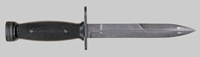
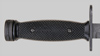
Imperial Knife Co. | Imperial Knife Co. was awarded contract DA-19-058-ORD-7882 in July 1954. The contract was for 44,586 bayonets in the amount $87,388. This was the first M4 Second Production contract.
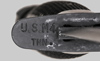
Imperial's M4 Second Production bayonets have a marking on the latch plate (Circle-I), similar to wartime M4 bayonet latch plates marked by subcontractors Standard Products and Hemphill. Careful examination of this mark shows that it has the appearance of being formed into the part, rather than stamped after-the-fact. While there is not hard documentation identifying the subcontractor represented by the Circle-I mark, there is circumstantial evidence of a likely candidate. A Boston firm, Isthmian Metals Inc., was the developer of sintered latch plates that the Army evaluated 1944–45. In 1954 and 1955, a few months after Imperial was awarded this 1954 M4 contract, technical articles authored by Isthmian Metals Inc. appeared in metals industry trade publications describing their manufacture of M4 bayonet latch plates and M1 Carbine sears from powdered metals. |
Guard: "US M4", "Imperial"
Guard (reverse): DAS Latch Plate: Circle-I |
|||||||
    |
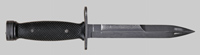
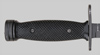
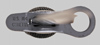
Turner Manufacturing Co. | Turner Manufacturing Co. was awarded contract DA-19-058-ORD-7886. Production continued into 1956. Cunningham indicates that Turner delivered 298,691 M4 bayonets.
While Turner's award was likely near-contemporaneous with Imperial's 1954 contract, the contract serial numbers substantiate that Imperial was actually the first M4 Second Production contractor. It appears that Turner was primarily an assembler of M4 bayonets, with components provided by external suppliers. According to Frank Trzaska, Camillus Cutlery Co. supplied Turner with blades. Recent findings have identified American Insulator Corporation of New Freedom, PA, as the supplier of Turner’s plastic grips. I was able to locate some period images of M4 bayonet production at Turner. The C. H. Turner company of Statesville, NC, began in 1916 as a manufacturer of agricultural equipment. In 1926, the company’s foundry and machining operations were merged into a single firm which, by the 1930s, was renamed Turner Manufacturing Co. Turner was then manufacturing tractors, sawmills, and agricultural equipment. By the 1940s, they began manufacturing woodworking machinery. Turner ventured into manufacture of consumer goods and government contracting during the 1950s to diversify their business. Textile manufacturer, Fletcher Industries of Philadelphia, PA, acquired Turner in 1960, taking over operation of the Statesville factory to manufacture yarn twisting and winding machinery; and narrow-fabric looms (used for making braid, ribbon, clothing labels, etc.). Fletcher is still in business today, playing a crucial role during the Covid-19 pandemic by manufacturing specialized braiding machinery used to weave the elastic bands for N95 masks. |
Guard: "US M4", "TMN." | |||||||
    |
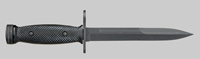
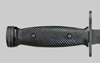
Conetta Manufacturing Co. | Conetta Manufacturing Co. of Stamford, Connecticut, was awarded contract DA-11-199-AMC-724 in June 1966. There were four orders placed under this contract totaling $531,000. Conetta M4 production ran from 1966 into at least 1969 (3/69 packing date observed).
Conetta Tool and Die Co. was founded in 1946. In 1954, they began an expansion that came to include three additional wholly-owned subsidiaries. In 1959, Conetta Manufacturing Co., Inc. became a publicly-traded corporation. The initial stock offering occurred in August 1960. Conetta produced trigger and sear assemblies for the M1 and M14 rifles; M4 and M7 bayonets; and, Mk. 2 knives for the government. During the 1960s, Conetta Manufacturing Co. became increasingly indebted. In September 1968, as the government was finalizing the M7 bayonet contract award that went to Bauer Ordnance Co., a Philadelphia-based venture capital firm purchased 90 percent of Conetta Manufacturing Co. In November 1968, Conetta Manufacturing Co. was merged into Dynetics Corp., legally terminating Conetta's existence. Dynetics Corp. was a privately-held corporation that had existed since at least 1961 and, in which Louis Conetta obtained shares in 1966. In November 1969, Louis Conetta ceased being an officer or director at Dynetics. In May 1970, Dynetics Corp. filed to become a publicly-traded corporation. The filing listed Dynetics as “formerly Conetta Manufacturing Co.” One of the stated uses for the money raised from stock sales was repayment of what were obviously Conetta Manufacturing Co. debts. Louis Conetta’s Dynetics shares were to be sold in the public stock offering. This effectively ended the Conetta family’s involvement in the firm. New Jersey surplus dealer SARCO (now in Pennsylvania) purchased many of the leftover bayonet and knife parts, using them to assemble items for commercial sale. The M7 Bowie bayonet is an example of a SARCO commercial product assembled from leftover Conetta parts. |
Guard: "US M4", "Conetta" | |||||||
    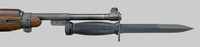 |
Bren-Dan, Inc. | Bren-Dan, Inc. of Stamford, Connecticut was awarded contract DAAF01-71-C-0851 in June 1971. There were two orders placed under this contract totaling $184,000. Bren-Dan M4 production ran 1971–72. These were the last M4 bayonets produced for the U.S. government.
Bren-Dan had two other small arms-related contracts 1971–72, totaling $40,000, that could have been for bayonets or spare parts, but no documentation to validate what these contracts were for has been found. Bren-Dan, Inc. was incorporated in August 1959. In 2022, Louis Conetta’s niece confirmed that the company was named after Louis Conetta's two children (at that time), Brenda and Daniel. The Conetta family continued bayonet production via Bren-Dan, Inc. following loss of Conetta Manufacturing Co. The Bren-Dan factory was across the street from the former Conetta factory. In the 1990s, author/researcher Frank Trzaska visited the Bren-Dan factory and spoke with the owners, Peter S. Conetta and Michael Sabia. Peter began work at Conetta Tool & Die Co. in 1950. During the 1990s, Peter Conetta was president and treasurer; Sabia was vice-president and secretary. A third owner, J. Michael Cantore, Jr., assumed the role of vice-president in 2003. These three sold the company to local real estate investors in 2008, ending the Conetta family’s involvement in the firm. |
Guard: "US M4", "Bren-Dan" | |||||||
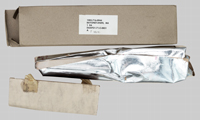 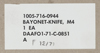 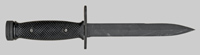 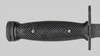 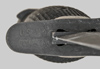  |
Despite the sale of old Conetta parts to SARCO, it appears that Bren-Dan used a few old Conetta parts in some of their M4 production.
This example was found in its original packaging bearing the Bren-Dan contract number with a 12/71 packing date. However, the bayonet inside is marked “Conetta” on the guard. |
Label:
1005-716-0944 Guard: "U.S. M4" and "Conetta" |
||||||||
| 1960s Commercial M4 Bayonets | Commercial M4 bayonets appeared in 1961, shortly after the first commercial M1 carbines came to market in late 1960. At the time commercial M1 carbines were coming to market, the US Government appears to have released few surplus M4 bayonets. Commercial M1 carbines were followed by the sale to NRA members of 240,000 surplus M1 carbines beginning in May 1963.
Common characteristics of 1960s commercial M4 bayonets are that they were patterned on the wartime leather-grip M4, were manufactured in Japan, and imported to the U.S. for commercial sale. The identity of the Japanese manufacturer or manufacturers is not known. Similarities observed in both bayonets and scabbards suggest that the same manufacturer likely supplied multiple U.S. importers. However, variances observed suggest that, over time, there may also have been more than one manufacturer. There is a lot that we just don't know regarding 1960s commercial M4 bayonets. The 1960s commercial M4 bayonets most familiar to bayonet collectors include those from: —Kiffe Sales Co., a New York sporting goods retailer. Some 1960s commercial M4 bayonets are completely unmarked or are only marked “Japan.” The ca. 1967 exhaustion of NRA M1 carbine sales and the Gun Control Act of 1968 prohibiting private mail-order firearm sales effectively ended the heyday of the commercial M4 bayonet. Surplus USGI M4 bayonets became more available during the 1970s, making commercial M4 bayonets increasingly difficult to sell. My working paper on the George Rose & Co. and the ROSCO M4 Bayonet provides additional history on 1960s importation of commercial M4 bayonets. |
|||||||||
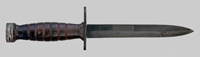    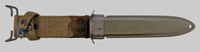  |
Kiffe Sales Co. | Kiffe bayonets vary. The leather grip can be found with either five or six grooves. The length of the blade's false edge varies. The blade and other metal parts are blued. The "Kiffe Japan" marking can be found on the ricasso or guard. This example is of poor construction compared to American military issue bayonets. However, some are of better quality, including a rare variation for use with the Armalite AR10 rifle.
Author/researcher, Gary Cunningham, compiled the history we know today of the Kiffe firm. Kiffe was founded in 1875 by Herman H. Kiffe as a New York City manufacturer and retailer of sporting goods, especially baseball equipment. The company was renamed several times over their nearly 100 year existence. Examples include: Herman H. Kiffe Sporting Goods—1875 Over the years, Kiffe sold all manner of camping, hunting, and fishing gear; and, military surplus as well. Both M4 and M5 bayonets have been observed with the Kiffe private label. The new-made bayonets were paired up with military surplus M8A1 scabbards or commercial copies of the M8A1 scabbard (both web and leather hangers are encountered). The scabbard with this example is a Second World War U.S. M8A1, made by the Beckwith Manufacturing Co. of Dover, New Hampshire. The glove fastener was made by the United-Carr Fastener Corporation of Cambridge, Massachusetts. United-Carr was famous for developing the “DOT” fastener (aka Lift-the-Dot) still widely used today. United-Carr was absorbed into TRW Corporation in 1969. |
Ricasso: "Kiffe" over "Japan"
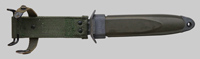
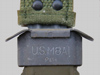
Scabbard (throatpiece): "U.S. M8A1" over "B. M. Co." Scabbard (body): superimposed "vp" over "6" Scabbard (Glove Fastener): "United" over "Carr" |
|||||||
  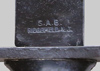     |
Service Armament Co. | Service Armament Co. of Ridgefield, New Jersey was a dealer of surplus military firearms. Established in the late 1950s, they were a forerunner to today's Navy Arms Co. Author/researcher, Gary Cunningham, spoke with S.A.C. founder, Val Forgett, who indicated that the manufacturer made an error, accidentally marking the blades "S.A.B." rather than "S.A.C."
This December 1962 S.A.C. advertisement in Guns Magazine was the earliest of their advertisements that I was able to locate listing "Carbine & Garand Bayonets" for sale. The bayonet and scabbard were sold separately. These are sometimes found with commercial copies of the M8A1 scabbard (both web and leather hangers are encountered). The M8A1 scabbard with this example was assembled at the Pennsylvania Working Home for the Blind 1965–68. |
Ricasso (left): "S.A.B." over "Ridgefield, N.J."
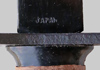
Ricasso (right): "Japan" Scabbard: "U.S. M8A1" over "P W H" |
|||||||
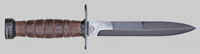 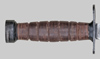     |
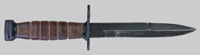
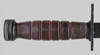
ROSCO | Los Angeles businessman, George W. Rose, imported ROSCO-brand knives and firearms using his importation firm, Madison Import Corp.
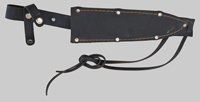
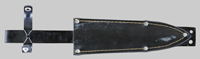
Rose wholesaled these bayonets nationwide using his wholesale distribution firm, George Rose & Co. well into the 1970s. He also would have retailed them by mail-order using his retail sales firm, Seaport Traders, Inc., until it ceased operation in 1964; and at his Los Angeles store until it closed ca. 1968. It is unclear exactly when these bayonets were imported, however, it was most likely ca. 1961–62. During 1963, Rose began distancing himself from the ROSCO brand and soon after ceased using it. Had Rose imported these bayonets during or after 1963, it is doubtful that they would have been marked ROSCO. Seaport Traders and the ROSCO brand were ruined by national publicity regarding Rose’s mail-order firearms sales practices and revelation that Seaport Traders had sold Lee Harvey Oswald the revolver used to murder a Dallas policeman 40 minutes after the assassination of President Kennedy. The matte black vinyl scabbard shown with this example is the original scabbard supplied with ROSCO M4 bayonets. This pair were purchased together in the late 1960s. A similar scabbard is also found on Japan-import M4 bayonets marked “Sportsworld.” The cheesy scabbard supplied helps explain why so few of these bayonets are found in them today. Many were simply thrown away or replaced with M8A1 scabbards or commercial M8A1 copies. My working paper on George Rose & Co. and the ROSCO M4 Bayonet provides additional history on ROSCO M4 bayonets and the business that imported and sold them. |
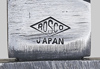
Ricasso: "ROSCO" inside a diamond over "Japan"
Scabbard (reverse): "Japan" |
|||||||
      |
Sportsworld | There has been speculation that Sportsworld was a Los Angeles retailer or a Chicago, retailer. However, there were in the 1960s (and still are) dozens of American businesses using the name Sportsworld. Unless/until an individual with first-hand knowledge or documentation (e.g., catalog, advertisement, packaging, etc.) surfaces, the true identity of this retailer may remain a mystery.
Construction and finish of this example is very similar to the Kiffe, ROSCO, and SAC bayonets, leaving open the possibility that they were produced by the same Japanese manufacturer. The scabbard with this example is identical to the ROSCO scabbard shown above, except that it is made of shiny black vinyl. The rivet securing the hilt strap has fallen out of this example and the strap secured with stainless steel safety wire by a previous owner. |
Ricasso: "Sportsworld" over "Japan"
Scabbard (reverse): "Japan" |
|||||||
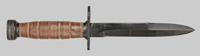 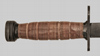   |
Sportsworld | This Sportsworld example is of decidedly different construction and finish, suggesting that, over time, there may have been more than one Japanese manufacturer. | Ricasso: "Sportsworld" over "Japan" | |||||||
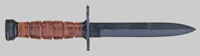 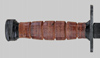  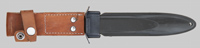  |
Unmarked | This example is completely unmarked, but is obviously a commercial 1960s Japanese import.
The scabbard is a commercial copy of the US M8A1, with an unreinforced molded plastic body and leather belt hanger. This type of scabbard was also sold by Kiffe and SAC with some of their commercial M4 bayonets. In the early 1960s, it was common to sell the commercial M4 bayonet and scabbard separately. This likely accounts for why similar commercial M8A1 scabbard copies are found on Japanese-import commercial M4 bayonets from different retailers. As surplus USGI M4 bayonets began to be offered, mid-1963, retailers began selling commercial M4 bayonets together with a scabbard. |
Scabbard: "U.S. M8A1" | |||||||
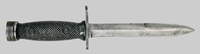 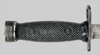 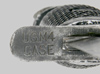   |
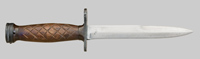
Cast Aluminum Grip | This is a M4 First Production bayonet that has been modified with cast aluminum grip scales painted black. The grip scales mimic the second production plastic grip scales.
These were once thought to have been another experimental type. However, in his book, Collecting Bayonets, Dr. Jim Maddox confirms that these were a mid-1960s commercial product of a surplus dealer near Warner Robbins, GA. Although not an official variation, the aluminum grips are an interesting curiosity. I have also seen an M5 bayonet with a similar cast aluminum grip. |
Guard: "USM4" over "Case"
Pommel: "Sp" and "43B" |
|||||||
| Greece | 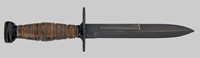  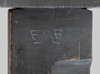  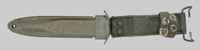 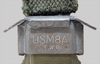 |
M4 | Greek copy of the wartime U.S. M4 bayonet-knife for use with the caliber .30 U.S. Carbine M1.
Military Assistance Program (MAP) records document that the U.S. provided 38,264 M1 and M2 Carbines to Greece between 1951 and 1963 under the Military Assistance Program. The origin of these bayonets is a mystery. They came to the USA in 2010–11 when Greece returned its stock of M1 Carbines to the U.S. Government. Although patterned after the US M4 bayonet-knife, there are distinct differences and the workmanship is poor. The blade is copper-plated, then finished in a black coating of some sort. Traces of copper show through where the black finish has worn away. The leather grip has much greater taper than other leather-gripped M4 variants. The guard is patterned after the wartime M4 production, however, the muzzle ring is slightly off-center. The identity of the maker represented by the "EME" trademark and the date of production are unknown. In the Greek alphabet, "EME" would be Epsilon Mu Epsilon. There is an Italian cutlery maker, EME-Posaterie. I corresponded with them and they indicate that they were not the maker of these bayonets. Hopefully, further research will reveal the maker's identity. The U.S. M8A1 scabbard with this example was assembled at the Pennsylvania Working Home for the Blind 1969–70. |
Ricasso: "EME"
Scabbard: "U.S. M8A1" over "TWB" |
||||||
| Italy | 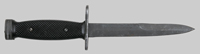 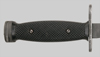   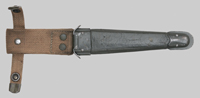   |
M4 | Bayonet-knife for use on the caliber .30 U.S. Carbine M1.
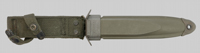
MAP records document that the U.S. provided 146,863 M1 and M2 Carbines to Italy between 1951 and 1963. The M1 Carbine had a lengthy service life in Italy, well into the 1990s. Carbines remaining in Italian stores were returned to the USA in the mid-2000s and sold to collectors via the Civilian Marksmanship Program. This example is probably a U.S.G.I. bayonet that has been heavily reworked. Any markings it may have had are gone, the blade has been reground, and the peening on the tang is not U.S.G.I. The guard profile is consistent with U.S. M4 Second Production, which differs significantly from the guard profile of Italian M4 production (below). The scabbard has a leather body, constructed similar to the M1871 and M1891 scabbards. The leather body and steel mounts are painted green. These are often said to be reworked M1891 scabbard bodies. However, the tapered profile is unlike any M1891 leather scabbard body. These were more likely new-made, using machinery left over from wartime M1891 scabbard production. The khaki tan-colored web belt hanger is patterned on the US M8A1 design. |
None. | ||||||
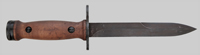 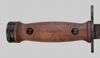       |
M4 | This example was made in 1955 at Arsenale Esercito Torino (Turin Army Arsenal).
Italy produced M4 bayonets from 1955–1960. Most were equipped with brown plastic grips that mimic the profile of the wartime U.S. leather grip. A very few examples have surfaced that have a smooth wood grip, as does this bayonet. Most of the wood grip examples observed have been dated 1955, so it may be that wood grips were used as a substitute in early production until the plastic grips were available. The guard on Italian M4 production has a different profile than either U.S. M4 production variants. The U.S. M8A1 scabbard with this example was assembled at the Pennsylvania Working Home for the Blind 1965–68. The scabbard's M1910-style wire belt hanger has been deleted. |
Ricasso (left): "A.E.T." over flaming-bomb & crossed-canons over "1955"
Ricasso (right): "30186" Scabbard: "U.S. M8A1" over "P W H" |
|||||||
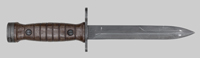      |
M4 | This example was made in 1958 at Arsenale Esercito Torino (Turin Army Arsenal).
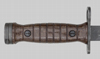
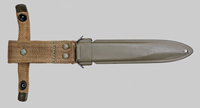
The grip scales are the brown plastic type most common on Italian M4 bayonets. The workmanship on Italian M4 bayonets is quite good, in sharp contrast to the crudely-reworked U.S. bayonet above. The scabbard is an Italian-made U.S. M8 clone, with the body made of fiberglass with an olive green gel coat. The belt hanger is made of khaki tan cotton webbing.
|
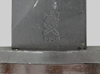
Ricasso (left): "A.E.T." over flaming-bomb & crossed-canons over "1958"
Ricasso (right): "84378" |
|||||||
| South Korea | 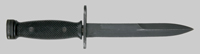 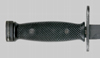   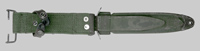   |
K–M4 | South Korean copy of the U.S. second production Bayonet-Knife M4.
According to South Korean sources, following the 1953 Korean War Armistice, South Korean forces had 159,393 M1 Carbines and an unknown quantity of bayonets. MAP records document that the U.S. subsequently provided 949,641 M1 Carbines, 22,068 M2 Carbines, and 90,526 M4 bayonets to Korea between 1951 and 1972. An additional 72,000 Carbines were reportedly provided 1963–74 under Foreign Military Sales (FMS). The scabbard is also a South Korean copy of the US M8A1 scabbard. The "winged anchor & star" is the South Korean Ministry of Defense logo. |
Guard (Front): "K-M4"
Guard (Rear): Starburst inside a circle. Scabbard (Throat): "K-M8A1" on front and winged star with Korean characters on reverse. |
||||||
| Netherlands | 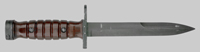 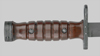   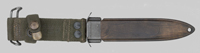 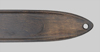 |
M4 | Bayonet for use on the caliber .30 U.S. Carbine M1.
MAP records document that the U.S. provided 84,523 M1 and M2 Carbines to the Netherlands between 1950 and 1963. The Netherlands M4 bayonet is patterned after its US cousin, but is a distinctly different design. The most obvious difference are the red phenolic grip scales, patterned after the US leather grip. The guard is much heavier, requiring a stepped muzzle ring due to the extra thickness. The pommel is secured with solid pins, where the US bayonet uses rolled pins. Examples are found with grip scales secured by rivets or (like this example) with screw bolts. These were made by the German firm, E. & F. Hörster, in 1951–52. This example has the Hörster commercial trademark on the guard, although not all are so marked. The scabbard is patterned after the US M8A1, however, the metal is blued. The scabbard body is made of Durofol, a laminated wood developed in Germany during the Second World War. It is made by impregnating beech veneers of 0.2 to 0.3 mm. thickness with 25 to 35 percent of a water-soluble phenolic resin cured under both high pressure and temperature. Post-War, Durofol KG, J. Brangs & Co. of Solingen became the exclusive manufacturer, which later became Durofol Presswerk GmbH. |
Guard: "H" bisected by a sword, inside an oval. | ||||||
| Norway | 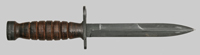 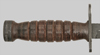 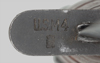  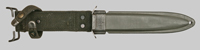 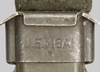 |
M4 SLK | Bayonet-knife for use on the caliber .30 U.S. Carbine M1, which Norway designated the Selvladekarabin (SLK).
MAP records document that the U.S. provided 98,267 M1 and M2 Carbines to Norway between 1951 and 1963. The Norwegian M4 bayonet is closely patterned after the Wartime U.S. M4 Bayonet-Knife, with the narrow guard and grooved leather grip. Similar in appearance and quality of manufacture to its U.S. cousin, the markings are uniquely Norwegian. The scabbard is a clone of the U.S. M8A1, before introduction of the metal tip protector. The Norwegian scabbard is marked "U.S. M8A1" in outline letters, however, it was manufactured entirely in Norway. Production is believed to have began circa 1954 at Kongsberg Våpenfabrikk (Kongsberg Weapons Factory). Both bayonet and scabbard carry the Crown-K factory stamp. |
Guard: "U.S.M4" and Crown-K (Kongsberg Våpenfabrikk factory stamp)
Pommel: Crown-K Scabbard: "U.S. M8A1" over Crown-K |
||||||
| Vietnam | 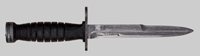 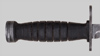 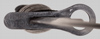  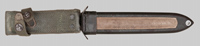 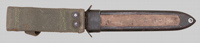 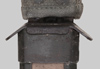 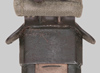 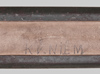 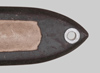 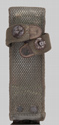 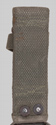 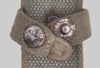 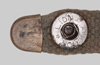 |
Viet Cong Captured U.S. M4 Bayonet and M8A1 Scabbard Copy | Captured U.S. M4 bayonet that was heavily sharpened, consistent with Viet Cong use as a field knife.This crude M8A1 scabbard copy is believed to have been produced by the Viet Cong during the Vietnam War.
The Viet Cong had an extensive network of ordnance workshops throughout South Vietnam. These scabbards have turned up occasionally, usually carrying a captured U.S. bayonet or improvised knife, suggesting that they were brought back by returning service members. However, a sufficient number of specimens have been observed to indicate that they were a production item. The strap assembly is fabricated similar to the U.S. M8A1, just more crudely and without the wire belt hanger. The scabbard body is of welded construction made from sheet steel. The scabbard body consists of a sheet-steel frame, welded to the fitting, then furnished with a leather insert. The leather is typically found marked with a handwritten Vietnamese name. The point includes an aluminum eyelet for a leather thong (missing from this example, but observed on other examples). Evidence suggests that these scabbards date from the period of U.S. involvement in Vietnam, when an influx of U.S. bayonets flooded into the country. Although the French used the U.S. M1/M2 Carbine in Vietnam 1946–54, M1/M2 Carbines provided to France during and shortly after the Second World War lacked the bayonet lug. However, the majority of M1/M2 Carbines used by U.S. forces and the Army of the Republic of Vietnam (ARVN) from 1955-onwards incorporated the bayonet lug. In addition to bayonets fielded by U.S. forces, Military Assistance Program records show provision of 183,114 M4 bayonets, 122,757 M5A1 bayonets and 659,295 M7 bayonets to South Vietnam. |
Bayonet: "U.S. M4" "Utica" Ordnance Shell-and-Flame.
Scabbard: None |
||||||
| M5 & M6 Bayonets (U.S. & Foreign), U.S. M7 Bayonets, M8, M8A1, & M10 Scabbards | ||||||||||
| Foreign Variants of the M7 Bayonet | ||||||||||
| Other Bayonets with M4-M7 Series Features | ||||||||||
| Top | ||||||||||
| © Ralph E. Cobb 2011 All Rights Reserved | ||||||||||