Pakistan—Pakistan Ordnance Factory
No. 9 Mk. I bayonets were made at the Pakistan Ordnance Factory from 1953–1966 on equipment obtained from R.O.F Poole. The Pakistan Ordinance Factory (POF), Wah Cantonment, Pakistan, produced approximately 35,000 No. 4 rifles. Although not documented, the number of bayonets produced was likely similar. POF No. 9 Mk. I bayonets are very well made, equal to their British cousins in both dimensions and quality.
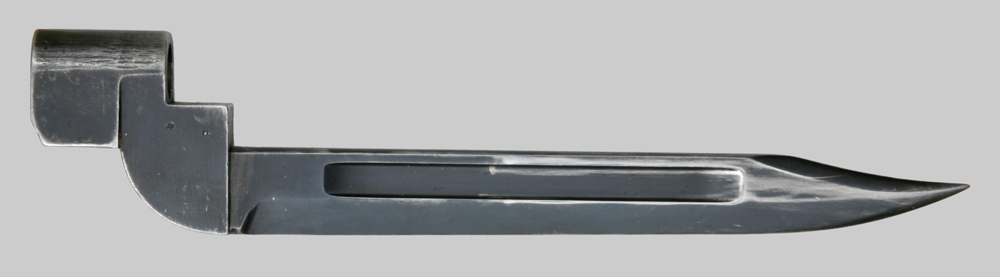
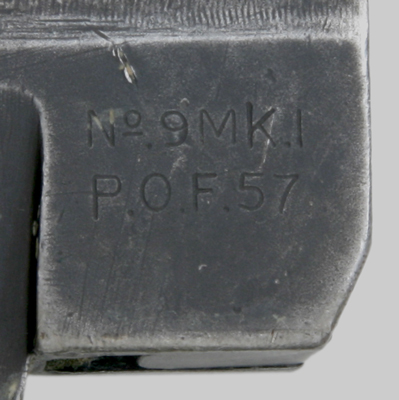 This No 9. Mk. I bayonet was made at the Pakistan Ordnance Factory in 1957.
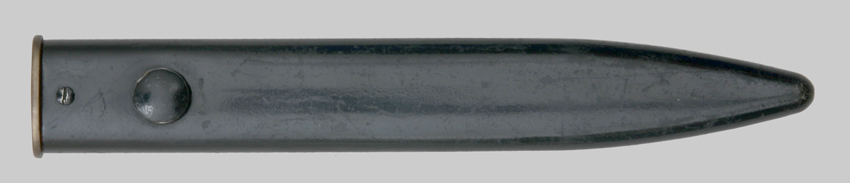
The standard scabbard was the post-War No. 5 steel scabbard with the heavy brass throat.
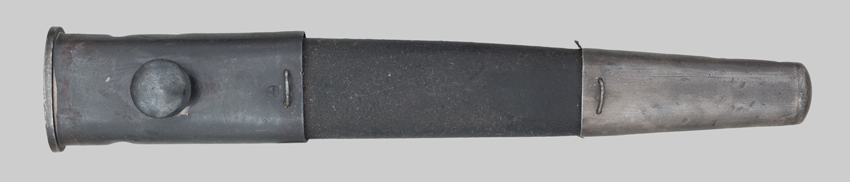
Pakistan No. 9 Mk. I bayonets are occasionally found with short P1907 scabbards as a substitute for the No. 5 scabbard.
Pakistan—Metal Industries Ltd.
This is a No. 9 Mk. I bayonet made by Metal Industries Ltd. in Lahore. M.I.L. had produced No. I Mk. II and Mk. III bayonets during the Second World War, while Lahore was still under Indian jurisdiction. The maker's identity had remained a mystery, because the few examples that had surfaced had only partial maker marks (like this example). Collector-researcher Carl Ziegler (http://www.old-smithy.info) discovered an example with the complete marking, solving this conundrum.
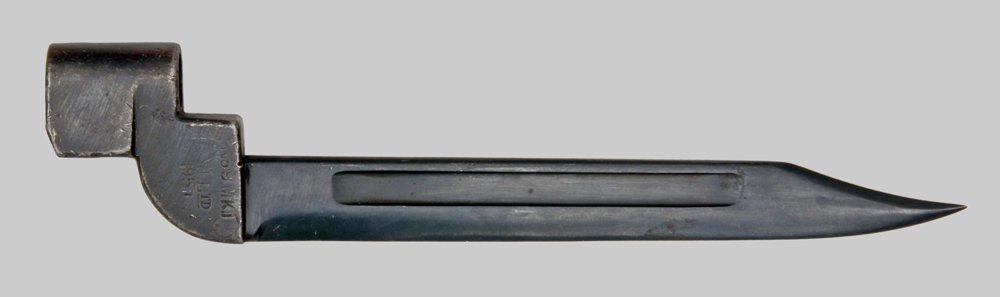
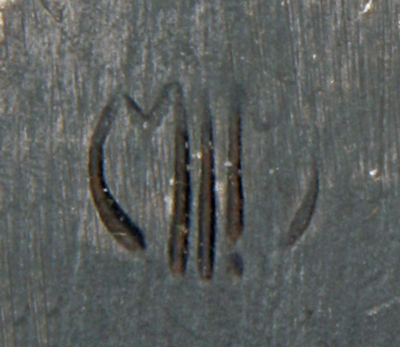
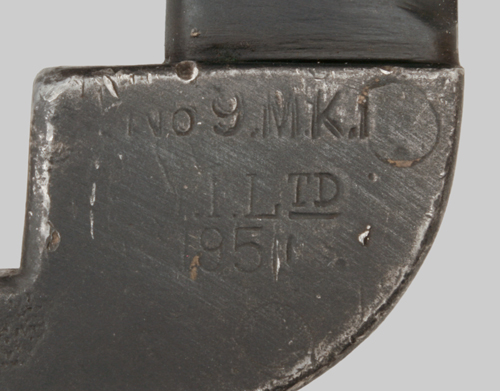
The blade profile is more rounded and the edge less refined than the British No. 9 Mk. I bayonets. Only a small number of these bayonets have surfaced, so production must have been very low before manufacturing ceased and the factory moved to Wah, away from the border with India.
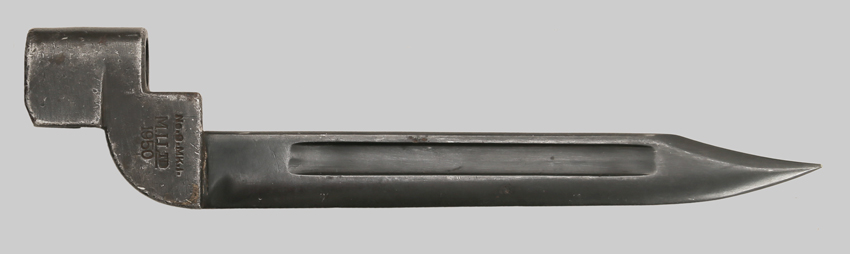
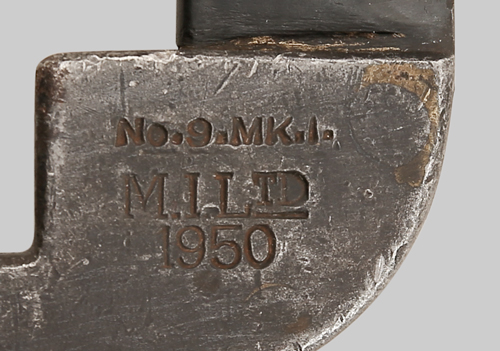
At the time the following 1950-dated example was discovered, in 2016, all previously-known examples were dated 1951. Subsequent to discovery of this example, a 1949-dated example has been documented. Discovery of 1949 and 1950-dated examples demonstrates that the shipment of production equipment from R.O.F. Poole to Pakistan took place earlier than believed.
South Africa—ARMSCOR
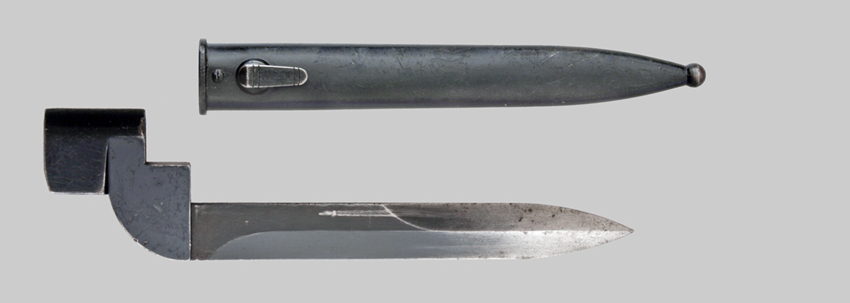
While South Aftrica used the British-made No. 9 Mk. I bayonet, they also manufactured a uniquely South African variant of the No. 9. The South African No. 9 blade profile differs significantly from its British cousin. This is a No. 9 bayonet made by Armaments Corporation of South Africa (ARMSCOR), Lyttelton Engineering Works, in Pretoria. ARMSCOR is the State-owned arms manufacturer in South Africa.
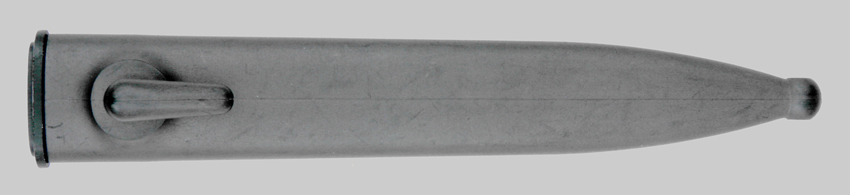
The British No. 5 Mk. I scabbard would not work with the So. African No. 9 blade, so other scabbards were substituted. There was no dedicated So. African No. 9 scabbard. The scabbard pictured below with this example is from a M1 bayonet. The M1 was the So. African variant of the Belgian FAL Type A bayonet. By the time the So. Africa No. 9 bayonets were made, the M1 bayonet was being replaced by the R1 bayonet (the So. African variant of the Belgian FAL Type C bayonet). While the M1 scabbard was compatible with the So. African No. 9 blade profile, it was longer than necessary for the No. 9 blade.
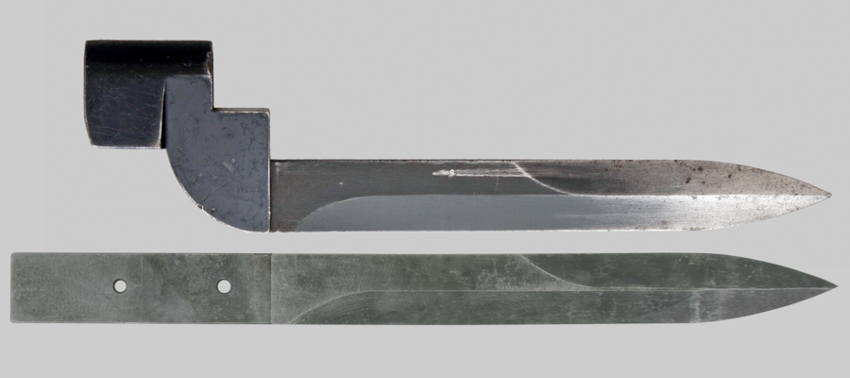
According to Skennerton, the bayonets were made up in the 1960's using blades salvaged from FN-made Uzi submachine gun bayonets (known in So. Africa as the S1 bayonet). However, it has not been conclusively documented whether old S1 blades were actually used or whether the S1 blade was just copied. I was able to acquire the unassembled Uzi bayonet blade pictured below from a seller in Tel-Aviv, Israel, to compare with the S.A. No. 9. The Uzi blade is dimensionally identical to the blade of the S.A. Pattern No. 9. A close study also demonstrates that, if the blade were used for the S.A. No. 9, the forward grip hole would need to be welded and ground flat, then two new holes machined for pinning the Uzi blade to the No. 9 socket. This comparison demonstrates that it is entirely plausible that salvaged Uzi blades could have been used for manufacturing the S.A. No. 9 bayonet.
The S1 scabbard was also used with the No. 9 bayonet. The S1 scabbard is a shorter version of the steel M1 scabbard. The nylon R1 scabbard (pictured below) was also used with the So. African No. 9 bayonet. The R1 scabbard has a universal throatpiece allowing use with the R1, S1, FAL Type B, and S.A. No. 9 bayonets.